The Fifth Cord: Bazzoni's Architectural Giallo
Franco Nero, Ennio Morricone and the best-photographed thriller Italy ever made
Contents
The Italian title is Giornata nera per l’ariete — “black day for Aries” — which is a horoscope, and the English title is The Fifth Cord, which is a glove. Both titles are pointing at the same thing from different angles: a film obsessed with counting, in which somebody is working through a list and the only question anyone can usefully ask is how far down it they are.
Luigi Bazzoni made it in 1971, at the exact moment the giallo turned from a curiosity into an industry. Dario Argento’s The Bird with the Crystal Plumage had cleaned up the year before and every producer in Rome wanted one. Most of what resulted is disposable. This one has Vittorio Storaro behind the camera and Ennio Morricone on the score, and it is, by a distance I do not think is arguable, the best-photographed film the entire cycle produced.
The drunk
Franco Nero plays Andrea Bild, a journalist, and the film’s first good decision is to make him useless. He is an alcoholic. Not a charming one, not a functional one with a flask and a wisecrack — a man whose drinking has already cost him his marriage, his standing and most of his usefulness to his editor, and whose investigation of a series of murders is conducted between bouts he does not remember clearly.
By 1971 Nero was a star. Django had made him internationally famous in 1966, Hollywood had put him in Camelot, and he had the sort of face that Italian cinema normally deployed to solve problems. Bazzoni casts that face and then gives it nothing to do. Nero plays Bild with a slack, aggrieved intelligence — a man who is genuinely the cleverest person in most rooms and is also, at any given moment, about four drinks into ruining it.
This matters structurally. The giallo’s standard protagonist is an outsider who sees something and spends the film trying to recover the image. Bild is an insider who cannot be trusted with what he sees, which means the film’s suspense runs in a direction the genre rarely permits: you are not waiting for him to remember, you are waiting to find out whether anything he has told you is true.
There is a further wrinkle that the film handles with real nerve. Bild is a suspect. He was at the party where it started, he cannot account for his movements, and his own paper is running the story. A journalist investigating a case he may be inside is a conflict of interest so total that the film could have built a farce out of it; Bazzoni instead plays it as fatigue. Bild pursues the thing because the alternative is sitting still with himself, and Nero lets you see that the investigation is a symptom rather than a duty.
Storaro, and buildings that are doing something
Now the reason this piece exists. Storaro shot this four years after Bertolucci gave him The Conformist, and he brings the same central idea: architecture as a statement about the people standing in front of it.
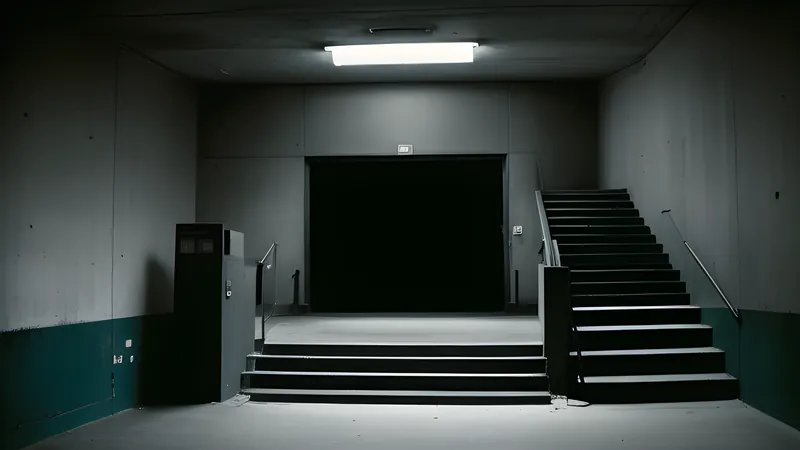
Bazzoni sets the film in a Rome of modernist and brutalist surfaces — concrete, glass, long horizontal slabs, staircases with no handrails, spaces designed by people with a theory. Storaro photographs them with wide lenses and a lot of air, and the consistent compositional decision is to place the human figure at the bottom of the frame and give the top two-thirds to the structure. Over a hundred minutes this becomes an argument. The buildings are permanent, indifferent and beautifully lit; the people are small, temporary and mostly in the way.
The much-praised set-piece is a murder staged in a stark modernist house, and it is worth studying rather than merely admiring. Bazzoni shoots the sequence in bright, even light, in a room with almost nothing in it. There is no darkness to hide a killer, no clutter to disguise an approach, no shadow doing the work. Everything you would need to see is visible. The horror comes from the fact that visibility turns out to be no help at all, because the architecture supplies the concealment: sightlines interrupted by a slab, a staircase that hides its own underside, a room that is legible from one position and blind from another. He has found a way to make a completely lit space frightening, which is the opposite of every instinct the genre had.
Compare it with what Argento was doing in the same years. Argento’s grammar is colour and glass — the frame as a stained-window, the murder as a composition in red. Bazzoni’s grammar is geometry and daylight. Both are beautiful. Only one of them has been imitated, and that is a fact about which style is teachable rather than which is better.
Storaro and Bazzoni would reunite four years later for Footprints on the Moon, where the same instinct — dwarf the person, over-expose the world — is applied to a woman losing her own history. The two films are a matched pair and should be watched together.
Morricone, minimal
Morricone’s score is one of his sparest for the genre. Where his work for Lucio Fulci the same year was all lush wrongness — atrocity scored as romance — here he strips down to percussion, isolated piano, and long passages of near-nothing. The choice fits Storaro’s frames exactly. A concrete plaza does not need strings; it needs a footstep and a lot of space around it.
There is a recurring rhythmic figure that functions as the count, and once you hear it as counting the whole film clicks into shape. The glove with fingers removed, one for each victim taken; the horoscope of the Italian title; Morricone’s ticking figure. The film is a subtraction problem, and everyone in it is a number that has not come up yet.
The silence is a genuine risk and it is worth flagging how unusual it was. Italian genre film-making of this period scored everything, continuously, on the reasonable commercial theory that an audience left in silence starts noticing the budget. Morricone and Bazzoni bet the opposite way, and the wager pays because Storaro’s spaces are already saying something. A plaza with one man in it and no music on the track is a statement about scale that no cue could improve.
The source, and what Bazzoni threw away
The Fifth Cord is adapted from a 1967 novel by D. M. Devine, a Scottish crime writer of the old fair-play school, admired by Agatha Christie and largely forgotten now. Devine wrote proper puzzles: clues placed, deductions available, a reader theoretically able to solve it.
Bazzoni keeps the plot and throws away the epistemology. What survives is the mechanism; what goes is the promise that a diligent observer can arrive at the truth. His detective is drunk, his camera is more interested in the buildings than the evidence, and his film is fundamentally not curious about who did it. Purists find this maddening. I find it the most honest thing about the picture, because it is a film made by a man who does not believe reasoning gets you anywhere, adapted from a novel by a man who devoted his life to the proposition that it does.
Watch, too, for Wolfgang Preiss in the cast. Preiss had played Dr Mabuse for Fritz Lang in The Thousand Eyes of Dr Mabuse in 1960 and in the German sequels that followed. Putting the face of Mabuse into a 1971 Italian thriller is the film quietly acknowledging its other parent: the German krimi, the Edgar Wallace cycle, all those gloved stranglers in fog, which is where a great deal of the giallo’s furniture actually came from. Blood and Black Lace gets the credit for inventing the form, and deserves it, but the krimi was the compost.
The case against
The plotting is the weak leg, and it is a real weakness. The victim list is a set of names rather than people, and the film’s disinterest in its own mystery — which I have just spent a paragraph defending as a philosophical position — is also, straightforwardly, sometimes just laziness. There is a difference between refusing to supply catharsis and not bothering to make the middle act coherent, and The Fifth Cord crosses back and forth over that line.
The women are thinly written even by the standards of a genre with a bad record here. And Bild’s alcoholism, bravely central as it is, does not develop; he is as drunk in the last reel as the first, and the film never decides whether that is tragedy or texture.
Where to watch: restored, and worth the effort of finding a good one. This is the extreme case of a film where transfer quality is the film. Storaro’s whole method here is gradation in bright light — the difference between one shade of concrete and the next — and a compressed, contrasty copy flattens every frame into grey mush and takes the entire picture with it.
The wider shelf is the giallo canon; the descendants are traced in the giallo’s fingerprints on the modern slasher.
Spoilers below
The solution is a disappointment, and I have come to think the disappointment is load-bearing.
The killer’s identity, when it arrives, is the sort of reveal that a Devine novel would have earned across two hundred pages of placed clues and that Bazzoni essentially just hands over. The motive is domestic and sordid, of a piece with the genre’s usual buried-scandal machinery. There is no grand design behind the counting, no astrological scheme, nothing that pays off the enormous formal apparatus the film has built. The glove was a flourish. The horoscope was a title.
You can call that a failure and many good critics have. My reading is that the deflation is the point of the architecture. Bazzoni has spent ninety minutes photographing people as small figures at the bottom of enormous, permanent, indifferent structures, and then he produces a murderer whose reasons are petty and human-scaled. The buildings do not care. The concrete outlasts the motive by centuries. A film that ended with a satisfying, elegant solution would have handed the humans back their significance, and Storaro’s frames have been arguing against exactly that from the first shot.
Bild solves it, in the sense that the information reaches him. He is not improved. He does not stop drinking, the murders were not about him, and the last thing you take away is a man standing in a very well-composed space that will be there long after he is not. Bazzoni made the same film four years later with a woman and a moon, and it was even better and did even worse.
Related Content