The Element of Crime: Von Trier's Sepia Detective Nightmare
A drowned Europe shot in sodium light, a detective handed a method that asks him to think his way inside a murderer, and the most confident debut of the 1980s
Contents
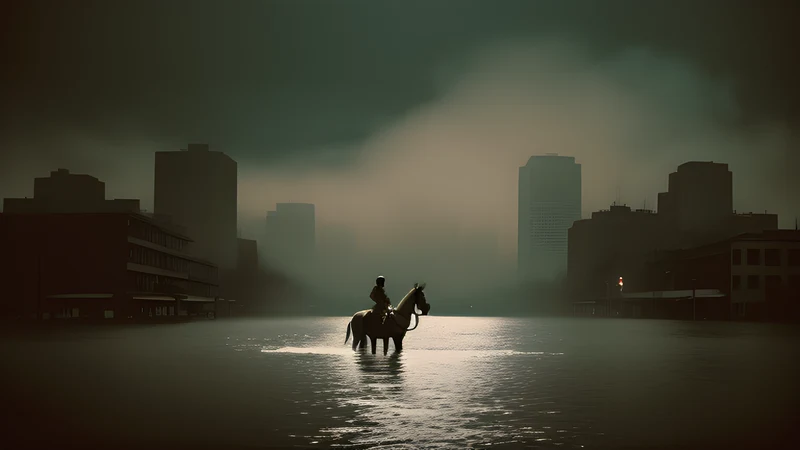
Everything in Forbrydelsens element (1984) is underwater, or about to be. Lars von Trier’s first feature takes place in a Europe where the drains have failed and nobody has commented on it, so that policemen wade to crime scenes, files rot on shelves, cars throw up bow waves, and a horse stands patiently in standing water in a ruined hall as though this were entirely ordinary. It is the most confident debut of the decade and one of the most obnoxious, and thirty years of von Trier’s subsequent career have not produced anything that looks like it.
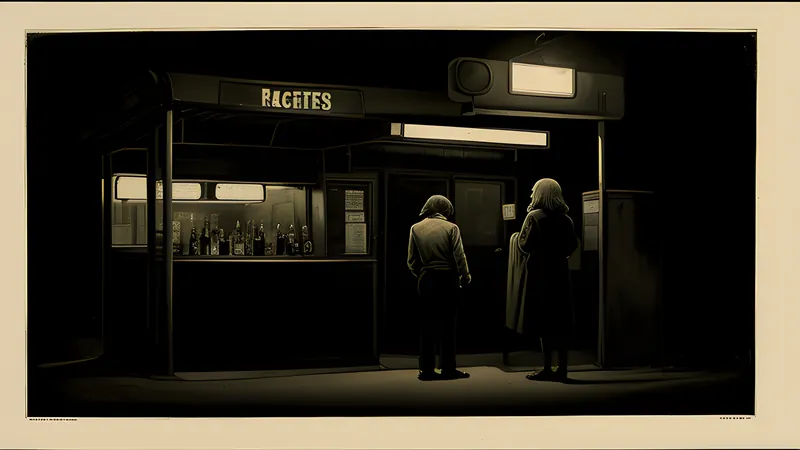
The film is shot almost entirely in a single colour. Tom Elling lit it with sodium vapour — the orange of motorway lighting — and processed it so that the image is a bruised amber-sepia with the blacks crushed to tar and, very occasionally, a single stab of blue from a lamp or a screen. There is no daylight. There is barely any colour information at all. Watching it is like reading a case file that has been left in a puddle.
The set-up
Fisher is a detective who left Europe for Cairo thirteen years ago and has come back. He is not well. The film’s frame is a hypnosis session in Egypt, where a therapist walks him back into his own memory to recover what happened, and everything we see is Fisher’s recollection under trance — which is von Trier telling you, in the first scene, that nothing you are about to watch can be trusted.
The case is a series of murders of young girls who sell lottery tickets. The suspect is a man called Harry Grey, who may or may not still be alive. And Fisher’s approach is inherited: his old mentor Osborne wrote a book of criminology called The Element of Crime, and its method is the film’s engine. To catch a criminal, Osborne argues, you must stop looking for evidence and instead identify with him — reconstruct his pattern from the inside, occupy his logic, go where he would go, want what he wanted. Follow the geometry of the man rather than the trail he left.
So Fisher gets a map, plots the killings, discovers the pattern makes a shape, and sets out to walk the rest of it. He will finish the design and be waiting where the next murder belongs.
Why the method is a horror premise
This is the film’s real idea, and it is a superb one. Every procedural since has a version of the detective who understands the killer too well, and most of them treat it as a professional hazard with a therapy scene attached. Von Trier treats it as a chemical reaction. If the method requires you to become the man, and if the method works, then success and infection are the same event. There is no version of Fisher solving this case in which Fisher survives it as himself.
Osborne knows. Esmond Knight plays him as a wrecked, evasive old man who has clearly been somewhere and would rather not discuss it, and who keeps trying to warn his student off a technique he cannot bring himself to disown. He is the film’s tragedy, delivered in about four scenes.
That casting is one for the collector. Esmond Knight was a British actor of the previous generation who was very nearly blinded serving aboard the Prince of Wales in the war and spent the rest of his career, including a long run as a Powell and Pressburger regular, working with severely damaged sight. Von Trier — a 28-year-old Dane who had recently awarded himself the “von” — cast a half-blind veteran of British cinema’s golden age as the man who wrote the book about seeing too clearly. It is a better joke than most of the ones von Trier makes on purpose.
The craft: how the water works
Two decisions carry the film. The first is that von Trier never explains the flood. There is no exposition, no news broadcast, no character remarking that things have got bad. The water is simply the condition of the world, uncommented upon, which is exactly how genuine collapse feels from inside. A lesser film would have a scene about the drains. This one just has the drains not working, for two hours, until you stop noticing and start absorbing it as dread.
The second is the camera. Tómas Gislason cut it and Elling shot it, and the compositions are ostentatious in a way that would be intolerable if they were not so good: extreme deep focus, action staged in multiple planes at once, mirrors and water surfaces doubling everything, long takes that drift across an environment and find three separate things happening in it. Von Trier keeps putting reflections in the bottom of the frame so that the flooded floor gives you a second, inverted version of every scene. In a film about a man being duplicated by a method, that is not a flourish. That is the argument, in the composition.
The sound is the underrated third element. There is almost always water moving somewhere in the mix, and von Trier lets ambient noise crowd the dialogue, so that the film feels overheard rather than presented. The dialogue itself is in English, spoken by a cast of Danes, Britons and others in wildly incompatible accents, and von Trier plainly does not care. Europe here is a place where everyone speaks a second language badly, and the effect is genuinely disorienting.
The bloodline
The debts are visible and von Trier has never hidden them. Tarkovsky’s Stalker supplies the ruined zone, the standing water, the quest that is really an interior journey. Welles’s The Trial supplies the architecture and the bureaucratic nightmare. Blade Runner, two years earlier, supplies the permanent night and the detective moving through a world past saving. What von Trier adds is a specific Northern European coldness — the sense that this apocalypse is being administered by a civil service.
For the collector, the essential companion is Kiyoshi Kurosawa’s Cure, which arrives thirteen years later and independently reaches the same thesis: a detective hollowed out by proximity to a killer, a hypnotist in the machinery, and a refusal to grant the audience a clean solution. The two films together make an argument that the procedural is a horror genre wearing a coat.
Sideways, Alan Parker’s Angel Heart does the other version of this — a private eye whose investigation is a trap built out of his own identity — with far more melodrama and rather less nerve. And The American Friend shares this film’s diseased European palette and its conviction that the crime story is really a study in contamination.
Von Trier himself went on to make Epidemic and Europa, completing what he called the Europa trilogy, and then eventually to the wholly different asceticism of Dogme and the late provocations. Melancholia is the film to pair this with if you want to see what stayed constant across thirty years: the gorgeous, unhurried certainty that it is all going to end, and the refusal to be sad about it in any conventional way.
The case against
It is a young man’s film and it shows. The picture is in love with its own surface to a degree that starves the human material — Fisher is a function rather than a person, Michael Elphick is a fine actor given very little to hold, and the women in this world exist almost entirely as victims or as bodies. Me Me Lai’s Kim is handed a role that the film needs and never bothers to write.
It is also, frankly, tiring. Two hours of unbroken sepia with no daylight, no colour and no comic relief is an endurance proposition, and von Trier’s contempt for the audience — a career-long feature — is already fully operational. There is no warmth anywhere in it. Some viewers find that bracing. Others find it a long way to walk for a thesis you could state in a sentence.
Where to find it
Restored, on disc from the boutique labels, and a fixture on the arthouse platforms. Watch it in a dark room with the brightness up. On a bad screen, in daylight, the film is literally invisible — the blacks eat everything, and you will spend two hours looking at a brown rectangle.
Spoilers below
Fisher completes the map. He works out the shape the murders make, identifies the missing points, and travels to the place where the next killing is scheduled by the pattern rather than by any person. And because Osborne’s method works, he arrives to find that he has been thinking Harry Grey’s thoughts for weeks, and that the difference between predicting a murder and committing one has quietly evaporated.
Von Trier’s masterstroke is to make Harry Grey a question the film declines to answer. Grey may be dead. He may never have existed as a discrete individual. He may be a pattern that any sufficiently receptive detective can be induced to complete, which would make Osborne’s book less a work of criminology than a set of instructions for building a murderer out of a policeman. Osborne’s own fate — the film’s bleakest turn, a man destroying himself rather than watch his student finish the argument — reads as the confession of an author who understood what he had published.
The child is what makes it unbearable. Fisher, at the end of his reconstruction, is standing where a girl selling lottery tickets is due to die, and the film has arranged matters so that he is the only candidate available. Von Trier stages it without emphasis, in the same drowned amber as everything else, and the horror is entirely in the arithmetic: the method promised that if you follow it correctly you will find yourself in the killer’s position, and here he is, in the killer’s position, correctly.
The frame closes in Cairo, and the therapist tries to bring Fisher up out of the trance. He does not come. The last thing the film gives us is a man stuck in his own reconstruction, being called back by a voice he cannot follow, while the water keeps rising in a Europe that may only exist in his head. It is a private hell dressed as a procedural, and it announced, at 28, exactly the director von Trier was going to be for the next four decades: dazzling, unkind, and entirely serious about the joke.
Related Content