The Drive-In and the Teenage Audience That Built a Genre
What happens to horror when the venue cannot make anyone watch, and the customer is seventeen
Contents
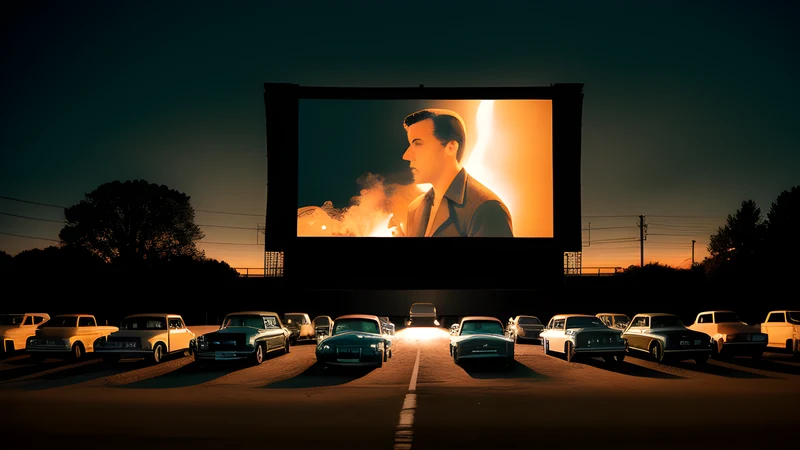
Richard Hollingshead opened the first patented drive-in theatre in Camden, New Jersey, on 6 June 1933, having worked out the ramp geometry in his own driveway with a projector on the bonnet of a car and a sheet nailed between two trees. He was solving a parking problem and a comfort problem. What he actually built was a new kind of audience, and within twenty-five years that audience had redesigned American horror from the inside.
The peak came around 1958, when the United States had somewhere in the region of four thousand drive-ins operating. Cheap land at the edge of expanding suburbs, near-universal car ownership, and a generation of young families who could bring a baby without a babysitter. The numbers were enormous and the studios could not reach them, which is where the genre comes in.
The supply problem that created the product
The majors would not sell first-run A pictures to a drive-in. The reasoning was straightforward: the picture quality was poor, the presentation was undignified, the exhibitors were independent, and the downtown hardtop theatres — many of them still studio-connected or studio-friendly — would have revolted. So the fastest-growing exhibition sector in America was structurally starved of product.
Somebody was going to fill that gap, and the collapse of the studio B unit after the 1948 Paramount decision had just made a lot of people available who knew exactly how to make a film for very little money in very little time. American Releasing Corporation set up in 1954 under James H. Nicholson and Samuel Z. Arkoff, renamed itself American International Pictures in 1956, and made one decision that changed the shape of the genre: rather than selling a single feature, it sold the exhibitor a complete double bill, both halves made in-house, at a price fixed in advance. The AIP assembly line exists because a car park needed two films by Friday.
Then AIP asked the question nobody at the majors had bothered with: who is actually in these cars?
The teenager as a commercial category
The answer was young, and it had money. Post-war American adolescents had disposable income and a car, and by the mid-1950s the industry had noticed. Blackboard Jungle in 1955 put Bill Haley over its titles and caused a commotion; Rock Around the Clock followed in 1956.
AIP built its whole model on the observation. Arkoff and Nicholson worked from an explicit demographic theory — the target was a young man of around nineteen, on the reasoning that a girl will attend a film a boy chooses more readily than the reverse, and that younger children will watch what the older ones watch. Everything followed from that: the poster came first, the title came before the screenplay, and Nicholson would test a title and commission the artwork before a writer had been hired to justify it.
The result was a genre that took teenagers seriously as protagonists, which is a genuine first. I Was a Teenage Werewolf (1957) is a ridiculous film with a straight face on it — a troubled boy, an unethical therapist, a transformation as adolescence — and it was made for a sum usually reported in the region of $82,000 and returned many multiples of it. I Was a Teenage Frankenstein and Blood of Dracula followed the same year. The formula was crude and it was doing something no studio horror film had done: it placed the monster inside the audience’s own age group and its own school.
Everything the slasher does with a teen ensemble twenty years later is licensed here. Halloween inherits an audience that had already spent two decades watching people its own age be threatened on a screen at the edge of town.
The mechanic: films built for a venue that cannot compel attention
This is the part that gets missed, and it is the reason the drive-in film has a distinct grammar rather than merely a distinct budget.
A drive-in audience sits in a private box with a door, a radio, a bag of food, a companion and no social pressure whatsoever to face forward. Nobody will shush you. Nobody can see you leave. The film is competing against every other thing available inside a Chevrolet, and a substantial share of the audience has come for those other things.
A film made for that room has to be built differently, and the adaptations are specific. It has to hook in the first two minutes, because attention lost at the start is never recovered. It has to deliver its incidents on a short cycle, because a viewer who returns to the screen after ten minutes away must be able to re-enter the film instantly. It has to be legible in wide shot with the sound coming through a tinny window speaker, which favours bold blocking, high-contrast photography and dialogue that carries information rather than nuance. Plot points get stated twice. Characters get announced by costume. And the most valuable material — the monster, the flesh, the crash — is distributed evenly through the running time rather than saved for a climax, because the climax is the one part of the evening you cannot guarantee anyone is watching.
Look at that list and you are looking at the exploitation aesthetic. What reads as crudeness is engineering for a specific room. The same logic, moved indoors and made filthier, produces the 42nd Street grindhouse bill, where a continuous programme played to an audience that wandered in mid-reel and had to be able to pick the film up cold.
The venue even wrote its own act break. A drive-in ran an intermission with a countdown clock and animated concession trailers — the dancing hot dog is a real artefact of a real revenue problem, since the snack bar was where a drive-in actually made its margin. That meant the double bill was structured around a scheduled fifteen-minute exodus, and a producer who ignored it lost his audience mid-scene. The two-feature format with a hard interval between is one of the few exhibition rituals the genre has kept as an aesthetic long after the commercial reason evaporated, which is why the affectionate modern homages always include the fake trailers. The advertising was part of the show.
There is a second-order effect on content. A venue with no supervision and an audience of couples in cars can sell material the hardtop could not, and the industry knew it. Russ Meyer proved the point commercially with The Immoral Mr. Teas in 1959 and spent a career at the drive-in making films that no downtown chain would touch. The nudie, the biker picture, the roughie and eventually the gore film all found their venue in a field.
The cycles the field produced
The teen monster gave way to the beach party run from 1963, which is AIP discovering that the same audience would pay to watch itself have fun. Then Corman’s biker films — The Wild Angels in 1966, an enormous hit that spawned a cycle — and the drug picture with The Trip in 1967, written by Jack Nicholson. Gas-s-s-s closed Corman’s AIP years in 1970 with a youth apocalypse that the company recut over his objections.
Regional horror arrived alongside. A drive-in circuit will book a film made by anyone, which meant a Texan or a Tennessean with a camera and a lab bill had a distribution route the studios could not gatekeep. Don’t Look in the Basement is the type specimen; the same circuit carried The Texas Chain Saw Massacre and Night of the Living Dead into profit. Australia ran a parallel system and produced an entire national cycle on it.
What killed it
Several things at once, and the order matters. The Uniform Time Act of 1966 extended daylight saving, which pushed the first show later into the evening and cut a screening off the summer schedule. Suburban land at the edge of a city stopped being cheap as the city caught up with it — a drive-in occupies fifteen acres to seat what a multiplex seats on one. The shopping-mall multiplex arrived in the 1970s with air conditioning and a decent print. And home video finished it, because the entire proposition of the drive-in was watching a film in private, and a VCR delivered that for the price of a rental. A few hundred survive in the United States. The death of the video shop is the same story told one generation on.
The honest case against
The nostalgia industry around the drive-in is thicker than the evidence supports, and I have no first-hand claim on any of it — everything I know about that field comes from prints, books and the people who were in the cars.
The films were mostly appalling. The venue’s tolerance for inattention meant a producer could ship a picture with a dead thirty minutes in the middle and suffer no penalty, and thousands did. The demographic theory that made AIP rich also produced two decades of films in which the young woman’s function is to scream and be looked at, and calling that a golden age requires ignoring most of what is on the screen. And the argument that the venue shaped the aesthetic has a competitor: the budget shaped it too, and cheap films made for hardtops look much the same.
What the drive-in genuinely did, and what nothing else in American exhibition did, is create a channel that the majors could not control, aimed at an audience the majors did not understand, run by people who would book anything. Every independent horror film that has ever broken through has needed a channel like that. Corman’s shop was the first to industrialise it, the grindhouse inherited it, video shelves inherited it after that, and the streaming platforms have quietly closed it again by putting the gate back up. That is the loss worth mourning, and the cars are just where it happened to sit.
Related Content