The Devil's Backbone: Del Toro's Ghost of the Spanish Civil War
A boy, a bomb and a sighing ghost — where the war's dead are condemned to repeat
Contents
“What is a ghost?” A voice asks it at the start of The Devil’s Backbone and answers itself: a tragedy condemned to repeat, an instant of pain, something dead that seems alive, an emotion suspended in time like a blurred photograph or an insect trapped in amber. Guillermo del Toro puts that definition at the front of his 2001 film because the whole picture is an argument for it. This is a ghost story where the ghost is the least frightening thing in the building, and where the real horror is the war grinding toward the orphanage gates. Made in Spanish after del Toro’s bruising experience on the Hollywood studio picture Mimic, it was his return to the personal register, and it remains the purest statement of the idea that would run through his entire career: the monster in the corner is a wounded child, and the true evil wears a human face and wants the gold.
I return to it more than to almost any other ghost film, because it refuses the genre’s usual bargain. It does not want to make you jump. It wants to make you grieve, and it earns the grief through craft so controlled that the sadness feels inevitable rather than manipulated.
An orphanage at the end of a war
The setting is a remote orphanage in a sun-scorched Spanish plain in 1939, in the dying months of the Civil War, sheltering the sons of dead Republicans. Into it arrives Carlos, a boy whose father has been killed in the fighting, left behind by a tutor who doesn’t return. The adults who run the place — the ageing, impotent doctor Casares, played by del Toro’s talisman Federico Luppi, and the one-legged headmistress Carmen, played by Marisa Paredes — are keeping something more than orphans. They are hiding a cache of Republican gold, and the young caretaker Jacinto, a former orphan himself, means to have it.
Standing in the middle of the courtyard, half-buried and defused, is an unexploded bomb. It fell from a plane, killed a boy, and now sits nose-down in the earth, ticking faintly, draped in prayer ribbons by the children. It is the film’s central image and its cleverest object: the war made physical and frozen, a threat suspended in the ground exactly as the ghost is a moment suspended in time. Del Toro rhymes the two — bomb and phantom, both dormant, both waiting, both the war’s leavings — and the whole film lives in the dread that one of them will finally go off.
The ghost is Santi, a boy who vanished the night the bomb fell, remembered by the orphans as “the one who sighs.” Del Toro and his cinematographer Guillermo Navarro design him as a masterpiece of restraint: pale, cracked like old porcelain, a wound in his temple from which blood rises upward and disperses into the surrounding air like ink in water, refusing gravity. That single detail — blood that floats — tells you instantly that you are looking at a moment out of time, physics itself broken around the injury. It is one of the great ghost designs in modern horror, and it works because it is beautiful and wrong in equal measure.
The real monster is a man
Del Toro’s governing conviction is that human cruelty dwarfs the supernatural, and The Devil’s Backbone is where he first states it cleanly. Santi means the living no harm; his appearances are warnings, a plea for justice rather than a threat. The predator in the building is Jacinto, played by Eduardo Noriega as a beautiful, vain, brutal young man who despises the orphanage that raised him and would burn it down for the gold he thinks he’s owed. He is the fascist principle rendered domestic — greed and grievance and violence in a handsome package — and everything terrible that happens flows from him, not from the dead boy in the cistern.
This inversion is the film’s moral spine and the seed of del Toro’s entire body of work. The tender monsters, the villainous men: it is the same architecture that organises his fairy tales and creature features, argued at book length in any account of how del Toro makes the monsters the good guys. Here it is stated for the first time with real political weight, because the human monster is explicitly a figure of the coming Francoist order, and the ghost is explicitly one of its victims asking to be remembered.
The craft: amber, patience, and the fairy-tale frame
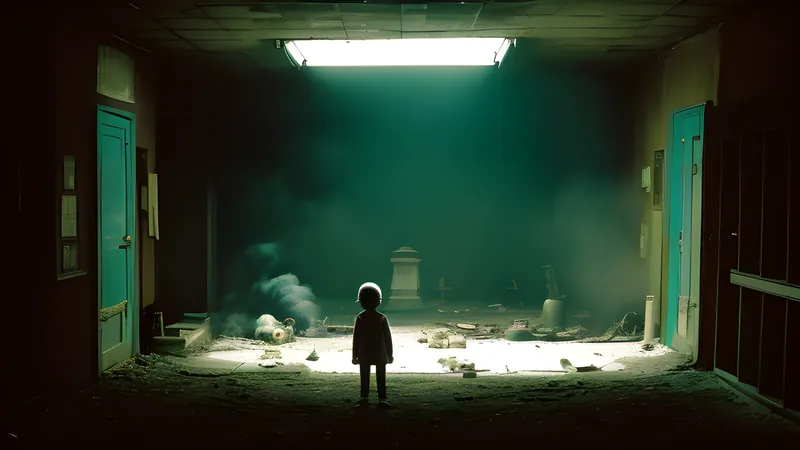
The film’s texture is unmistakable. Navarro shoots it in warm ambers and cold blues, the orphanage glowing like an object preserved in the very amber the opening narration describes. Del Toro paces it with a patience that has become rare in horror — long stretches of childhood politics, cruelty and alliance among the boys, so that when the supernatural intrudes it lands in a world you’ve come to know as real. Javier Navarrete’s score is mournful and lullaby-simple, a companion to the melancholy visuals.
Above all, del Toro frames the film as a dark fairy tale for and about children, told with the seriousness adults reserve for real history. This is the exact method he would perfect four years later in his other Spanish Civil War ghost story, and the two films are best watched as a pair — Pan’s Labyrinth is the louder, more baroque sibling, but The Devil’s Backbone is the quieter and, for many, the more moving of the two. Both take a child’s-eye view of fascism and both insist that the fantastical is where the truth of history hides when the official record lies about it.
The film’s compassion for the dead child as a figure of unfinished grief also makes it the clear ancestor of the Spanish ghost cinema that followed, most directly the del Toro-produced The Orphanage, which took the same setting — a house full of lost children and one who won’t leave — and turned it toward mourning. If you want the lineage of the melancholy, humane ghost story, this is close to its fountainhead.
Why it still works
The Devil’s Backbone endures because it repurposes the ghost story’s machinery toward something larger than fright. The haunting is a metaphor made flesh: history is what haunts us, the unremembered dead of a lost cause condemned to repeat their moment of pain until the living finally do them justice. Del Toro understood, at the start of his career, that a ghost is the most political creature in the horror canon, because a ghost is an argument that the past is not over. Two decades on, in a country still contesting the memory of that war, the film’s central question keeps its edge. What is a ghost? Something that refuses to be forgotten. The film makes sure you won’t.
Spoilers below
Stop here if you haven’t seen it.
The mystery of Santi resolves into an indictment. The ghost did not die by the bomb; Jacinto killed him. On the night of the bombing, Santi caught Jacinto stealing from the safe, and Jacinto struck him and dumped his body, still alive, into the orphanage’s flooded cistern, where he drowned. The sighing ghost has been trying, all along, to point the living toward his murderer and the truth of the gold. The supernatural is not the disorder in the house; it is the conscience of the house, demanding an accounting.
Jacinto’s greed detonates everything, including the literal bomb’s counterpart in kerosene and fire. His raid for the gold triggers an explosion that guts the orphanage and kills most of the adults, including Casares, who dies and lingers on as a second ghost, the new guardian of the surviving boys. Carmen loses her life; the fragile sanctuary is destroyed by the same human appetite the war unleashed on the whole country.
The ending is del Toro’s most satisfying act of justice, and it belongs to the children. The surviving orphans, hunted through the ruins by Jacinto, turn on him together — wounding him and driving him into the cistern where he drowned Santi. There, in the dark water, the drowned boy is waiting. Santi’s ghost pulls his murderer down to share his grave, the victim finally reclaiming the man who made him a ghost. The abused become the agents of their own reckoning, and the war’s small crime is closed even as its larger one grinds on outside.
The film’s last image returns Casares’s spectre to the doorway of the wrecked orphanage, watching the surviving children walk out into the plain and the uncertain, Francoist future. He asks the opening question again, in voiceover, and we understand that he has become the answer — a tragedy condemned to remain, a guardian who cannot leave, an emotion suspended in amber. The war is lost, the children walk into a hostile country, and the dead stay behind to keep the light on. It is one of the most tender endings in horror, and it costs everyone almost everything.
Related Content