The Devil Rides Out: Hammer Does Occult Menace
Richard Matheson adapts Dennis Wheatley, Christopher Lee finally plays the hero, and Charles Gray steals the film with a smile
Contents
Christopher Lee spent his Hammer career being the thing in the shadows and loathed it. He had been trying to get The Devil Rides Out made for years, pushing Dennis Wheatley’s 1934 novel at the studio, partly because he admired the book and partly because it contained something he almost never got offered: a lead who is on the right side, speaks in complete sentences, and knows more than everyone else in the room. When Hammer finally moved in 1967, Lee got the Duc de Richleau, and it is the best performance of his long tenure at Bray precisely because nobody has to point a crucifix at him.
The film is also the moment Hammer’s gothic engine turned to face the twentieth century. There is no castle. There is no crumbling Mitteleuropa. The Devil Rides Out is set in 1920s England among people with motor cars, country houses and money, and its monster is a well-dressed man who arrives during the afternoon and behaves impeccably. Terence Fisher, directing his last unambiguously great film, understood the shift.
Matheson tightens the screws
Wheatley’s novel is a magnificent slab of pulp with a great deal of occult exposition and a plot that wanders. Richard Matheson, hired to adapt it, did what Matheson always did and cut it to the bone. He was by then the most efficient horror writer in America — the man who had written I Am Legend, half the best Twilight Zone episodes, and, in the same period, the script for Night of the Eagle with Charles Beaumont, another British film about a rationalist losing an argument with the supernatural.
Matheson’s discipline shows in the film’s refusal to explain itself. Richleau simply knows things — he identifies a satanic altar at a glance, names the Goat of Mendes, recognises a baptismal mark — and Lee delivers each identification as settled fact with no time for anyone’s disbelief. Rex Van Ryn, played by Leon Greene and dubbed by Patrick Allen, does the audience’s scepticism for about ten minutes before events overrule him. The result is a horror film with the tempo of a thriller, which was unusual for Hammer and remains the reason this one plays better than most of its stablemates.
The satanic material is presented with the same matter-of-factness. Simon Aron has been recruited into a coven; his house has an observatory that is a temple; the film’s inciting scene is two friends turning up unannounced, noticing the wrong details, and knocking a man unconscious to abduct him from his own party for his own good. Fisher shoots all this in bright daylight and it works — a form of dread that the desk keeps returning to, from the sunlit horrors of The Wicker Man onward.
Charles Gray’s manners
Mocata is the finest villain Hammer ever put on screen and Charles Gray plays him almost entirely on courtesy. He is plump, silky, beautifully spoken and completely relaxed. He does not threaten; he offers. His great scene is a social call — he arrives at the Eatons’ house, Marie receives him because refusing would be rude, and over the course of a perfectly civil conversation in a sunlit drawing room he hypnotises her, works on her mind while smiling, and departs on a note of mild regret with a promise that something will follow in his place. Sarah Lawson plays Marie’s slow loss of her own will with genuine terror and Gray does not raise his voice once.
That scene is the film’s craft lesson. Fisher stages it in wide, clean, unhurried takes with no score, so the horror emerges from an English drawing room behaving normally while one of its occupants is being dismantled. Gray had a light comic instrument — he would go on to be the Criminologist in The Rocky Horror Picture Show and Blofeld in between — and he weaponises the charm. Every subsequent film about a smiling occultist in a nice house owes him.
The night in the pentacle
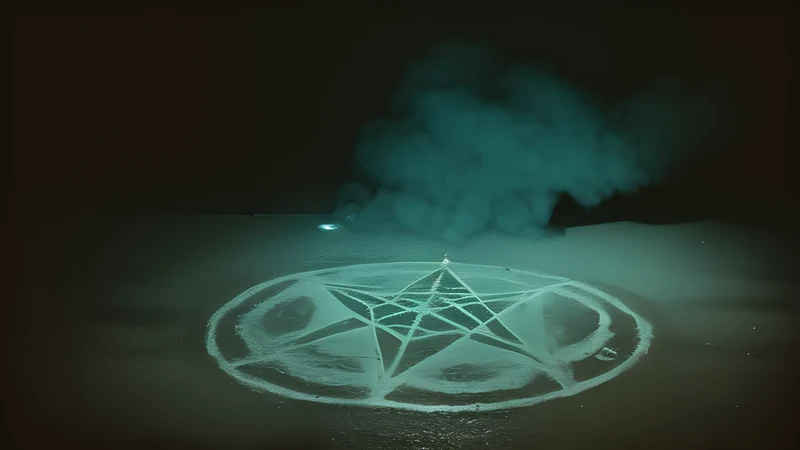
The set piece runs about twenty minutes and is one of the great sustained sequences in British horror. Richleau chalks a pentacle on the floor of the Eatons’ library, sits his four charges inside it, and tells them that whatever they see or hear, they must remain within the lines until dawn. Mocata then sends everything he has.
The mechanics are pure theatre. The threat is entirely psychological because the rule is absolute and known: nothing can cross the chalk, so the coven attacks the will instead. A phantom in the doorway. A dead child. A voice. The temperature. Fisher shoots almost all of it from inside the circle, so the audience is under the same constraint as the characters, and James Bernard’s score — all shrieking strings and hammered brass — does the work the budget cannot.
Because the budget cannot do much. The Angel of Death arrives on a black horse, the giant spider descends, and both are exactly as convincing as 1967 Elstree optical work permits. Studiocanal’s 2012 restoration offered enhanced replacements for some of the effects, which is a defensible commercial decision and slightly beside the point; the sequence survives its own spiders because Fisher grasped that the fear lives in the rule rather than the apparition. Lee sitting in chalk telling four terrified people to keep still is worth any monster.
Where it sits
America got it as The Devil’s Bride, retitled by Fox on the reasonable suspicion that a picture called The Devil Rides Out would be shelved with the westerns. The retitling did not help. The film underperformed, which is the reason Hammer left Wheatley alone for the better part of a decade — and when the studio finally returned to him with To the Devil a Daughter in 1976, the novelist was appalled by the result and effectively closed the door on further adaptations. So the Wheatley screen catalogue amounts to one very good film, one he disowned, and a gap where a series should have been. Fisher directed only two more pictures.
Wheatley reportedly regarded this as the best adaptation of his work, which for once is a novelist’s judgement worth taking seriously. The film’s real ancestor is Jacques Tourneur’s Night of the Demon, the other great British occult picture, which also pits a certain man against a charming cultist and also has its effects argued over forever. Its descendants are everywhere in the satanic cycle that followed: Rosemary’s Baby arrived the same year with better clothes and worse intentions, and the whole religious turn is mapped in the possession film and the return of the religious. For Hammer’s own shelf, it belongs beside Dracula on the essential ten.
The verdict comes down to nerve. The Devil Rides Out is ninety-five minutes, has one embarrassing spider, contains the best twenty-minute sequence Hammer ever shot, and gave Christopher Lee the only chance he ever had to be the cleverest man on screen at Bray. He took it with both hands.
Spoilers below
The film’s cruellest move is the child. Mocata, having failed to break the circle, retaliates by killing Peggy Eaton’s playmate through the coven — and then, when Richleau’s party pursues him, takes Peggy herself, holding a small girl as the hostage in a war of wills between adults. Hammer rarely put children in genuine jeopardy and the film’s late reels are considerably nastier than the reputation suggests.
The resolution is where Wheatley’s pulp instincts win and the film has to be defended rather than excused. Richleau invokes the Sussamma Ritual through Tanith’s body, and the working reverses time itself: the sequence rewinds, the child’s death is undone, and Mocata is destroyed by the forces he summoned, consumed on his own altar. Everyone lives. A film that has spent ninety minutes establishing that these rules are ironclad and lethal finishes by revealing a rule that unmakes the plot.
It should be fatal and it is only a bruise, for a reason worth naming. The reversal is consistent with the film’s own theology — Richleau has insisted from his first scene that the left-hand path and the right are two applications of one power, and that the side you serve determines what the power does. Mocata used it to hypnotise a woman in a drawing room; Richleau uses it to unpick an afternoon. The film pays for its deus ex machina by having established the machinery in the first reel, which is more than most occult films bother to do.
Fisher’s last shot is Richleau reminding the survivors who saved them, and Lee delivers the line with the calm of a man closing a file. Then Hammer sent him back into the cape.
Related Content