The Day the Earth Stood Still (1951): The Sermon in a Flying Saucer
Robert Wise made the first alien picture that came to preach rather than destroy
Contents
In 1951 a saucer landed on the President’s Park Ellipse in Washington, a man in a silver suit walked down the ramp with his hand raised in peace, and a jittery soldier shot him for his trouble. That gesture — the outstretched hand, the reflexive bullet — is the whole of The Day the Earth Stood Still in one beat. Robert Wise’s film is a sermon disguised as a science-fiction thriller, and it remains the founding document of the benevolent-visitor tradition, the picture every later filmmaker who wanted the alien to be wiser than us had to answer to.
It arrived at the exact moment the flying saucer became mass culture. The Roswell reports were four years old, the Cold War was hardening, the atomic bomb had a sequel in the hydrogen bomb, and Hollywood was gearing up to spend the decade dramatising the fear of annihilation as insect swarms and pod people and things from other worlds. Into that climate Wise dropped a film that looked at the same anxieties and drew the opposite moral: the danger is not out there, it is in the trigger finger.
A message and a warning
The story is spare and moves like a parable. Klaatu, played by the British actor Michael Rennie with a still, watchful gravity, has come from an interstellar federation with a single message for the leaders of Earth. Humanity has split the atom and started building rockets, and a species that violent, once it can reach other worlds, is a threat that the federation will not tolerate. He asks to address all the nations at once. Told that the world’s governments cannot agree to sit in the same room, he slips away to live among ordinary people and learn what they are actually like, taking a room in a Washington boarding house under the name Mr Carpenter.
The alias is the film’s least subtle and most durable idea. Klaatu is a carpenter who comes from the heavens with a message of peace, is betrayed and killed by the authorities, returns from death, delivers a final warning, and ascends. Screenwriter Edmund North, adapting Harry Bates’s 1940 short story “Farewell to the Master,” has admitted the Christ parallel was deliberate and that he kept it quiet to avoid a fight with the studio. The Breen Office did notice, and the resurrection had to be softened with a line insisting that only “the Almighty Spirit” holds true power over life and death. The compromise is visible in the finished film, and the allegory survives it intact.
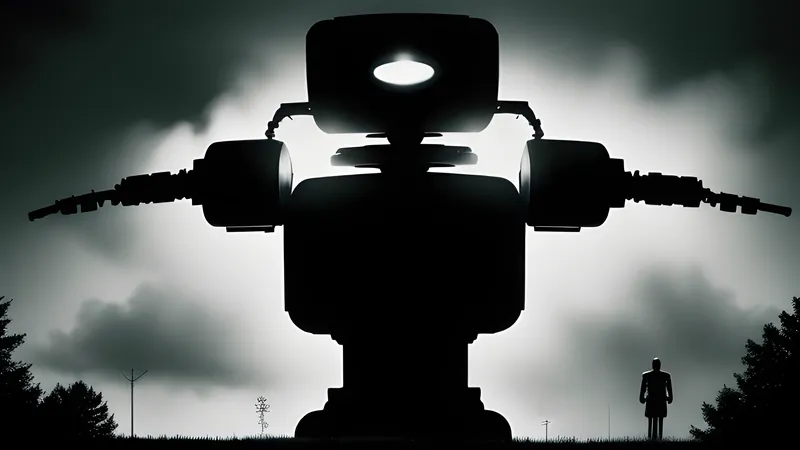
His companion is Gort, a faceless robot policeman of the interstellar order, played inside a foam-rubber suit by the seven-foot-plus doorman Lock Martin. Gort is the film’s masterstroke of design: a smooth, seamless, expressionless sentinel whose visor lifts to release a disintegrating ray. The federation, Klaatu explains, has handed its peace-keeping to an incorruptible race of robots with irreversible power to destroy any aggressor, including their creators. It is a chilling political idea dressed as pulp — freedom traded for security, the nuclear balance of terror rebuilt as theology — and the film presents it with a straight face as the price of survival.
The sound of the other
Bernard Herrmann’s score is where the picture stops being a well-made message movie and becomes something stranger. Herrmann built his orchestra out of two theremins, electric violin, electric bass, three organs, brass, and a battery of pianos and harps, and used it to give the alien a sonic signature that had never existed before. The theremin’s wavering, disembodied wail — a pitch you play by moving your hands through an electromagnetic field, touching nothing — became instantly and permanently the sound of the extraterrestrial. Every eerie sci-fi cue for the next twenty years is chasing what Herrmann did here first.
The craft point worth dwelling on is how the sound does the alienating that the budget could not. This is a modestly scaled film; the effects are a saucer, a ray, and a robot suit. Herrmann understood that you cannot make the audience feel the uncanny with hardware alone, so he made them hear it, seeding the theremin under Klaatu’s scenes so that even when Rennie is sitting quietly in a boarding-house parlour, a thread of the wrong music tells you he is not one of us. It is the same principle Spielberg and John Williams would later invert for Close Encounters of the Third Kind, where five notes become a hymn of welcome rather than a warning. Both films know that first contact is an event you score before you shoot.
The day it stopped
The title refers to Klaatu’s demonstration of power, a stunt calibrated to frighten without killing. To prove he can be taken seriously, he neutralises all electrical power across the planet for exactly thirty minutes — cars stall, factories halt, the world holds its breath — while hospitals, aircraft in flight, and other places where a stoppage would cost lives are pointedly spared. It is a beautifully judged idea: a global act of force that harms no one, the exact opposite of the bomb the film is really worried about. The screen goes still, and the stillness is the argument.
Wise, who had cut his teeth in the RKO editing rooms and worked on Citizen Kane before directing, shoots the whole thing with a documentary flatness that grounds the fantasy. Washington is real, the newsreel voices are real, the panic is staged like reportage. That plainness is a deliberate strategy: the more ordinary the world looks, the more the saucer on the lawn reads as an actual visitation rather than a fantasy. It is the same trick Don Siegel would use a few years later to make Invasion of the Body Snatchers so unnerving — small-town normality as the ground against which the impossible cuts.
What it started
Set this film beside the decade it opened and its oddity sharpens. The 1950s science-fiction cycle was overwhelmingly a cinema of dread — the atomic anxiety projected outward as monsters, the Red Scare projected inward as impostors. Wise’s picture stands almost alone in that company as an argument for reason and disarmament, a film that trusts a lecture to hold the screen. Its ancestor is less the pulp of its own moment than the grand civic warnings of early science fiction; you can draw a line back to Metropolis, which likewise wrapped a moral thesis about how societies destroy themselves inside spectacle and secular allegory.
Its descendants are everywhere the movies decided the visitor might be wiser than the visited. And its shadow-self is the great fear film of the sound era, The Thing (1982), which takes the same premise — a being from space walks among us — and answers it with total, curdled distrust. Wise’s Klaatu asks to be understood; Carpenter’s Thing cannot be. The two films are the poles the whole genre swings between, and The Day the Earth Stood Still got there first.
The verdict
The film is didactic, and it knows it, and the confidence is what saves it. A message movie only works if it believes its message enough to stake the whole picture on a speech, and Wise believes. Michael Rennie’s calm — that sense of a man who has already seen how this story usually ends and is disappointed rather than surprised — carries the sermon past the point where a lesser lead would have turned it into a lecture. Seventy years on, the specific fears have shifted and the parable has not aged a day, because the trigger finger never went away.
Watch it as the opening statement in a long argument the movies are still having. Follow it forward to the wonder of Close Encounters of the Third Kind, and sideways to the Freudian strangeness of Forbidden Planet, the two 1950s films that took the flying saucer somewhere other than terror.
Spoilers below
The betrayal and resurrection land the allegory. Klaatu, hunted by the authorities after his demonstration, is shot dead in the street. His body is taken by the military, and it falls to Helen Benson — the widowed boarding-house tenant played by Patricia Neal, the one human who has come to trust him — to save the world by carrying his instructions to Gort. She has memorised the phrase he taught her: Klaatu barada nikto, the command that stops the robot from retaliating against the planet after its master’s death. Gort recovers Klaatu’s body and revives him aboard the ship, and Klaatu emerges to deliver the film’s closing address on the Ellipse.
The words are worth hearing straight. He tells the assembled scientists that his federation offers Earth membership on one condition, and the condition is disarmament under guard: join the other worlds in surrendering aggression to the robots’ irreversible authority, or be reduced to a burned-out cinder. Live in peace, or the peace-keepers will end you. Then he ascends, and the film cuts to black on the choice, refusing to tell us which way humanity jumps.
That final speech is far darker than its reputation suggests. The benevolent visitor turns out to be issuing an ultimatum backed by unstoppable force, and the utopia he describes is a police state run by executioner robots who cannot be reasoned with or switched off. Klaatu’s peace is the nuclear stalemate rewritten as salvation — safety bought with the total surrender of the power to make war, enforced by a machine that will incinerate you for trying. Wise lets the sermon end on that unresolved threat, and the queasiness underneath the uplift is exactly why the film still holds. It came in peace, and it came armed.
Related Content