The Creature-Restraint Principle: Why Less Monster Is More
The imagination has a bigger effects budget than any studio, and the best creature films know it
Contents
The most influential creature effect in horror history was a mechanical shark that did not work. During the Jaws shoot in 1974, the pneumatic shark the crew nicknamed Bruce kept failing in the salt water off Martha’s Vineyard, and Steven Spielberg, twenty-seven and terrified for his career, was forced to shoot around it. He suggested the shark with a floating yellow barrel, a dorsal fin, a subjective camera gliding under swimmers, and John Williams’s two-note pulse standing in for a body he could not show. The film became the highest-grossing picture ever made to that point, and it invented a rule that filmmakers have been half-remembering and half-forgetting ever since: the monster you cannot quite see is doing more work than the monster you can.
Call it the creature-restraint principle. It is not mysticism and it is not a blanket ban on showing your monster. It is a claim about where fear actually lives, and about the single most expensive mistake a creature film can make.
The imagination outbudgets the effects shop
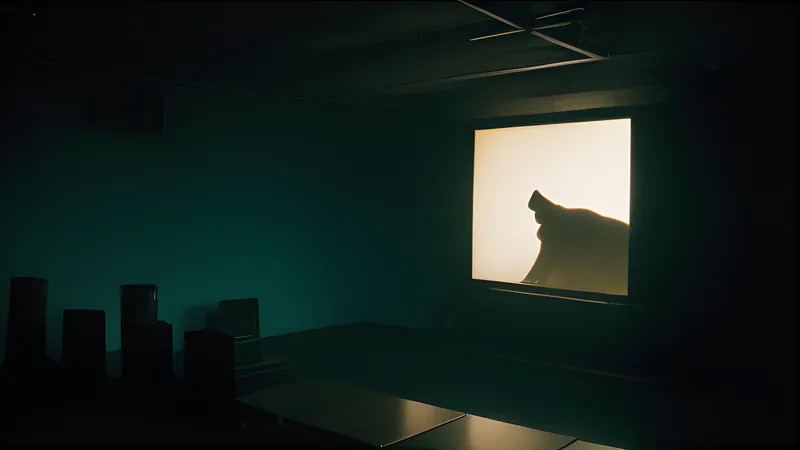
Every audience arrives with a private effects department that has no line-item cost, no deadline, and no upper limit on horror. When a film withholds the creature — a shadow, a sound, a shape at the edge of a torch beam — it conscripts that department to do the work. The viewer builds the monster to their own exact specifications of dread, and because they are building it out of their own fears, it fits perfectly. The instant the film cuts to the finished practical or digital creature, that private version is overwritten by a fixed one on the screen, and a fixed thing can be measured, sized up, and found survivable. Measurement is the enemy. Fear needs the creature to remain slightly larger than the frame.
This is why the middle stretch of Jaws frightens people who have seen a hundred shark documentaries. The fear has nothing to do with a great white being unknowable; it comes from Spielberg keeping the animal below the waterline, present as pressure and absence, so that your nervous system treats the whole sea as the monster. When Bruce finally surfaces and Roy Scheider delivers the famous line about the boat, the reveal lands as a release valve — the film has earned the right to show you, and it shows you for barely long enough.
Restraint is as much an audio discipline as a visual one, and the two great examples prove it in opposite directions. Jaws gives the unseen shark a sound — the Williams motif — so that the animal exists in your ears before it exists on screen, a body made entirely of two alternating notes. Alien does the reverse and gives the creature almost no signature sound at all, so that the Nostromo’s hum and the crew’s breathing become the whole soundscape and any small wrong noise is the monster. Both understand that a creature can be conjured in the mix long before, or entirely without, a shot of its face.
The tradition runs straight back to producer Val Lewton and director Jacques Tourneur at RKO in the 1940s, whose Cat People (1942) gave us the “Lewton bus” — the swimming-pool sequence where a woman is stalked by something we hear, feel the water ripple from, and never see. Lewton had almost no money, and turned poverty into method: show nothing, imply everything, let the dark do the acting. Half a century of horror craft is a footnote to that swimming pool.
Modern films keep rediscovering it. It Follows (2014) built an entire creature around restraint: an entity that can wear any body, walks toward you at a constant human pace, and is never explained, never named, never given an origin. David Robert Mitchell shoots it as a figure in the middle distance that only the cursed can see, which weaponises the frame itself — every deep-focus wide shot becomes a place to search for a slow-walking stranger. The monster is frightening in exact proportion to how little the film will tell you about it. The instant you could describe its rules on an index card, the pressure would drop.
Alien did it on purpose, and knew why
If Jaws discovered restraint by accident, Alien (1979) practised it as doctrine. Ridley Scott had H.R. Giger’s extraordinary biomechanical design and a performer, Bolaji Badejo, inside the suit — and he chose, for almost the entire film, to show the creature in fragments: a tail in the dark, a second mouth, a silhouette unfolding from the wall of a corridor lit like a cathedral of pipes. The full-body glimpses are counted on one hand and none of them lasts. Scott understood that Giger’s design was most powerful as a series of wrong details your brain could never assemble into a whole animal, and so he kept it un-assemblable.
Watch what happens across the franchise once the restraint relaxes. James Cameron’s Aliens is a masterpiece on its own terms, and it is a completely different emotion — Cameron floods the screen with creatures and converts dread into combat, trading horror for adrenaline in a deliberate, clear-eyed swap. It works because Cameron changed the genre of the film on purpose. The lesson is not that showing the monster is wrong; it is that showing the monster changes what kind of film you are watching, and you had better mean it.
When full disclosure is the right call
Restraint is a tool, and a tool used reflexively becomes a tic. There is a whole class of creature film where hiding the monster would be a betrayal, because the horror is not mystery — it is transformation, or contamination, or the body itself turning traitor.
John Carpenter’s The Thing (1982) shows you everything. Rob Bottin’s effects — the splitting chest, the spider-head, the dog-thing peeling open like a wet flower — are among the most explicit ever committed to film, and the movie is terrifying anyway. It works because the dread of The Thing is not “what does the monster look like” but “who at this table is already it,” and the grotesque reveals feed that paranoia by proving the creature can wear any shape and open into any horror. Full disclosure here is the mechanic. The same is true of David Cronenberg’s The Fly, where the whole point is to make you watch, in unbearable detail, a man decompose. To cut away would be cowardice, and would break the film’s contract that you will not be spared.
The rule underneath both cases is consistent. Hide the creature when the fear is the unknown. Show it, in loving practical detail, when the fear is the known made intolerable — decay, mutation, the body as meat. The failure mode is applying the wrong strategy: a slow reveal for a body-horror piece drains its nerve, and a full early reveal for a mystery-creature hands the audience a ruler.
The reveal is a one-way door
The reason so many creature films collapse in their final third is that the reveal is irreversible. You can build suspense for eighty minutes; you can spend it in eight seconds. Once shown, the monster cannot be un-shown, and if the design cannot survive daylight and a long look, the film deflates in real time. The smartest creature films budget their reveals like a poker player budgets chips — a fragment here, a silhouette there, and the full hand kept face-down until the single moment where turning it over wins the pot rather than ending the game. This is the same instinct that ruins the horror remakes when they explain away their ghosts — clarity feels like generosity to the filmmaker and reads as a refund to the audience.
The shift from practical effects to computer imagery made the temptation worse, because a digital creature can be shown fully, in motion, in daylight, at no marginal cost — and so it usually is, at length, until the mystery is gone. The creature designers who came up in latex and foam understood a discipline the render farm forgot: a monster built to be glimpsed is a different object from a monster built to be watched, and the ones built for the shadows were often the ones that lasted.
What to watch for the lesson
Put Jaws and Alien side by side as the twin foundations — one that learned restraint under duress, one that chose it. Then watch The Thing immediately after, as the great counter-argument, and notice that all three are frightening for reasons that contradict each other, which is the whole point: there is no universal rule, only a match between strategy and subject. Cat People remains the elegant miniature of the whole idea, the swimming pool that started it. And if you want to see the principle taken to its absolute limit — a monster the film flatly refuses to show at all, ever — The Blair Witch Project proved that zero frames of creature could scare a generation, on the strength of nothing but a bundle of sticks and the dark doing what the dark does best.
Related Content