The Conformist: Bertolucci's Fascist Noir in Colour
Vittorio Storaro's light, Ferdinando Scarfiotti's marble, and a man who joins the secret police because he wants to be normal
Contents
Il conformista (1970) is the most beautiful film ever made about a coward, and the beauty is the argument. Bernardo Bertolucci was 29 when he made it. He had Vittorio Storaro behind the camera, Ferdinando Scarfiotti designing the world, Alberto Moravia’s 1951 novel as a spine and Jean-Louis Trintignant as a man with almost nothing inside him. The result reorganised what film could look like, and half of American cinema in the following decade was made by people who had watched it and taken notes.
The story is simple and the film refuses to tell it simply. Marcello Clerici, a young Roman of good family with something wrong at the centre of him, decides to become normal. He will marry a conventionally silly bourgeois girl. He will go to Mass. He will join the fascist secret police, and he will volunteer for a job that will prove his commitment: the state wants an exiled anti-fascist professor dealt with, in Paris, and the professor was once Marcello’s university tutor. Marcello offers to do it. Not from conviction. From the desire to be the kind of person who would.
Form as diagnosis
Bertolucci builds the film around a car journey. Marcello is being driven toward the thing he has agreed to do, and the whole picture unspools out of that drive in flashbacks that arrive out of order, triggered by nothing you can predict. This is not decoration. A conventional chronology would let us watch a man make a series of choices. Bertolucci’s structure makes us watch a man who has already made them, assembling a justification on the way to the appointment, and the fragmentation tells you that Marcello’s interior life is a set of disconnected panics rather than a self.
The flashbacks are staged with escalating unreality — a mother’s decaying villa full of leaves, an asylum, a mad father, a wedding-night confession delivered in a train compartment while the world flickers past outside. Bertolucci lets each memory be lit as a genre. The Paris material is a romance. The Rome material is an architectural nightmare. The childhood is a fairy tale gone wrong. Marcello has no consistent self, so his past has no consistent style.
Storaro, and the invention of a look
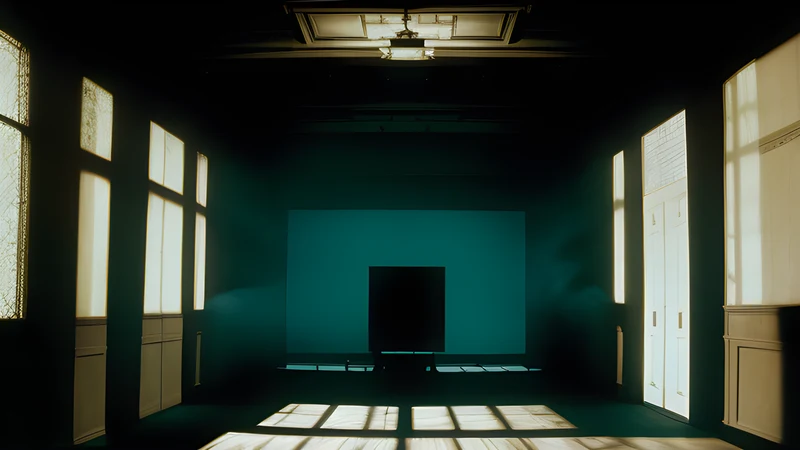
Vittorio Storaro was 29 as well, and The Conformist is where he became the most influential cinematographer alive. What he does here had barely been attempted in colour: he lights for shadow. Fascist Rome is rendered in enormous slabs of white marble and enormous slabs of black, with the human figure reduced to a fleck moving through the gap. Venetian blinds throw noir’s signature stripes across faces — the visual grammar of 1940s American crime films, resurrected in wide colour and given a political job.
Two specific tricks are worth naming. First, Storaro almost never fills a shadow. When a face turns away from the key light it goes to nothing, and Bertolucci lets actors deliver whole speeches from inside that nothing. Second, the camera moves constantly and unmotivated — craning, dollying, drifting past pillars, boxing characters behind foreground objects. In a film about a man who wants to be part of a mass, the camera is forever finding architecture to squeeze him against.
And then there is the wind. A Paris apartment sequence plays with leaves blowing horizontally through the frame, and a later scene in a wood is composed almost entirely of moving trees and moving light. Storaro shoots the natural world as a thing that will not hold still for fascism. It is the closest the film comes to hope, and it is entirely in the lighting.
Ferdinando Scarfiotti’s design is the other half. He put Marcello inside real fascist architecture — the vast, deliberately dehumanising civic modernism of the regime — and used it as characterisation. Marcello’s ministry is a hall so large that a man crossing it becomes a rounding error. Every interior in his Roman life is composed to make individuality look like a design flaw. Then Bertolucci moves him to Paris and shoots interiors that are cluttered, warm, full of furniture and books and mess, and the meaning is unmistakable before a word is spoken.
The joke on Godard
Bertolucci gave the exiled professor a Paris address and telephone number, and they were Jean-Luc Godard’s real ones. Godard had been Bertolucci’s idol and the presiding spirit of his early work. Here the young director makes his intellectual father a man to be assassinated by the state, and puts his home address in the film. Bertolucci was open about the patricide. It is a joke of enormous nerve and slight ugliness, and it is the sort of thing a 29-year-old does when he knows he has just made something better than his teacher would have.
The professor also delivers a lecture on Plato’s cave — the prisoners chained facing a wall, watching shadows of the real world and mistaking them for it. Bertolucci stages it with Storaro throwing the men’s actual shadows onto the wall behind them. It is the least subtle moment in the picture and it survives, because the film has earned the right to say its thesis out loud once: Marcello is a man who has chosen the shadows, and who will help murder the person offering to turn him round.
Trintignant’s nothing
The performance is a feat of subtraction. Jean-Louis Trintignant plays Marcello as a man performing normality with the strain of someone doing sums. He watches other people to learn what a person does. He mimics enthusiasm a half-second late. His fascism has no ideological content whatsoever — he never argues a position, never expresses hatred, never seems to believe anything — and this is Moravia’s and Bertolucci’s real accusation. The regime did not run on monsters. It ran on men who wanted to be unremarkable, and found a machine that would issue them a certificate.
Stefania Sandrelli’s Giulia is a superb piece of casting against the material: she plays the vulgar, chattering, unserious wife as somebody with an appetite for life that her husband regards as an embarrassment and cannot supply. Dominique Sanda’s Anna is the film’s danger, and the celebrated ballroom sequence — where she pulls Giulia into a tango and the two women dance while a room of provincial French diners gradually joins in and Marcello sits alone at the edge — is a whole novel of exclusion in three minutes.
The bloodline
The influence ran straight into New Hollywood and never left. Storaro’s shadowed interiors and roving camera are all over the American cinema of the 1970s; he went on to shoot Apocalypse Now, and Coppola’s Godfather Part II flashback structure and darkness owe this film a great deal. Scorsese and Schrader both spoke about it for decades. If you have ever wondered why 1970s American film suddenly looked like that, a large part of the answer is that everyone had seen The Conformist.
For the collector, the essential companion is Elio Petri’s Investigation of a Citizen Above Suspicion, released the same year, which takes the same subject — the psychology of a man who becomes the state’s instrument — and plays it as a jangling satirical nightmare instead of an elegy. The pair is one of the great double bills in Italian cinema. Track the argument forward to Paolo Sorrentino’s Il Divo, which asks what the conformist looks like once he is in charge and has stopped needing to justify himself at all.
Sideways, Jean-Pierre Melville’s Army of Shadows is the necessary corrective, the same era filmed from the side of the people Marcello’s colleagues were hunting, and just as fatalistic. And for the European film that uses gorgeous surfaces to portray a man dissolving into someone else’s life, Purple Noon got there a decade earlier with sunshine instead of marble.
The case against
The film’s psychology has dated badly in one specific and serious way. Bertolucci roots Marcello’s fascism in a childhood sexual encounter, and the implication — that his politics are a symptom of a repressed and pathologised sexuality — is the film’s least interesting idea and its most 1970 one. Moravia’s novel carries the same freight, but the film puts a very heavy causal weight on it. The result is that a devastating argument about ordinariness keeps getting rerouted into an argument about deviance, which lets the ordinary off.
It is also, for all its beauty, a film that can be admired more easily than felt. Marcello’s hollowness is the point and it is still a hollowness, and there are stretches where the picture’s formal brilliance is the only thing on offer. That is a real cost. It is also, at this level of craft, a small one.
Where to find it
The restoration is superb and the film is a fixture on disc and the arthouse platforms. Watch the longest available cut — a sequence involving a blind men’s dance was cut from early releases and later restored, and it belongs there. Give it a real screen. Storaro shot it for one.
Spoilers below
The professor’s assassination in the wood is one of cinema’s great set pieces and one of its cruellest, and its cruelty is structural. Marcello sits in the car. He does not get out. He watches through glass while Manganiello’s men do the work, and Bertolucci films the killing from inside the vehicle — smeared, distanced, muffled — so that we are trapped in the passenger seat with a man who has arranged a murder and cannot bring himself to attend it.
Then Anna sees him. She runs to the car, and she is at the window, screaming, hands on the glass, close enough to touch, and Marcello looks at her and does nothing at all. He does not open the door. He does not look away. He simply sits, and she is dragged off into the trees and shot while running through the wind and the light that Storaro spent the whole film establishing as the only living thing in the picture. The car window is the whole film’s thesis in one prop: a transparent barrier through which a man watches the world and declines to enter it.
The coda jumps to 1943. Mussolini has fallen, the city is celebrating, and Marcello is on the street among crowds pulling down the regime’s images. He immediately, loudly, denounces his blind friend Italo as a fascist to a passing mob — reconforming in real time, switching sides with a fluency that requires no thought because there was never anything to convert. And then he sees Lino, alive: the man whose supposed death has been the hinge of his entire psychology, sitting there in the dark, undead, meaning that the foundation of Marcello’s whole self-explanation was never true.
Bertolucci’s last image leaves him by a fire, turned toward the light, looking away from a young man behind him. A conformist under fascism has become a conformist under the mob, and the film’s final position is merciless: this man will be fine. He will be fine under every regime. That is what he was built for.
Related Content