The Colour of Pomegranates: Cinema as Illuminated Manuscript
Parajanov's 1969 life of a poet, told in frescoes that move
Contents
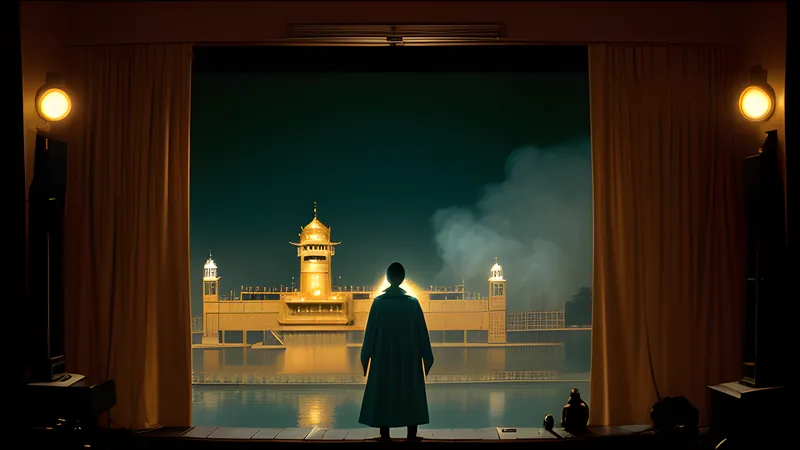
Most films ask you to follow. Sergei Parajanov’s The Colour of Pomegranates (1969) asks you to look, the way you’d look at a page of an illuminated Gospel — a thing built to be dwelt on rather than turned. It runs about seventy-eight minutes, purports to tell the life of the eighteenth-century Armenian troubadour Sayat-Nova, and contains almost nothing a screenwriting manual would recognise as a scene. People rarely move toward a goal. The camera almost never pans. What you get instead is a sequence of frontal, jewel-coloured compositions, each held long enough for the objects inside it to start meaning something.
I came to it late, on a restored disc, decades after its 1969 Armenfilm release, and I remember the specific vertigo of the first ten minutes — the sense that I’d been handed a language whose grammar I’d have to reconstruct from scratch. That vertigo is the film working exactly as designed. It is one of the few pictures that genuinely reinvents how the medium addresses a viewer, and it remains, more than half a century on, the strangest biography ever committed to celluloid.
A poet’s life, told in objects
Sayat-Nova was a real figure: a troubadour who wrote in Armenian, Georgian and Azerbaijani, served at the Georgian court, fell from favour, took holy orders, and died — by tradition — during the Persian sack of Tbilisi. Parajanov gives you all of that, but never as drama. He gives it as still life. The poet’s childhood is a rooftop drying wet books, their pages breathing in the wind. His awakening senses arrive as dyers’ vats, wool lifted dripping in deep reds and blues. His youth at court, his renunciation, his old age, his death — each gets a chapter, and each chapter is assembled from ritual gesture, textile, fruit, and the pomegranates of the title, whose juice bleeds across white cloth in the shape of a kingdom.
The Georgian actress Sofiko Chiaureli plays six roles across the film, male and female, including the young poet and the muse he loves — a doubling that quietly insists the artist and his subject are the same substance. Parajanov worked from Armenian miniatures and church frescoes, and the debt is total: figures face the camera dead-on, space is flattened, depth is refused. The soundtrack layers folk instruments and recited fragments of Sayat-Nova’s verse. Nothing is explained. The pomegranate, the seashell, the golden thread, the slaughtered lamb — they accrete meaning through repetition, the way a motif does in music.
Why the tableaux actually work
The obvious question a hostile viewer asks is whether any of this is more than beautiful wallpaper. It is, and the reason is worth pinning down, because it explains why so many films that imitate the look fall flat.
Parajanov’s compositions work because they are kinetic inside a static frame. The camera holds still, so your eye does the travelling — and Parajanov choreographs small, insistent movements within the picture to guide it: a hand turning a page, wine poured, a bird released, cloth pulled taut. Each frame is a closed system with one or two moving parts, and because everything else is locked down, those parts carry enormous weight. This is the discipline most homage misses. Imitators reproduce the flatness and the saturated colour and forget that Parajanov earns the stillness by making the stillness do something. A held frame is only hypnotic when the eye has a task.
The second mechanism is symbolic economy. Parajanov never dilutes an image by literalising it. When juice stains cloth into the outline of a map, he doesn’t cut to a narrator telling you the poet’s world is bleeding. He trusts the rhyme between the fruit’s red and the poet’s later suffering to land on you unassisted, hours later if need be. It’s the montage principle Eisenstein theorised — meaning generated by collision — but slowed to the pace of contemplation and stripped of ideology. You assemble the biography yourself, from evidence, and a life you have assembled feels truer than one you’ve been told.
There’s a third thing at work, harder to name, which is Parajanov’s sense of ritual time. A gesture in this film is never performed once and dropped. Wine is poured, cloth is folded, a candle is lit, and the action is repeated with the gravity of liturgy until it stops being an event and becomes a rhythm. That repetition is what tips the film from illustration into something closer to prayer. You aren’t watching a poet do things; you’re watching the ceremonies a life is made of, isolated and burnished. By the time a motif returns for the third or fourth time, it carries the accumulated weight of everything it stood beside — which is how symbols work in scripture, and how they refuse to work in ordinary narrative cinema, where an image usually means one thing and is then spent.
It’s worth remembering the film almost didn’t survive in this form. Soviet authorities found it politically illegible and formally suspect; the director Sergei Yutkevich re-edited it for wider distribution, reordering chapters and adding explanatory intertitles to make it behave. Parajanov himself was later imprisoned for years on trumped-up charges, and the picture became a byword for the cost of making art the state couldn’t parse. The version most of us now see was reconstructed toward Parajanov’s intentions, notably in the restoration that Martin Scorsese’s foundation backed. Watch it knowing it’s a survivor.
Where it sits, and what to watch around it
For a collector, the pleasure of Pomegranates is tracing its bloodline in both directions. Behind it stand the Armenian miniaturists and the whole Orthodox icon tradition, which had spent a thousand years perfecting the frontal, symbolic, gold-ground image before cinema borrowed it. Ahead of it stands a good half-century of filmmakers who learned from Parajanov that a movie can be a reliquary.
The nearest cousin in spirit is the ritual-symbolic surrealism of Alejandro Jodorowsky. If you’ve followed my argument about The Holy Mountain and its alchemical procession of tableaux, you already know the mode — the image loaded past the point of literal sense, daring you to read it as scripture. Jodorowsky is louder and lewder, Parajanov is liturgical and chaste, and the family resemblance is unmistakable. For the other pole — dream logic built from industrial dread rather than devotional beauty — David Lynch’s Eraserhead works the same trick of holding an image until it curdles into meaning.
Two pieces from the Eastern European avant-garde make the ideal double bill. Věra Chytilová’s Daisies shares the collage instinct and the same defiance of a state that wanted films to be legible propaganda, and Valerie and Her Week of Wonders shares the fairy-tale grammar of objects that mean more than they are. All three came out of a system that treated formal strangeness as a threat, which is part of why they still feel dangerous.
The verdict
The Colour of Pomegranates is not difficult in the way people fear — it doesn’t withhold or condescend. It’s difficult the way a poem in a language you half-know is difficult: the meaning is right there on the surface, in the colour and the gesture, and the only work is trusting the surface. Give it a single uninterrupted watch with the subtitles that translate the verse, resist the urge to reach for a plot summary, and let the pomegranates do what pomegranates do. It rewards surrender more completely than almost anything in the cult canon, and it will permanently change what you think a biopic can be.
Where to watch: it circulates in the World Cinema Project restoration, and any edition sourcing that transfer is the one to seek — the colour is the whole film, and a bad copy is no copy at all.
Spoilers below
There’s little to spoil in the conventional sense, but the film’s closing movement is worth discussing for anyone who found the earlier chapters opaque. The final act follows Sayat-Nova into the monastery and toward death, and Parajanov stages the end with the same refusal of melodrama he’s held throughout: the poet, aged, lies down among the ruins and the ritual objects, and angels — figures in white — descend to close his eyes and call for him to sing. Even death arrives as tableau, an image of composure rather than agony.
What lands, if you’ve stayed patient, is the rhyme the whole film has been building. The pomegranates that bled a map in the opening chapter return as the blood of a life spent; the wet books of childhood become the manuscripts of an old scribe; Chiaureli’s twinned poet-and-muse resolves into the recognition that the beloved and the self were always one figure seen twice. Parajanov never states any of this. He simply lets the last images call back to the first, and the biography closes like a manuscript closing — a completed object you can hold in your mind entire. That structural rhyme, achieved without a word of exposition, is the film’s quiet masterstroke, and it’s why the ending feels earned rather than merely arrived at.
Related Content