The City of the Dead: Christopher Lee's Witch-Town
The 1960 British chiller that drowned New England in dry ice and killed its heroine halfway through
Contents
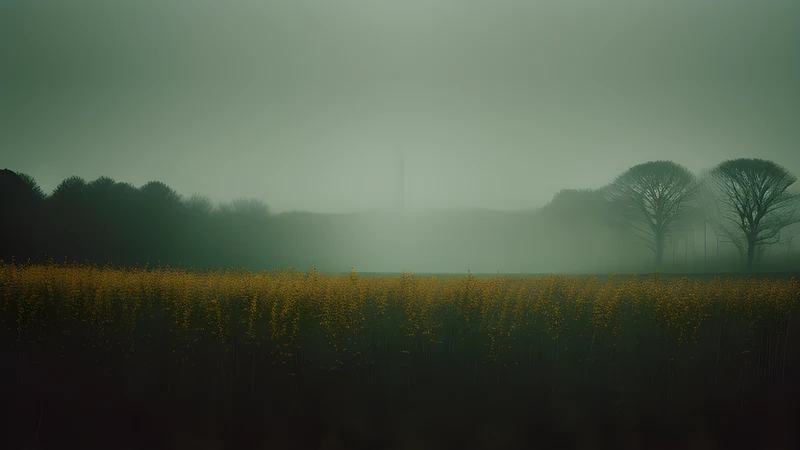
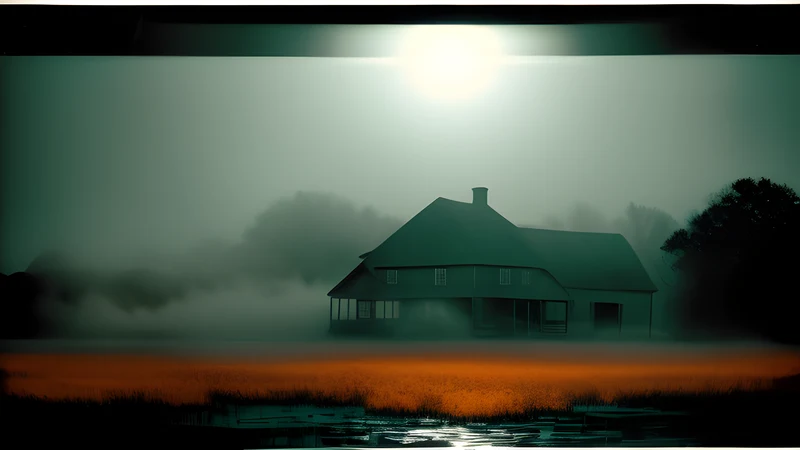
Whitewood, Massachusetts does not exist, and The City of the Dead is careful never to let you forget it. The town was built on a stage at Shepperton in 1959 and then buried under so much dry ice that you can rarely see where one building ends and the next begins. There is no horizon. There is no sky. A signpost looms out of the murk, a gas station appears with no road leading to it, and figures walk in from a whiteness that has nothing behind it. A more expensive film would have gone to New England and shot the real thing. This one could not afford to, and the poverty produced one of the most complete atmospheres in British horror: a town that is less a place than a condition.
The film was made by Vulcan Films, the outfit run by Milton Subotsky and Max Rosenberg, who two years later would found Amicus and spend the next decade making the portmanteau horrors we have catalogued in Amicus and the art of the portmanteau horror. Subotsky supplied the story; George Baxt wrote the screenplay; John Llewellyn Moxey directed his first feature and then spent most of his career in television. Desmond Dickinson, who had shot Olivier’s Hamlet a decade earlier, photographed it in a black and white so dense that the fog reads as a physical substance. In America it was retitled Horror Hotel, which is both a lie about the film and a fairly good indication of what the distributor thought it had bought.
The town is the fog
The decision that makes The City of the Dead work is the refusal to establish geography. Horror films normally want you oriented, because a floor plan is what lets a director scare you with the door on the left. Moxey and Dickinson do the opposite. Whitewood is delivered in fragments — a porch, a stairwell, a graveyard gate — with white nothing packed into every gap, so the viewer never assembles a map. The effect is that the town feels infinite and enclosed at once. You cannot leave a place whose edges you have never seen.
This is a lighting solution to a budget problem, and it is worth being precise about why it lands rather than merely looking cheap. Fog on a stage flattens depth, which normally kills an image. Dickinson counters by pushing hard, specific light sources into it — a lamp, a window, a headlight — so the murk acquires structure. Each light carves a small volume out of the white and defines a shallow pocket the actors move through. The frame ends up with a foreground and an immediate middle distance and then simply stops. The audience’s eye keeps reaching for the depth cue that never arrives, and that reaching is the unease. Carpenter would rediscover the same principle two decades later on the California coast for The Fog, where the mist is again both the monster’s vehicle and the reason you cannot see it coming.
The sound design contributes more than its reputation suggests. Whitewood has almost no ambience. Footsteps land on nothing; voices carry no room tone; the chanting that drifts through the inn arrives from a direction the film declines to specify. Douglas Gamley’s score keeps dropping out entirely, and the silence it leaves is worse than the cues.
The girl who dies first
Nan Barlow, played by Venetia Stevenson, is a university student researching witchcraft. Her professor recommends Whitewood as a field site. She drives there, checks into the Raven’s Inn, meets a landlady of considerable stillness, and pokes about asking questions. The film gives her its full attention for forty minutes: her curiosity, her scepticism, her small competences. She is the protagonist by every signal a 1960 audience knew how to read.
Then the film kills her, and hands the story to her brother Richard and her boyfriend Bill, who arrive in the second half looking for someone the audience has already watched die.
The obvious comparison is Psycho, which opened in America in June 1960; The City of the Dead reached British screens that September. The comparison collapses on the production dates. Moxey shot his film in 1959, before Hitchcock’s was in cinemas, which means two films arrived at the same structural heresy without either copying the other. That coincidence is more interesting than an influence would have been, because it suggests the trick was in the air — a symptom of what the genre had started to want.
The effects differ in a way worth separating. Hitchcock’s murder is a violation of a thriller’s contract, staged as a shock. Moxey’s is a ritual, staged as an inevitability: Nan is taken on Candlemas Eve by people who have been polite to her all week, and the film’s horror is that the sacrifice was scheduled before she arrived. Psycho makes you feel that anything can happen. The City of the Dead makes you feel that everything has already happened and the visitor is merely walking into her slot in a calendar.
That second feeling is the folk-horror engine, arriving more than a decade before the films that would get the credit for it. The village that runs on an older schedule, the outsider who is welcomed precisely because a date is coming up, the terrible courtesy of the locals — The Wicker Man would build a masterpiece on exactly this frame in 1973, with better weather and a Scottish accent.
Lee, and the professor problem
Christopher Lee plays Professor Alan Driscoll, and he had by then made The Curse of Frankenstein and Dracula for Hammer and was fully aware of what a horror audience expected from his voice. He gives Driscoll an academic’s clipped patience, a man who finds his students slightly tiring, and he plays the early scenes so straight that the lecture on Massachusetts witch trials sounds like a lecture. Lee is on screen for perhaps fifteen minutes. He does not need more.
The performance’s cleverness is that Driscoll’s menace is entirely in his helpfulness. He recommends the town. He recommends the inn. He tells Nan to give his regards to the landlady. Every one of these is a normal thing for a supervisor to say and every one of them is a door closing. Lee understood that the scariest thing an authority figure can do is be useful, and he pitches the whole part at the register of a man arranging a favour.
Patricia Jessel does the heavier lifting as Elizabeth Selwyn, burned in 1692, and as Mrs Newless, who keeps the inn in 1960. Jessel plays both with the same low, unhurried voice, which is the film telling you the answer in the first reel and trusting you to be too polite to say it aloud. Valentine Dyall — the BBC’s “Man in Black”, a voice any British listener of the period would have recognised instantly — turns up as Jethrow Keane, a hitchhiker who does not stay in the car.
Where it sits in the collection
The ancestor of The City of the Dead is Val Lewton, and specifically The Seventh Victim from 1943, in which a young woman goes to Greenwich Village looking for a missing sister and finds a devil cult of tidy, well-mannered people. The debt is structural: the investigating woman, the courteous conspiracy, the horror generated by suggestion and shadow because the money for anything else did not exist. Lewton’s unit turned that constraint into a method, which we set out in Val Lewton and the poetry of the low budget, and Vulcan’s fog is a British restatement of the same argument.
Downstream, the film’s fingerprints are on every cursed-town picture that followed — the settlement with a debt outstanding, the visitor who is really an instalment. Regional horror and the local legend as engine traces where that idea went once American film-makers got hold of it. Bava would arrive at a related gothic from a completely different direction in the same year with Black Sunday, a witch burned in the past collecting in the present; 1960 was a good year for the vengeful dead.
Where to watch: seek out a restored transfer with real black levels. A washed-out print turns Dickinson’s calibrated fog into grey soup and takes the film’s only special effect with it.
Spoilers below
Elizabeth Selwyn was burned as a witch in Whitewood in 1692 and, in the seconds before the fire took her, made a pact with Lucifer that granted her continuation on the condition of blood. Mrs Newless is Selwyn, unchanged, running the inn that catches the necessary travellers. Driscoll is her creature, a respected academic operating as a recruiter, which is why his advice was so good: he was filling a rota. The coven needs two sacrifices a year, on Candlemas Eve and on the Witches’ Sabbath in March, and Nan Barlow was the first.
The film’s second half is a countdown to the second. Patricia Russell, the local minister’s granddaughter, is the chosen victim, and Richard Barlow’s rescue turns on a detail the film has quietly established from its opening scene: the coven cannot bear the shadow of the cross. The graveyard’s stone cross, carried into the ritual, throws a shadow that burns the witches where they stand. It is the era’s standard theology and it works because Moxey stages the burning as a mirror of the 1692 prologue, the same faces, the same fire, the account finally settled.
The bleakest touch is reserved for Bill Maitland, who dies in the fog on the road before he reaches the town at all — killed by the hitchhiker he was decent enough to pick up. Whitewood’s fog does not merely hide the town. It reaches out to the county road to collect the people who were coming to help.
Related Content