The Church: Soavi's Cathedral of Demons
A sequel that escaped its franchise and became the most beautiful film Italian horror made in the 1980s
Contents
The Church opens with a column of Teutonic Knights riding down on a village accused of witchcraft. They kill everyone — men, women, the child with the mark — tip the bodies into a mass grave, drop a carved stone over the pit, and then build a cathedral on top of it. The stone has seven eyes cut into its face. The cathedral is not a monument. It is a lid.
Michele Soavi’s 1989 film says all of that in its first eight minutes, without a word of exposition, in a sequence photographed with more ambition than most Italian horror of the decade could muster in ninety. Then it jumps to the present, puts a curious librarian in the crypt, and lets him lift the lid. Everything after that is consequence.
The sequel that got away
The Church was conceived as Demons 3. Lamberto Bava had directed the first two entries for producer Dario Argento — Demons (1985) and its sequel a year later — and the formula was straightforward and effective: trap people in a building, infect one of them, let the contagion do the plotting. A third instalment was the obvious commercial move.
What happened instead is one of the more fortunate accidents in the genre. Bava moved on; the project drifted; Argento and his regular collaborator Franco Ferrini reworked the material with Soavi, and the film that emerged kept the trapped-in-a-building architecture and threw away almost everything else. The demons of the earlier films were a splatter delivery system. Soavi’s demons are theological. The result is a picture that carries a franchise’s DNA and behaves like an art film that has wandered into the wrong distribution deal, which is roughly what happened at the box office too.
Argento’s fingerprints are everywhere and never overwhelming: the fetish for architecture as a repository of old crimes, the willingness to sacrifice sense for a great image, the sense that a building’s floor plan is a plot device. That last instinct is the through-line of his whole career, traced in Dario Argento: colour, glass and the killer’s glove. Soavi took the lesson and applied it to a cathedral.
The best apprenticeship in Italian horror
Soavi’s CV before this film is genuinely extraordinary, and it explains why The Church looks the way it does.
He started as an actor in other people’s horror — he is in Fulci’s City of the Living Dead and The New York Ripper, in Argento’s Tenebrae, in Lamberto Bava’s A Blade in the Dark and Demons. He then worked as assistant director for Argento on Tenebrae, Phenomena and Opera, for Lamberto Bava on Demons, and — the detail that changes everything — for Terry Gilliam on The Adventures of Baron Munchausen. He also directed the documentary Dario Argento’s World of Horror in 1985, which is to say he spent a year professionally studying the man he was working for.
Gilliam is the key. Munchausen was a vast, chaotic, design-drunk production, and Soavi came off it having watched somebody build impossible spaces at enormous scale. The Church is the only Italian horror film of its era that feels like it has that in its blood: the crane moves, the depth, the crowds, the conviction that a shot should be composed rather than merely covered. His debut, StageFright (1987), had already shown he could shoot a slasher like a ballet. This is where the ambition outgrew the budget line.
The cathedral is a machine
The plot mechanism is the film’s finest invention, and it is worth stating plainly because most summaries fumble it.
The medieval architect who built the church over the grave knew what was underneath, so he designed the building to imprison it. The cathedral can seal itself: doors, shutters, everything, an automatic lockdown intended to keep the damned in. He also built in a way to destroy it. When Evan the librarian (Tomas Arana) breaks the seal in the crypt, the church does exactly what it was designed to do, and everyone who happens to be inside on that particular day — a school party, a bridal photoshoot, a scatter of tourists, a fashion shoot — is sealed in with what is coming up through the floor.
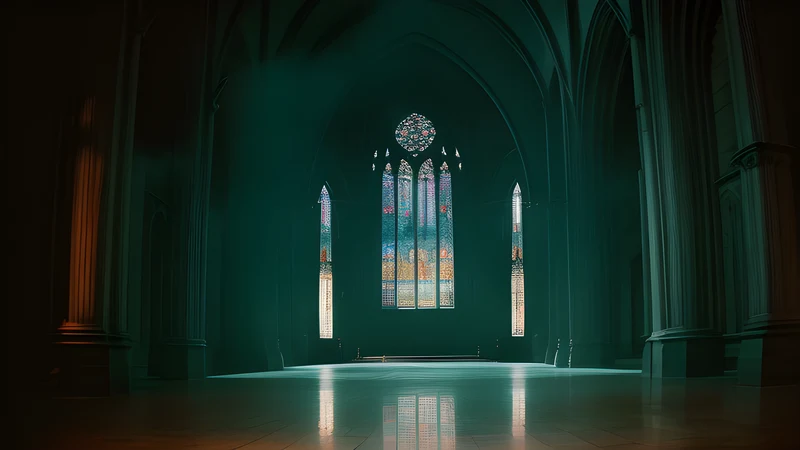
This is a superb piece of horror engineering. The building is the antagonist, the victim, the prison and the cure at once, and Soavi shoots it accordingly: from the vaulting, from under the flagstones, in long sinuous moves that treat the architecture as anatomy. Renato Tafuri’s photography turns Gothic stone into something wet and organic. The frescoes on the walls are the film’s memory, and Lisa the restorer (Barbara Cupisti) spends the picture literally cleaning the past until it becomes visible.
The possessions themselves are staged as visions rather than attacks — a woman’s congress with a goat-headed thing, faces flowering into something else, a chain of hallucinations that reach openly for Bosch and for Fuseli’s The Nightmare. Soavi is more interested in the iconography of damnation than in the mechanics of a body count, which is why the film’s pacing frustrates viewers who arrive expecting Demons and its cinema full of infected teenagers.
The soundtrack nobody would greenlight now
The score is credited to Keith Emerson, Philip Glass and Goblin’s Fabio Pignatelli, which is an absurd sentence and a completely accurate one. Emerson supplies the prog-liturgical bombast, Glass’s minimalist repetitions supply the dread, Goblin supply the pulse. It should be a disaster. It works because the film is itself a collision of registers — a splatter sequel wearing a cathedral — and the music refuses to resolve the argument.
The cast helps. Hugh Quarshie plays Father Gus as a sceptical, physical, deeply unhappy priest; Feodor Chaliapin Jr, three years after The Name of the Rose, brings the bishop the weight of a man who has read the file. And a thirteen-year-old Asia Argento, in one of her first roles, plays Lotte, the sacristan’s daughter — the only character in the building who treats the cathedral as a place to live in rather than a mystery to solve.
Where it stumbles
The film has one real structural problem and it is worth naming rather than excusing. Soavi locks a dozen people in his cathedral and gives almost none of them a life to lose. The wedding party, the schoolchildren, the models — they exist to be present when the doors close, and the middle third circles them without ever settling long enough for a single one to become a person. Compare the trapped ensemble in Carpenter’s church basement, where every character has a job, an opinion and a reason to be sceptical; Soavi’s crowd is scenery with faces. The consequence is that the possessions land as images rather than as losses, and a film with this much visual conviction should have been able to break your heart as well as your nerve.
The distributors read the same weakness and reacted by dragging it backwards. In several territories it went out with the franchise bolted back on — Demons 3 on the poster, promising the cinema-of-the-damned splatter that Soavi had deliberately walked away from — and audiences who bought that ticket got a slow Gothic meditation on institutional guilt instead. It underperformed, which is what happens when a distributor sells the film the director refused to make.
The real ancestor
The film everyone should reach for is John Carpenter’s Prince of Darkness (1987), released two years earlier: an ancient evil sealed in a church basement, a group of specialists locked in with it overnight, and possession spreading through the party while the institution that has been guarding the secret for centuries proves useless. Soavi’s film is the Gothic European answer to Carpenter’s Californian one — the same premise, argued in stained glass instead of quantum physics.
Behind both stands Ken Russell’s The Devils (1971), which established that the most disturbing thing you can put on screen is a consecrated building full of people losing their minds inside it. And the mass-grave prologue is descended from the Italian Gothic proper — Mario Bava’s witch-burnings, the idea that a crime committed centuries ago is still structurally load-bearing.
Soavi made one more masterpiece, Cemetery Man (1994), and then largely left the genre for television, which remains a loss. The Church was the middle of his short, brilliant run, and it is the film where you can watch a director realise he is better than his brief.
Spoilers below
The trap closes and stays closed, and the film’s endgame is a genuine moral problem rather than a chase.
Once the seal is broken and the cathedral locks itself, the possessed inside are past saving. Evan is gone early; the congregation goes one by one; the building fills with people who used to be people. Father Gus works out what the bishop already knows: the architect left a way to bring the whole structure down, and using it means killing everyone still inside, the innocent along with the damned, plus whoever pulls it.
Gus goes down and does it. The cathedral collapses on the demons, on the trapped, and on him — a priest destroying a church to keep hell in the ground, which is about as bleak a resolution as Catholic horror has ever committed to. There is no exorcism and no rescue. The institution’s only functioning tool is demolition.
Lotte survives, because Soavi gives the escape to the child who knew the building rather than to any of the adults who came to study it. That is a proper piece of thematic bookkeeping: the prologue’s murdered girl and the film’s living girl rhyme across seven hundred years, and this time the child gets out.
Then the coda declines to close the door. The film’s last movement makes it unambiguous that the seal is back in the world and that what the knights buried has only been postponed again — the same bargain, handed forward to whoever is next. It is the most Italian-horror ending imaginable and the correct one for a film whose entire subject is the idea that you cannot build over a crime, you can only build over it again.
Where to watch: a restored transfer is essential — the film is composed in deep shadow and the old tapes turn Tafuri’s photography into soup. Watch it as a double bill with Prince of Darkness and see which one frightens you more; my money is on the one with the better architecture.
Related Content