The Children (1980): The Radioactive Schoolbus Kids
A nuclear leak, an empty bus, and the most upsetting hug in horror
Contents
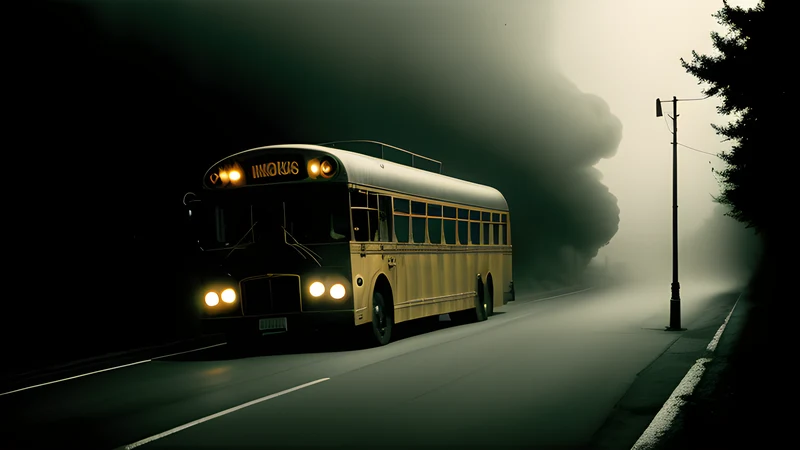
The image is perfect and the film knows it. A yellow school bus sits on an empty country road with its door open and nobody inside. There is fog. There are no bodies, no blood, no sign of struggle. A busload of children has simply stopped existing at that spot, and the adults who find the bus have to stand there and work out what to do with a fact that has no shape.
The Children (1980), directed by Max Kalmanowicz, spends the rest of its runtime failing to live up to that image, and being interesting the whole way.
The premise, and the thing it does right
A leak at a nuclear plant releases a cloud across a rural road in the fictional town of Ravensback. The school bus drives into it. The children come out the other side changed: pale, slow, black-fingernailed, and affectionate. They want to be held. Anyone they hold is cooked alive.
That last detail is the film’s one genuinely inspired idea, and it is worth sitting with, because it inverts the entire grammar of the killer-child picture.
The standard move — Village of the Damned, The Omen, the whole lineage — is to make the child cold. The horror is withdrawal: a small person who looks like your child and has nothing behind the eyes. It works by removing the thing that makes a child a child.
Kalmanowicz’s children are not cold. They are warm. They walk towards adults with their arms out, smiling, doing the exact thing a small child does when it wants comfort, and the correct parental response — the automatic, physical, unthinking one — is the thing that kills you. The film weaponises the reflex to pick up a child.
There is a scene where a mother sees her own daughter walking towards her out of the trees, arms up. Everything the film has told us says run. Everything a parent is says do not run. The film sits in that gap and lets it stretch, and no amount of shonky production value dents it. That is a real horror idea, arrived at by a small production in upstate New York, and it is better than the idea in most films with fifty times the money.
Why it works: Manfredini, and the sound of an approaching hug
The score is by Harry Manfredini, and this matters more than a credit-list footnote suggests. Manfredini scored Friday the 13th the same year — the whispered percussion that became the most recognisable horror cue of the decade — and the two films are, in sound design terms, a fascinating pair.
Friday the 13th uses sound to tell you the killer is present. It is a warning system: the audience hears what the characters do not, and the tension is the gap between our knowledge and theirs.
The Children uses its score for the opposite job. The cue that accompanies the kids is not a warning. It is a lullaby that has gone slightly wrong — sweet in construction, sour in execution, arriving with the children rather than ahead of them. You do not hear it and think danger approaching; you hear it and feel the wrongness of something you are supposed to find comforting. It is the aural version of the film’s whole thesis, and Manfredini gets there with very little.
The visual craft is thinner but has one reliable trick: Kalmanowicz shoots the children low and small in wide shots, at genuine child scale, in real daylight, in a real town. They are never lit like monsters. They are lit like kids in a home-movie, and then they do the thing.
The blackened fingernails are the only makeup effect of consequence in the film. The restraint is accidental; the budget simply did not permit anything else. It lands anyway, because a child who is entirely normal apart from one small detail is more disturbing than a child covered in prosthetics.
The regional-horror texture
The Children belongs to a category that barely exists any more: the American regional horror picture, made outside any studio system, in a real town, by people who lived near it.
This is why the film looks the way it does. The houses are somebody’s houses. The road is a road. The extras have the faces of people who were not cast. There is no production design in any meaningful sense — the camera has been pointed at rural New England and the film has accepted whatever was there. That approach ruins a film that needs atmosphere built for it, and it enormously flatters a film about children walking out of ordinary trees towards ordinary parents.
Compare what a studio would have done with the same script in 1980. The bus would be lit. The fog would be motivated. There would be a scene establishing the plant’s negligence and a second scene where a scientist explains the contamination in dialogue that tests well. Every one of those improvements would move the film further from the thing that works, because the thing that works is the total absence of cinematic reassurance. Nothing in the frame has been arranged to be watched, so nothing in the frame is protecting you.
The trade-off is severe and worth naming honestly: the same conditions that produce the texture also produce the performances, and you cannot have one without the other. A regional production casts locally and shoots fast. What you get is authenticity and amateurism arriving in the same take, often from the same actor, sometimes in the same line. Anyone who came up on video-shop horror learned to read past this early — the tapes were full of it — and the reward for reading past it here is a premise nobody with money would have been brave enough to shoot.
The collector’s cross-reference
The direct ancestor is Village of the Damned (1960) and, more precisely, its ugly, forgotten sequel Children of the Damned (1964). The nuclear framing puts it in conversation with the 1950s atomic cycle, where radiation made things large; the 1980s update makes radiation make things intimate, which is a fair index of how the fear had migrated in twenty-five years.
The film sits in the same American-anxiety moment as Dawn of the Dead — read the mall as the real monster for how that generation of horror aimed its contempt at institutions rather than individuals. Where Romero’s dead are a crowd, Kalmanowicz’s are your neighbours’ kids by name, which is a smaller and meaner target. For the wider lineage this film belongs to, see the killer-kids canon.
There is also a structural debt to Halloween, released two years earlier, and specifically to Loomis: the film hands its sheriff (Gil Rogers) the job of being the one adult who works out the rules and then has to persuade everyone else, on no evidence, that the rules are true.
The case against
Almost everything except the idea.
The acting ranges from serviceable to genuinely poor. The dialogue is functional at best. The pacing is repetitive — the film discovers its structure in the first twenty minutes and then executes it identically five times, and by the fourth encounter you are ahead of it in a way the film never anticipates.
More damagingly, the film keeps forgetting to be frightened of its own premise. There are stretches where the children are treated as generic monsters to be dispatched, and the moment they become monsters they stop being children, and the moment they stop being children the film has thrown away the only thing it had.
The nuclear framing is also pure set dressing. The plant appears, leaks, and is never mentioned again in any way that carries weight. A film genuinely interested in the politics of a nuclear leak would have made the plant a character; this one uses it as a starting pistol.
Watch it anyway, and watch it for the arms-out shots. A film with one great idea and no ability to execute it is a specific and valuable pleasure, because you can see the idea clearly. Nothing is in the way.
Where to find it
It circulated hard on video and has since had a decent restoration; it appears on the horror streaming services and on disc. The fog and the daylight both benefit from a clean transfer.
Spoilers below
The rule the film eventually lands on is the reason anyone remembers it: the children cannot be shot, stabbed or burned to death. The only way to stop them is to remove their hands.
That is a grotesque and rigorous piece of internal logic. The hands are the weapon; the affection is the delivery mechanism; so the film’s heroes spend the third act going through a small town with a sword and a machete, amputating the hands of primary-school children. The sheriff does it. A parent does it. The film asks its adults to do the single most transgressive thing an adult can do to a child, frames it as the responsible choice, and is completely straight-faced about it.
It is also where the film’s cheapness turns into an asset. The amputations are staged crudely, in flat light, with effects that convince nobody — and the crudeness makes the scenes worse rather than better, because there is no craft to admire and therefore no distance to hide behind. You are just watching adults hack the hands off kids in a field.
The ending seals it. The last movement centres on a newborn — the one child not on the bus — and closes on the possibility that the contamination has arrived anyway. There is no cure, no containment, no reassurance that Ravensback is done. The nuclear plant, incidentally, is never held to account by anyone. Nobody investigates it. The film’s final position is that the institution which caused this walked away, and the parents did the killing.
Related Content