The Chaser: The Serial-Killer Thriller That Sprints
Na Hong-jin's debut swaps the brooding procedural for a foot race through the hills of Seoul
Contents
Most serial-killer films are patient. They dole out the body count, tease the identity, and save the confrontation for the last reel. Na Hong-jin’s 2008 debut The Chaser does something almost reckless: it catches the killer at the halfway mark, tells you who he is, and then discovers it has a much worse story on its hands. What do you do when you have the monster in a cell and no evidence to hold him, and a victim who might still be alive somewhere in the dark? The film’s answer is to run — literally, up and down the steep alleys of a Seoul hillside — until your own legs ache.
A pimp, a cop’s instinct, and a bad night
The hero, if that word survives contact with him, is Eom Joong-ho, played by Kim Yoon-seok as a bull of a man with a wrecked conscience. He is a former detective now running a small ring of call girls, and lately his girls have been vanishing. Joong-ho assumes, in his self-interested way, that someone is selling them off behind his back, and the loss is cutting into his income. On a rainy night he sends out one of his few remaining girls, Mi-jin, to a client whose phone number he notices matches the last calls received by the women who disappeared.
The client is Je Yeong-min, played by Ha Jung-woo in a performance of eerie, boyish blankness. Through a sequence of near-misses and hard, ugly violence, Joong-ho collides with Yeong-min and brings him in — and here the film pivots. Yeong-min, questioned, calmly claims to have killed the missing women. The police, however, cannot make it stick; the evidence is thin, the confession slippery, and Korean law puts a clock on how long they can hold him. Meanwhile Mi-jin may still be breathing, wounded and hidden somewhere in the maze of the neighbourhood. Joong-ho, the disreputable ex-cop, is the only person truly motivated to find her, and he is racing both the killer’s silence and the incompetence of the system that is about to let the man walk.
Why it works: catch the killer, lose the safety net
Na Hong-jin’s structural gamble is the whole review. By identifying the killer early and removing the mystery, The Chaser strips away the genre’s usual source of suspense and replaces it with something far more agonising — the ticking possibility of rescue. We know who did it. We know he is caught. And we have to watch that knowledge count for nothing against paperwork, procedure, and time. The film generates more tension from a prosecutor’s shrug than most thrillers get from a chase, because the audience is screaming at a solvable problem that the machinery of justice cannot solve fast enough.
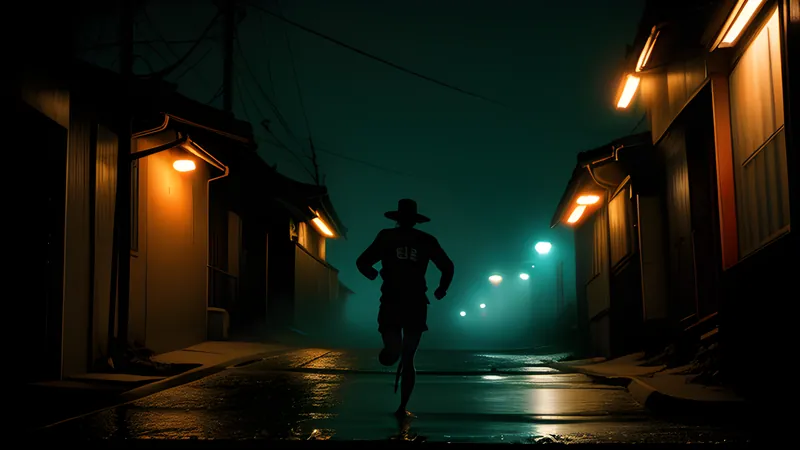
The craft lesson worth stealing is the film’s use of geography as suspense. The action is anchored in the hilly, tangled Mangwon-dong district, all narrow staircases, blind corners, and rain-slicked slopes, and Na shoots the pursuits so that you always feel the incline in your calves. When Joong-ho runs, he runs uphill, slipping, and the physical cost of every chase is right there on screen. The film’s most celebrated sequence is a foot chase down a series of alleyways that has real weight because the space is legible — you understand the layout, the dead ends, the distance closing and opening. This is action built on architecture, and it is why the set-pieces exhaust you.
Na also understands that dread lives in the mundane. Some of the film’s most unbearable scenes are administrative — a detained suspect eating a meal while a clock runs down, a detective realising the address on file is wrong, a bureaucratic form standing between a man and a girl bleeding out somewhere close by. By rooting the horror in procedure and delay, Na makes institutional slowness itself the antagonist, and the effect is a queasy realism that a more stylised film could never reach. The rain barely stops; the neighbourhood feels lived-in and grimy; nobody in this Seoul is glamorous. It is a debut with the confidence to let ordinary incompetence be the scariest force on screen.
Kim Yoon-seok carries the film on sheer physicality and a slow-burning moral awakening; Joong-ho begins as a man chasing money and becomes, almost against his own nature, a man chasing a life. Ha Jung-woo’s killer is the anti-showman, ordinary to the point of being invisible, which is precisely what makes him frightening — Na denies us the theatrical genius-murderer and gives us a bland young man with dead eyes. The film is loosely inspired by the real Korean serial killer Yoo Young-chul, and it keeps that grubby, plausible texture throughout.
The films it comes from, and its close cousins
The obvious ancestor, and the film every review reaches for, is Bong Joon-ho’s Memories of Murder, the 2003 masterpiece that turned a real unsolved Korean case into a national elegy about institutional failure. Na inherits Bong’s disgust at a justice system that fumbles the monster, but where Bong’s film is a mournful procedural about not knowing, Na’s is a howl about knowing and being powerless anyway. The two make a definitive Korean double bill on the limits of the law.
Look wider and you can see The Chaser in conversation with David Fincher’s Zodiac, another film obsessed with the maddening gap between certainty and proof, though Fincher is glacial where Na is frantic. And within the Korean crime cycle, The Chaser is the sweat-soaked, ground-level counterweight to the lacquered cool of A Bittersweet Life and the operatic cruelty of I Saw the Devil, the latter another Korean serial-killer film that shares this one’s willingness to sit inside genuine dread.
Na Hong-jin would go on to make The Yellow Sea (2010) and the extraordinary The Wailing (2016), and you can see the whole director already present here: the physical filmmaking, the moral queasiness, the refusal of comfort. For readers building a Korean watchlist from scratch, I mapped the essentials in Korean genre cinema: ten to start with.
The verdict
The Chaser is one of the great debut thrillers, a film that reinvents the serial-killer picture by throwing away its biggest card in the first half and betting everything on desperation. It runs on pure kinetic dread and a rising fury at a system that cannot move fast enough to save an innocent woman. Watch it for Kim Yoon-seok’s brute, awakening humanity, for a foot chase that belongs in any highlight reel of the form, and for the way Na Hong-jin turns a Seoul hillside into a labyrinth you cannot escape. It sprints from the first reel and never lets your pulse settle, and it announced one of the most exciting directors of his generation in a single, breathless stroke.
Spoilers below
The film’s masterstroke — and its cruelty — is that it refuses the rescue it dangles in front of you the whole way. Mi-jin does not survive. In one of the most devastating reversals in modern thriller cinema, she has actually managed to escape Yeong-min’s house on her own, badly wounded, and reaches a nearby shop; but through a chain of ordinary human failures — a shopkeeper’s hesitation, bad timing, the killer released and back on the streets because the police could not hold him — Yeong-min finds her again and finishes what he started. The audience has spent the film willing Joong-ho to reach her in time, and Na lets the clock run out anyway, punishing our hope for hoping.
The revelation of the killer’s method is deliberately anticlimactic and all the more sickening for it: no grand design, no game, just a man with a hammer and chisel and a house full of the evidence the police failed to search in time. When the full horror is finally uncovered, it lands as an indictment of the delay rather than a twist.
The ending gives Joong-ho his confrontation, and it is drained of triumph. He gets to the killer, and whatever violence he delivers cannot undo the failure that let Mi-jin die on his watch — a death he is partly responsible for, since it was he who sent her out that night. Na closes on a note of exhausted grief, a man who won the chase and lost the only thing that mattered. Pair it with Memories of Murder for a night that will leave you furious at every institution that was supposed to help.
Related Content