The Changeling: The Ghost Story With the Best Séance in Film
Peter Medak's 1980 haunted-house classic proves restraint is the loudest thing a ghost can do
Contents
Ask people to name the great haunted-house films and the same titles come round: The Haunting, The Innocents, maybe The Others. Peter Medak’s The Changeling, made in Canada in 1980, belongs in that company and is too often left off the list, which is a minor injustice, because it contains the single most frightening séance ever committed to film and a lead performance of shattering restraint from an actor most people associate with generals and bluster. It is the ghost story for grown-ups, and it works by whispering.
The premise is grief. John Russell, a composer played by George C. Scott, loses his wife and young daughter in a road accident in the film’s opening minutes — a snowbound, wordless catastrophe that hangs over everything after. To escape the memory he relocates across the country and rents an enormous, near-empty Victorian mansion, the kind of house that echoes when a man lives in it alone. The house has been empty for twelve years. It does not intend to stay quiet.
A ghost that grieves
What separates The Changeling from the haunted-house pack is the temperament of its ghost and the temperament of its haunted man, and how well they are matched. Russell is not a sceptic to be converted or a fool to be punished. He is a bereaved father who has already lost everything a house could threaten him with, which makes him the wrong man to frighten and the right man to listen. When the disturbances start — a banging in the pipes that arrives every morning at the same hour, a ball that returns after he has thrown it into a river, a locked attic room — Russell responds with a musician’s attention. He treats the haunting as a signal to be decoded, and the film follows his investigation with the patience of a procedural.
The ghost, correspondingly, is not malevolent so much as desperate. It wants something. The house is not trying to drive Russell out; it is trying to make itself understood, and the horror comes from the slow, awful clarity of what it is trying to say. Medak and his screenwriters — working from a story the writer Russell Hunter claimed derived from his own experiences in a house in Denver — grasp that a ghost with a grievance is far more frightening than a ghost with an appetite, because a grievance implies a story, and the story here is one of the ugliest a house can hold.
The séance
Every claim I have made for the film rests on one sequence. Roughly midway through, Russell, unable to interpret what the house wants, brings in a medium to conduct a séance in the mansion, and Medak stages it as a masterclass in mounting dread. The medium enters a trance and produces automatic writing, page after page, while the participants sit in the ordinary lamplight of an ordinary room. There is no fog, no floating furniture, no music cue telling you to be afraid.
The masterstroke is the tape recorder. Russell has been recording the session, and when he plays it back later the film delivers its coldest shock: beneath the medium’s murmuring voice, on the tape, is another voice answering — a child’s voice, thin and frightened, that no one in the room heard at the time. The horror lives in the playback rather than the séance itself, in the discovery that something was speaking in that room the whole time and only the machine caught it. It is a purely cinematic idea — sound as revelation, the recording that knows more than the ear — and no haunted-house film before or since has executed it with such nerve. The scene works because Medak has spent forty minutes teaching you that this film does not cheat, so that when the child’s voice surfaces you believe it completely.
Why it works
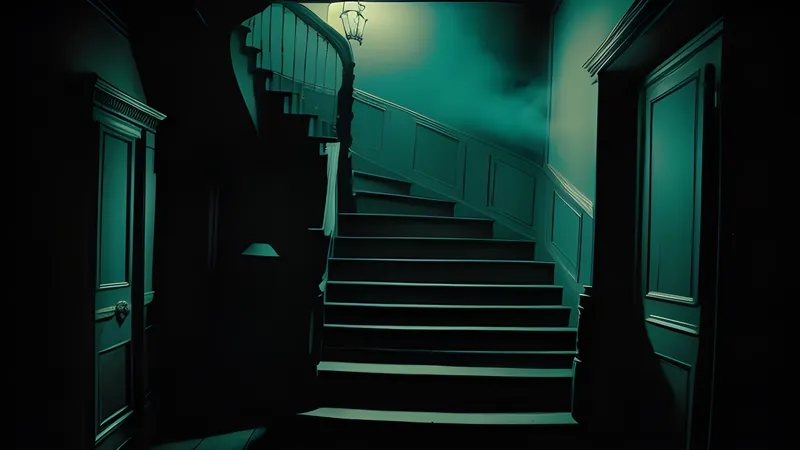
The film’s power is a matter of withholding. Medak, shooting in a real mansion with cinematographer John Coquillon — a Sam Peckinpah regular, which tells you something about the film’s grounded, unfussy eye — keeps the camera calm and the house cavernous, and lets empty space and long corridors do the frightening. The famous images are simple household objects made wrong: a child’s rubber ball bouncing down a grand staircase, a wheelchair that moves on its own, a small hand-print where none should be. Rick Wilkins’s sombre score and the enormous, echoing sound design turn silence into a substance you can feel pressing on the room.
George C. Scott is the film’s anchor and its dignity. This is an actor who could dominate any frame he chose, playing a man too grief-hollowed to raise his voice, and his restraint gives the supernatural somewhere solid to push against. Trisha Van Devere — Scott’s real wife — plays the estate agent who helps him, and Melvyn Douglas, near the end of a long career, lends the film’s later movement a weight of American history it turns out to need.
The lineage is clear and worth following. The Changeling descends directly from the “less is more” ghost tradition of Robert Wise’s The Haunting, which frightened audiences in 1963 without ever showing the thing, and from the psychological ambiguity of The Innocents. It sits alongside the earlier Hollywood ghost story that took its haunting seriously, The Uninvited, as one of the few American films to treat the form with real gravity. And its influence flows forward into the modern haunted-house revival — the bangs, the séances, the wronged child of the Insidious and Conjuring films are all drinking from Medak’s well, usually with more noise and less discipline.
An unlikely classic
It is easy to forget that The Changeling emerged from the Canadian tax-shelter boom of the era, the wave of financing that produced a great deal of forgettable product and a handful of durable films. This is the jewel of that period: when the first Genie Awards were handed out, The Changeling took Best Motion Picture, and the recognition has aged better than most, because the film’s virtues are the kind that do not date. Medak, a Hungarian-born director whose career ranged widely and unevenly, never made anything else this controlled, and the picture stands slightly apart from his filmography as a lightning-strike of tone and discipline.
Part of why it endures is that its central image — a house that will not let a buried injustice stay buried — is older than cinema and travels across every tradition of the ghost story. It is the same engine that drives the vengeful dead of the great Japanese ghost films, where a wrong done in life keeps the spirit tethered to the world until the debt is acknowledged. Medak simply relocates that ancient shape to a cold North American mansion and a modern man with a tape recorder, and finds that it loses none of its force.
Where to watch, and what to bring to it
The Changeling has been beautifully restored in recent years, and it deserves a dark room and full attention, because its scares are architectural and quiet and a distracted viewing will flatten them. Bring patience; the film builds like a piece of music, which is fitting for a story about a composer, and its terrors are cumulative. It will not assault you. It will get slowly, coldly under your skin and leave a chill that outlasts louder films by hours.
If the modern haunted house has taught audiences to expect a jump every ninety seconds, The Changeling is the corrective — proof that a ghost story reaches its greatest intensity when it trusts the audience to lean forward into the silence. It is a film about a man who listens, made for viewers willing to do the same.
Spoilers below
What the house wants Russell to uncover is a murder. The ghost is Joseph Carmichael, a chronically ill child who, decades earlier, was drowned in a bath by his own father out of cold financial calculation. The boy stood to inherit a large fortune under the terms of a trust, and the father killed him and secretly replaced him with a healthy orphan, a “changeling” who could pass as the heir and claim the money and grow up as someone else entirely. The real Joseph was buried, his existence erased, and his small body sealed away while an impostor lived his life and spent his inheritance. The banging, the ball, the drowned voice on the tape are all the murdered child trying, across sixty years, to make someone find him.
The film’s masterstroke is that the changeling is still alive. The healthy boy who took Joseph’s place grew up to become Senator Joseph Carmichael, played by Melvyn Douglas — a pillar of the community whose entire life, fortune and name are built on a dead child no one ever knew existed. Russell’s investigation is therefore not only a matter of laying a ghost to rest; it drags a powerful, respectable old man face to face with the fact that he is not who he has always believed himself to be, and that his whole existence is a theft from a murdered boy. The horror deepens because the villain is not evil in the ordinary sense — the Senator is himself a victim, a substituted child who never knew — and yet the wronged ghost cannot rest while the fruits of the crime still walk the earth. Medak grants the haunting its purpose and its release: the truth surfaces, the lie collapses, and the little ghost that only wanted to be found is finally, after sixty years in the dark, allowed to stop knocking.
Related Content