The Blackcoat's Daughter: Perkins's Frozen Convent Dread
The boarding-school possession film that sat on a shelf for two years and came out a classic
Contents
Osgood Perkins premiered his first feature at Toronto in September 2015 under the title February. It then vanished. A24 and DirecTV eventually pushed it out in 2017 as The Blackcoat’s Daughter, by which point Perkins had already shot and released a second film, and the whole affair had acquired the faint smell of a distributor who could not work out what they had bought. What they had bought was one of the most controlled horror debuts of the century, and a film so uninterested in reassuring an audience that the delay is almost self-explanatory.
The setup is bare. Bramford is a Catholic girls’ boarding school somewhere in upstate New York — the film was shot in Ottawa, and the Ontario winter does more acting than most of the cast. Winter break begins and two students are left behind because their parents have failed to arrive: Rose, an older girl played by Lucy Boynton, who has her own reasons for wanting the delay, and Kat, a younger one played by Kiernan Shipka, whose parents have not come and whose reason is worse. Two nuns remain in the building. Somewhere else, a young woman called Joan, played by Emma Roberts, is travelling in the cold with no clear destination. The film cuts between these strands, names them in chapter cards, and declines to explain the relationship between them for a very long time.
The coldest film in the drawer
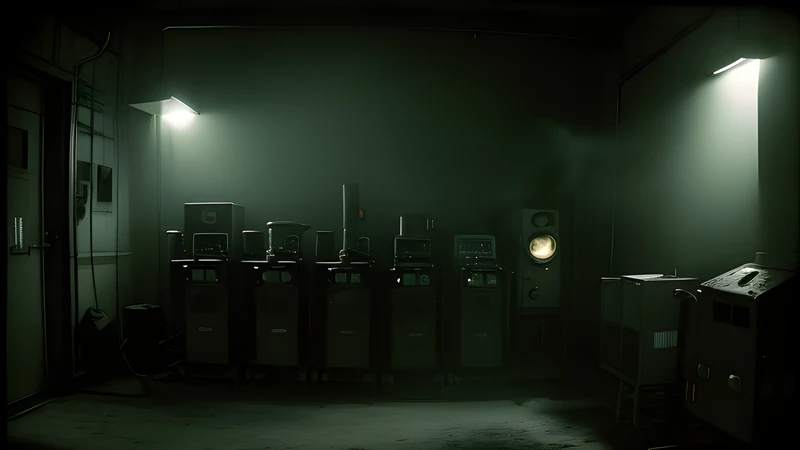
Perkins’s tempo is glacial in a way that goes beyond slow. Julie Kirkwood’s photography keeps the school at a distance — corridors framed head-on and held, figures placed small in the bottom of the frame with a weight of empty air above them, a palette drained to grey-blue and the particular dead white of snow under cloud. There is no warmth anywhere in the image. Even the interiors, which should be the refuge, are lit like a building that has been told the heating budget ends on Friday.
The compositional habit is the giveaway. Perkins repeatedly places a character at the edge of a wide shot and leaves the centre empty. Your eye, trained by a century of cinema to read the centre as the subject, keeps drifting into that vacancy. Nothing is put there. He does this dozens of times before anything ever occupies the space, which means that by the time something might, the audience has been conditioned into a permanent low-grade scan. It is the same principle Ti West works in The House of the Devil, executed with a colder hand — West wants you leaning forward, and Perkins wants you braced.
Shipka is the reason it holds. She had spent seven years as Sally Draper on Mad Men, and she brings a very specific skill to Kat: the ability to play a child who has already worked out that adults are not going to help. Her performance is almost affectless, and she calibrates it so that the flatness reads first as grief, then as something with an appetite. She does the whole thing with her chin and her eyeline. Boynton’s Rose has the harder job — she is the audience’s proxy, and Boynton plays her contempt for Kat as ordinary teenage carelessness, which makes it far more damning than cruelty would be. Roberts, cast against the register she was known for, plays Joan as a person who has been sedated for a long time and is deciding, moment to moment, how much of herself to show.
The sound is the possession
The score is by Elvis Perkins, the director’s brother, and it is the film’s genuine innovation. It is barely music. It is a low, grinding, mechanical drone that seems to come from the building’s plant rather than the soundtrack — furnace noise, metal under stress, something breathing at the bottom of the mix. Perkins scores rooms rather than scenes. The effect is that you cannot locate the threat in the film’s grammar, because the usual contract, where the score tells you what to feel and when, has been withdrawn and replaced with what sounds like an HVAC fault.
He goes further. In several stretches the drone rises under a scene of total banality — a girl walking to a bathroom, a phone call — and then simply stops, without resolution, when the scene ends. Nothing has happened. The score has lied, and it lies so consistently that it stops being a lie and becomes a description of the building’s mood. The furnace in the basement is the loudest character in the film and it never appears until it matters. That is a real craft idea, executed by someone who understood that a possession film is fundamentally about a noise in a house.
The Perkins inheritance
The school is called Bramford. The Bramford is the apartment building in Rosemary’s Baby, and Perkins is not being coy — he is filing his paperwork. The debt is real and specific: what both films understand is that the devil’s most effective tool is an institution full of polite people who have already decided what a young woman is for. The desk has argued the mechanics of that at length in Rosemary’s Baby and the horror of being not believed, and The Blackcoat’s Daughter is its most severe descendant.
The biography is unavoidable and Perkins has never pretended otherwise. His father, Anthony Perkins, died in 1992; Osgood was eighteen. His mother, the photographer and actress Berry Berenson, was aboard American Airlines Flight 11 on 11 September 2001. Osgood himself played the young Norman Bates, in flashback, in Psycho II in 1983. A man with that inheritance making a film in which a child is destroyed by parents who never arrive, and in which the horror is finally indistinguishable from bereavement, is not doing therapy on screen; he is using the only material he has with any authority. The film’s most frightening idea is that being abandoned and being possessed feel the same from inside.
The real ancestor
The convent-horror shelf is the obvious place to look, and the desk has surveyed it in nunsploitation and the convent as a horror engine, though Perkins takes nothing from that tradition’s heat and everything from its architecture: the corridor, the rule, the locked institution that stands between a girl and the world.
The truer ancestor is Repulsion. Polanski’s film is the template Perkins is working from — a young woman alone in a building, a camera that observes rather than sympathises, and a horror that could be an intrusion from outside or a collapse from within, with the film refusing to say. And the institutional strand runs through Session 9: the boiler room, the sense that the building’s mechanical underside is where the thing lives, the dread manufactured out of a place designed for people and currently containing almost none.
The case against
The film is punishing, and some of the punishment is unearned. Perkins withholds so aggressively that a first-time viewer spends forty minutes without a stable idea of what the film is even about, and the reward for that patience arrives in a single late structural move — a good one, but one that has to justify a great deal of preceding opacity. There is a fair charge that the film mistakes withholding for depth, and that a second viewing, which recontextualises everything, is doing work the first viewing should have done itself.
The chapter cards are also a slight cheat. They signal a formal rigour that the film’s actual construction, which depends on a concealment, does not entirely honour.
I take the point and I still think it is the best directorial debut in American horror since the turn of the century, because of where it finally lands. Almost every possession film is about the fight to expel the thing. Perkins made the only one I know that is about what happens after you win, and it is devastating. The film’s coldness is a preparation for a final image of pure, unbearable loneliness, and everything grey and slow and withheld in the preceding ninety minutes exists to make that image land. He would rework the same grief in gentler form in I Am the Pretty Thing That Lives in the House the following year. This is the version with no comfort in it at all.
It streams and discs under the Blackcoat’s title; the February prints are the same film. Watch it alone in bad weather. Watch next: Repulsion for the method, Session 9 for the boiler room.
Spoilers below
Joan is Kat. The three strands are not concurrent — Rose and Kat’s story happens over one winter break, and Joan’s happens nine years later, after Kat has spent that time in a psychiatric institution and escaped from it. Emma Roberts and Kiernan Shipka are playing the same person, and Perkins hides it in plain sight by shooting Joan’s strand in the same weather as the other.
What happens at Bramford is that Kat, whose parents are dead in a car accident she has somehow already sensed, is taken by something in the furnace. She kills Rose. She kills both nuns. She beheads them and arranges the heads in front of the boiler, in an act of worship that the film shoots with almost no emphasis at all — a wide shot, a held frame, the furnace noise rising. Then a priest exorcises her, and the thing leaves.
That is the reveal that reorganises the film, and it is not the ending. The ending is what Joan does with her nine years of freedom. The couple who pick her up hitchhiking, Bill and Linda, played by James Remar and Lauren Holly, are Rose’s parents. They are driving to Bramford for the anniversary of their daughter’s murder, and Linda knows exactly who is in the car — Remar plays Bill’s kindness as genuine and unwitting, which makes it worse. Joan kills them both and brings their heads back to the school, to the boiler, and offers them.
And nothing comes. The devil does not return. Perkins’s last movement is a woman kneeling in the snow outside a school, having murdered four people across nine years in an attempt to be repossessed, weeping and begging the thing that ruined her to come back — because it was the only entity that ever wanted her, and being emptied of it is worse than being filled. The exorcism worked. That is the horror. Every cold, vacant, over-wide frame in the film has been building a space for something to occupy, and the final shot is that space staying empty forever.
Related Content