The Big Combo: The Noir of Light and Shadow
Joseph H. Lewis and John Alton had almost no money and one great asset — the dark — and they spent it like millionaires
Contents
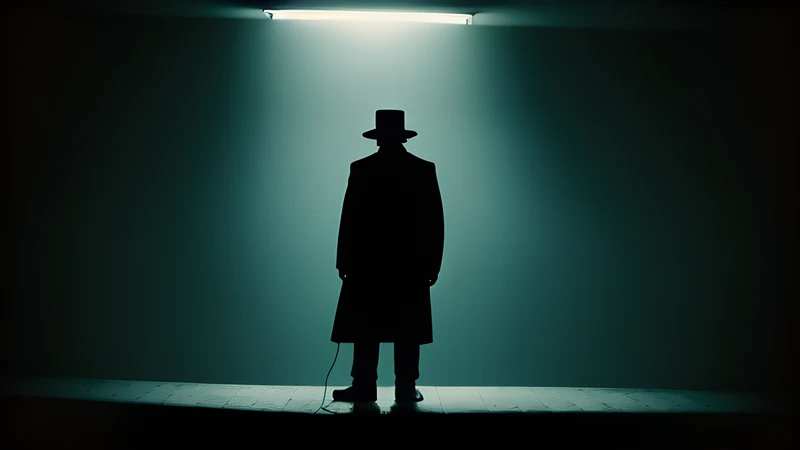
There is a moment in The Big Combo when a man stands in a pool of light with absolutely nothing around him — no wall, no furniture, no visible room, just a body and a lamp and a void that swallows everything past a metre of the lens. It is one of the most famous images in American cinema, and the reason it exists is that Allied Artists did not give Joseph H. Lewis enough money to build a set. John Alton, the cinematographer, worked out that if you light one thing and let the rest fall to black, the audience will assume the room is there. The film is a masterclass in turning a shortage into a style, and it is the reason a modest 1955 crime picture is still the first thing people reach for when they want to show someone what noir looks like.
By 1955 the cycle was ending. Television was taking the audience for the mid-budget crime film, the studios were retooling for colour and width, and the shadowy urban thriller was on its way to becoming a museum object. The Big Combo is one of the last of the line, and it plays like a film that knows it — pushed further, nastier, and more stylised than the cycle’s mid-period would have permitted.
Diamond, Brown, and the woman in between
Lieutenant Leonard Diamond (Cornel Wilde) is a policeman conducting what his own department regards as a vendetta. His target is Mr. Brown (Richard Conte), the head of a criminal organisation the film calls the combination, and the case against him is going nowhere at considerable public expense. The film is honest enough to let Diamond’s superiors have the better argument for most of its running time: he has spent a fortune of the city’s money on one man, and the reason is not entirely law enforcement. Diamond is in love with Brown’s woman.
Susan Lowell (Jean Wallace) is the film’s centre and its problem. A former society girl attached to Brown by something the film treats as an addiction rather than a romance, she opens the picture running down a corridor from two men and spends it trying to get out of a life she chose. Wallace plays her exhausted, which is the right note — this is a woman who has been trying to leave for years.
Conte’s Mr. Brown is the reason the film has a reputation. He is a monster built entirely out of talk, a man who explains himself constantly, and Conte plays him as an evangelist of the will. His famous credo about first place being the only place that exists is the kind of thing a lesser actor would deliver as a snarl; Conte does it as a man sharing good news. He is charming, small, tidy, and completely without a floor.
Around them, Lewis assembles the best supporting bench in late noir. Brian Donlevy’s Joe McClure is a demoted former boss reduced to Brown’s errand-runner, deaf and wearing a hearing aid. Lee Van Cleef and Earl Holliman are Fante and Mingo, two hired guns who share a flat, finish each other’s sentences, and are coded as a couple with a clarity that 1955 was not supposed to permit — which is exactly why the film smuggles it past in the margins, and why the pair are the only characters in the picture who seem to like anybody.
Why it works: Alton makes the darkness the set
Alton had written the book — literally, Painting with Light, published in 1949 — and The Big Combo is its most extreme demonstration. His method here is subtractive. Instead of lighting a scene and then adding shadow for mood, he lights only what the story requires you to see and lets everything else go to pure black, so the frame is mostly empty. Faces arrive out of nothing. A single bulb defines a basement. A corridor becomes a shaft of light with two silhouettes in it. The technique costs nothing and buys the film production value it could not otherwise afford, because a void has no budget.
The most celebrated application is the hearing-aid sequence, and it is worth being precise about what happens, because the reputation has flattened it into simple sadism. Brown’s men interrogate Diamond, and Brown uses McClure’s hearing aid to inflict the pain — sound driven directly into the ear at volume. Lewis then does the thing that makes the scene: when the aid is removed, the film’s soundtrack drops out entirely. We are given the deaf man’s experience, silence over violence, and the effect is far worse than noise would have been. The same device recurs late in the picture with the polarity reversed, and the second use is one of the cruellest jokes in the genre. Sound design as an instrument of plot was not standard practice in a mid-budget 1955 crime film. It is here because Lewis, as in Gun Crazy five years earlier, thought hard about the one free resource available to a director with no money — in that case where to put the camera, in this case what to take away.
David Raksin’s score, all jazz brass and nerves, does comparable work, and Lewis’s staging of Susan and Brown’s scenes together carries a physical charge that got past the Code by simple omission: the camera declines to follow, and what it declines to follow is unmistakable.
The real ancestor, and what came after
The film’s obvious parent is Fritz Lang’s The Big Heat from two years earlier — the obsessive policeman, the syndicate, the woman who pays for the men’s war. Lang’s film is the more humane and the better constructed. Lewis’s is the more visually radical, and it takes Lang’s premise somewhere colder: Diamond is a considerably less admirable man than Lang’s Bannion, and the film knows it.
Its true sibling is Kiss Me Deadly, released the same year, which also treats the noir hero as a species of thug and also plays like the genre eating itself. Between them they close the cycle. Everything after is revival, homage, or neo-noir with the self-consciousness that implies — a subject the desk has picked at before in the neon problem.
Downstream, Alton’s void is everywhere. Every interrogation scene lit by one hanging bulb, every villain who materialises out of black, every music video and comic-book adaptation reaching for “noir” as an aesthetic, is quoting a man who was economising. Frank Miller’s Sin City is essentially Alton with the contrast pushed to the stops. The difference is that Alton’s blacks meant something: they were the world the characters could not see into, and the film’s whole moral position is that nobody in it knows what is a metre away.
The honest case against
The screenplay is thinner than the images. Philip Yordan’s script builds Brown magnificently and then gives Diamond very little to be beyond a fixation, and Cornel Wilde — a decent actor and a better director than he is remembered as — cannot fill the hole, because there is nothing written in it. The romance between Diamond and Susan is asserted rather than dramatised, and Susan’s motivation is handed to a psychiatric explanation that the film would have been stronger without.
There is also a stretch in the second act where the plot machinery grinds audibly, sending characters to find a name that the audience is well ahead of. And the film’s treatment of Fante and Mingo, however subversive in its coding, is finally a bit of exploitation: they are the most human figures in the picture and are disposed of with the least ceremony.
Where to find it: it fell into the public domain for years and circulated in dreadful prints, which did real damage to its reputation — Alton’s whole method dies in a bad transfer, because if the blacks lift, there is no film. Restored versions exist now and are worth seeking out specifically. Watch it dark, in a dark room.
Spoilers below
The end is a fog-bound airfield, and it is a deliberate quotation.
Brown, cornered in an aircraft hangar, tries to escape into the mist, and Lewis stages the finale with a searchlight cutting through fog and two figures walking away towards a plane. Anyone who has seen Casablanca knows this airfield. Lewis is invoking the most romantic exit in Hollywood and then denying it: nobody here is nobly renouncing anything, and the couple who walk off into the fog are a broken woman and a policeman who has behaved appallingly for two reels. The image says departure and grace; the content says two damaged people leaving a hangar with nothing settled. It is the most sophisticated thing in the film, and it works because Lewis trusts you to have the reference.
Before that comes the picture’s real gut-punch. Fante and Mingo are blown up by their own employer, and Mingo, dying, gives Diamond the name that finishes Brown — the only piece of evidence the police could not buy, beat, or deduce in ninety minutes, delivered by a man out of grief for his partner. The combination is not brought down by the law. It is brought down by the one genuine attachment anywhere in the film, and Lewis puts that attachment in the two characters the Code would not let him name.
And McClure’s death is the second half of the hearing-aid joke, the cruellest beat in 1950s crime cinema: the deaf man is executed by a firing squad after his aid is removed, so he does not hear the shots, and the film cuts the sound so neither do we. Lewis had already taught us what that silence means an hour earlier. He does not explain it. He just turns the sound off and lets the audience finish the sentence.
Related Content