The Big Clock: The Man Hunting Himself
Ray Milland runs a manhunt he must ensure fails, inside a building that keeps its own time
Contents
The premise is one of the best ever handed to a crime picture, and it is entirely administrative. A woman has been killed. A witness saw a man leaving her flat. The publisher of a magazine empire orders his star crime editor — the man whose speciality is finding people the police cannot — to identify the stranger and deliver him. The editor accepts the assignment, assembles a team, requisitions the resources of an entire building, and begins a search that he must run brilliantly and cause to fail, because the man in the witness statements is him.
The Big Clock was released by Paramount in 1948, directed by John Farrow from Kenneth Fearing’s novel, and its central situation is so strong that it has been rebuilt at least twice since, most visibly as the Pentagon thriller No Way Out in 1987. What the remakes borrow is the trap. What they cannot reproduce is the building.
A poet writes an office
Fearing was a Depression-era poet before he was a novelist, and his book is a satire of the American magazine business — a machine that converts human catastrophe into monthly circulation. Jonathan Latimer’s screenplay keeps the venom. George Stroud edits Crimeways, one title in Janoth Enterprises, and the film’s opening act establishes the operation with genuine contempt: a floor of clever people, paid well, working at speed, whose product is other people’s worst days rendered legible for a commuter.
The joke the film never stops telling is that Stroud is very good at his job. His methods work. Given a fragmentary description, a few sightings and a purchase or two, he really can find a man in a city of millions — and the film’s suspense is generated by watching a genuinely expert investigator sabotage himself from the chair at the head of the table, redirecting his own people down false corridors while they keep, infuriatingly, bringing him correct information.
Ray Milland plays Stroud with a light comic touch that is easy to undervalue. He had won an Oscar three years earlier for a serious alcoholic in The Lost Weekend, and here he does something more technically demanding: a man whose face must convey competence to the room and terror to the audience simultaneously. Milland’s performance is built on small failures of composure. He never panics. He simply stops, for a half second, at every moment a subordinate mentions a green clock or a bar or a painting, and Farrow trusts him to carry the scene without underlining.
Charles Laughton is Earl Janoth, and he is monstrous. Laughton plays the publisher with a small moustache, a soft voice and a habit of appearing behind people, and his enormous physical presence is used against type — Janoth is a big man who has learned to move quietly through his own building. The relationship with Steve Hagen, George Macready’s icy lieutenant, is the film’s other real subject: two men bound by something that has nothing to do with publishing, and Macready plays devotion as a kind of chill.
Why it works: the building is the antagonist
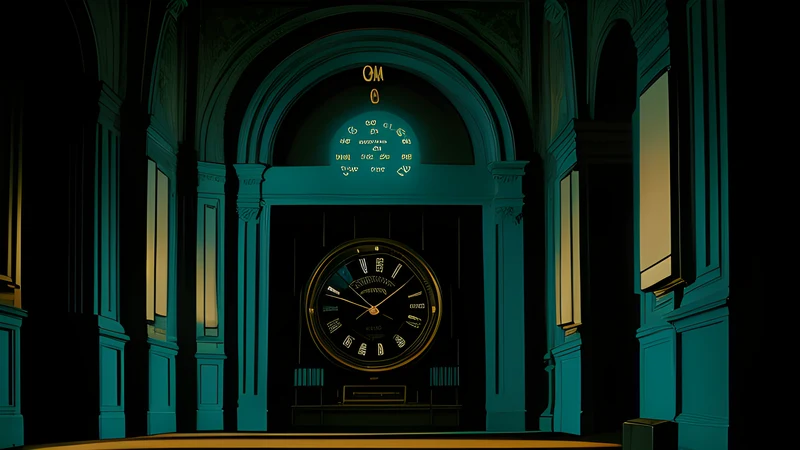
The clock of the title is a master timepiece in the lobby of the Janoth Building, and it controls every other clock in the tower. Janoth is proud of it. He talks about it the way a man talks about a monument he has raised to himself, and the film’s most cutting observation is that a publisher has built a machine to ensure that no employee’s minute is ever their own. It is a beautiful, absurd, entirely credible piece of corporate megalomania — and Farrow makes it a physical set, big enough to walk inside, so that the picture’s climax takes place within the mechanism of the boss’s ego.
Farrow was a director with an unfashionable enthusiasm for long takes and moving camera, and here it pays. The film opens with a crane sweeping into the building and finding a small man hiding inside the clock, then flashes back a day and a half to explain how he got there. That structure — the trap shown first, then wound backwards — is the film’s second-best idea, because it means every scene in the flashback is being read against a destination we have already seen.
The other reason the building works is that Farrow uses it as a countdown. Stroud’s colleagues are combing the city for a man, and the film narrows the geography by stages: first the city, then the district, then the building, then a floor, then a lift, then a room. This is a hunt that gets physically smaller. By the last reel the search apparatus Stroud himself designed has enclosed him, and the witnesses who can identify him are being brought upstairs one at a time to sit in a lobby he must cross.
John F. Seitz shot it, which is a fact worth pausing over. Seitz had photographed Double Indemnity four years earlier and would shoot Sunset Boulevard two years later, and his work here is deliberately less expressionist than either. The Janoth Building is well lit. It is a modern office with modern lighting, clean and bright and comfortable, and that is the horror: Seitz denies Stroud a single shadow to stand in. The film’s darkness is all in the schedule.
Elsa Lanchester steals every scene she is in as Louise Patterson, a chaotic painter with a house full of children and a fine contempt for the men buying her work. Casting her opposite her real husband Laughton is a private joke that pays public dividends — she is the only person in the film entirely unimpressed by Janoth’s world, and her scenes puncture the tension exactly when it needs it. Maureen O’Sullivan, Farrow’s wife, plays Stroud’s, and her role is the film’s weakest link: a good actress given a plot function.
Where it sits in the cabinet
The cabinet neighbours are Fritz Lang’s two studies of respectable men who take one step off the path — The Woman in the Window and Scarlet Street. All three are about a middle-aged professional who spends an evening he should not have spent and finds his ordinary life converted into evidence. Lang’s men are weak and self-deceiving; Stroud is neither, and the difference sharpens the picture. He is trapped by circumstance and by his own excellence, which makes the film a comedy of competence where Lang’s are tragedies of appetite.
The closer structural cousin is Panic in the Streets, two years later, another manhunt run by a man who cannot tell his own team what he is really looking for. Both films discover the same engine: an investigation is far more frightening when the investigator is lying to it.
The descendants are the corporate thrillers, and The Big Clock is their founding document. Every film in which the institution’s own resources — its records, its security, its speed — are turned against an employee inside it owes this picture, and the best of them keep its key insight: a large organisation is a search engine, and it does not care who it finds.
The verdict
The Big Clock is the wittiest of the classic noirs and the least interested in doom, and both facts are usually held against it. They should not be. The film is a machine, built with real precision, and its argument is unusual for the cycle: it says that the danger of the modern American workplace is that it works. The apparatus Stroud built to catch strangers catches him exactly as designed, on time, efficiently, because good systems are indifferent to who is standing in front of them. Laughton gives the character a quiet, plausible awfulness that most screen tyrants never manage, and Milland does the hardest thing an actor can do in a thriller, which is think visibly while talking about something else.
Watch it before the remake and then watch the remake, which relocates the whole apparatus to the Pentagon and adds a twist Fearing would have enjoyed. The Paramount original is the better film, and the clock is the reason.
Spoilers below
Janoth is the killer. The film tells us early, which converts the picture from a mystery into a suspense construction: Pauline York is Janoth’s mistress; Janoth arrives at her flat and beats her to death with a sundial ornament in a rage triggered by her taunting him — and the taunt concerns Steve Hagen, and what Janoth’s relationship with Hagen actually is. The film, in 1948, can only gesture at this, and it gestures hard. Hagen’s absolute loyalty, his management of the cover-up, and Janoth’s fury at being named alongside him are as close to explicit as the Production Code allowed, and the coding is legible enough that the murder’s motive is unmistakable.
The trap closes because Stroud was the man with Pauline earlier that evening — drunk, on the night he had missed his own delayed honeymoon train after Janoth refused him leave, in the company of a woman he did not sleep with and cannot now admit to having met. He was seen. He bought a painting in a bar while he was with her, a Louise Patterson, and the painting is the thread that will hang him. So Hagen, who knows what Janoth did, proposes the perfect solution: use Stroud’s own manhunt to find the mystery man and pin the killing on him. Neither Janoth nor Hagen knows that the man they are describing is the man they have hired.
The last act is the building closing. Stroud seals the lifts and the exits himself, as the search’s director, and then must move through a tower where every witness who can name him is being escorted to the lobby. The best sequence in the film is Patterson herself, brought in to identify the buyer of her painting, looking straight at Stroud and — from pure artistic spite, having been patronised by everyone in the room — refusing to give the description they want. She saves him by being difficult.
The resolution is a fall. Hagen, realising that Janoth intends to hand him over as the killer to save himself, is shot; and Janoth, cornered at last by Stroud’s evidence and his own building, steps into what he believes is a lift and drops down the shaft. The man who built a clock to own everyone’s time dies inside his own machinery, which is the tidiest ending in the cycle, and Farrow has the sense to play it fast and leave. The final joke is that Crimeways will run the story. The magazine gets its issue.
Related Content