The Big Bird Cage: Jack Hill's WIP Follow-Up
The 1972 sequel-in-spirit that turned the women-in-prison film into a jailbreak comedy with a revolution attached
Contents
The follow-up to a surprise hit usually arrives with more money and less nerve. The Big Bird Cage arrived in 1972 with roughly the same money, the same jungle, the same two stars and a completely different attitude. Jack Hill had built the women-in-prison template a year earlier with The Big Doll House and made New World Pictures its first real money. Handed the chance to do it again, he wrote the script himself and turned the formula into a comedy.
That decision is the whole film, and it is why The Big Bird Cage has aged into something more interesting than a cash-in. The picture knows exactly what it is. It knows the audience has seen the shower, the matron and the fence, and it plays every one of those beats with a raised eyebrow while still delivering them on schedule. There is a name for a genre entry that arrives one film into the cycle and starts satirising the rules: it is precocious, and Hill got there before anyone else had finished copying him.
Grier on the outside
The structural inversion is the first thing to admire. Pam Grier plays Blossom, and Blossom is a guerrilla. She and Django (Sid Haig) are revolutionaries robbing banks and running guns somewhere in an unnamed tropical republic, and when their movement needs recruits, Blossom gets herself arrested on purpose so she can organise the women inside.
Compare that to The Big Doll House, where the prisoners want out and nothing else. Here the prison break is a political operation with an objective beyond the fence, and the heroine walks into the cell as the most capable person in the building. Grier had been a supporting player a year earlier; she is the engine here, and the difference in her carriage is visible in the first minute. Hill was clearly working out what she could carry, and a year later he would build Coffy around the answer.
Haig is having the best time of his career. Django is a strutting, cackling, entirely unserious revolutionary who is also genuinely dangerous, and Haig plays him at a pitch that would be intolerable in a straight film and is perfectly calibrated for this one. He and Hill had been collaborating since Spider Baby, and the trust between them shows in how much rope Haig is given. Anitra Ford, as the kept woman Terry Rich who gets swept up in a raid and dumped into the prison as a naive fish, is the audience surrogate and takes the indignities with a poise that keeps the film’s cruelty legible.
The Philippines pipeline
Some context, because the film is unintelligible without it. By 1972 the Philippines had become an annexe of the American exploitation industry. Roger Corman and his competitors had discovered that a production could be mounted there for a fraction of a Californian budget: local crews who worked long days, jungle that photographed as anywhere tropical, standing infrastructure left behind by earlier shoots, and an exchange rate that turned modest American money into a real production. New World sent picture after picture out there for most of the decade, and a generation of Filipino technicians, stunt performers and character actors — Vic Diaz above all — became the reliable furniture of American drive-in cinema without ever being named on a poster in the States.
That arrangement produced the cycle’s signature look, and it is worth being honest about what it was. The films were shot in a country under martial law, on locations rented from whoever controlled them, by crews with no leverage. The jungle that gives these pictures their heat is real, and so is the economics that put the camera in it. Hill was a working director taking the job his studio offered; the pipeline he was working in was extraction with a call sheet.
The machine in the middle
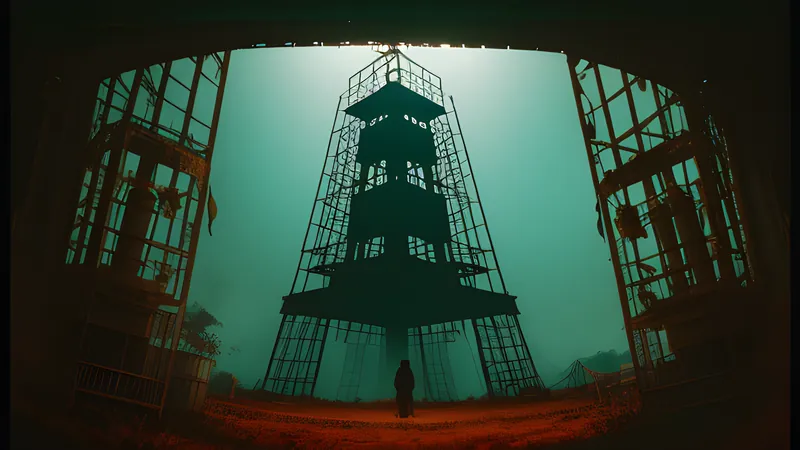
The title refers to a structure, and the structure is the film’s best idea. The prison’s labour is a colossal wooden sugar mill — a tower of beams and cogs and open platforms, hand-turned, with cane fed in at the bottom and juice boiling at the top. The women work it. Men work it. It kills people regularly, and the film treats each death as an occupational statistic.
As production design it is astonishing value: a single practical set that gives Hill vertical geography, moving parts, a constant threat, an industrial soundscape and a visual metaphor, all for the price of timber and Filipino carpentry. As a piece of filmmaking it is textbook. Hill establishes the mill’s mechanics in an early sequence with almost no dialogue — you learn where the cane goes, where the fire is, which platform has no rail, how far the fall is — and every one of those facts is spent later. The audience never needs to be told the mill is dangerous. They have watched it work.
This is the craft lesson Hill teaches in every one of these pictures. Show the machine, then let the plot use it. Most of the WIP films that chased him into the Philippines had a fence and some huts and a script that produced escapes out of nowhere. Hill builds a working world first, and his third acts are consequently the only ones in the cycle that feel inevitable rather than announced.
The real ancestor
The lineage everybody assigns runs backwards through The Big Doll House to the studio prison melodrama, which is correct for the earlier film. The Big Bird Cage is descended from something else entirely: the prisoner-of-war escape picture.
Watch the shape. A camp with a work detail. An organised resistance operating inside it with an outside contact. A plan that requires the compound’s own labour infrastructure to be turned against it. A comic register that sits alongside real deaths without cancelling them. Guards written as venal functionaries who can be worked, bribed and gulled. That is Stalag 17, and it is The Great Escape, and Hill has simply removed the war and the men and kept the machinery. The comedy is the giveaway — the POW film is the one genre where jokes and executions have always shared a scene, and Hill’s tonal balance here is lifted straight from it.
Once you see it, the film’s oddest choices make sense. The prisoners’ scheme to seduce the guards is a con, a POW-picture set-piece in different clothing, and it is played as farce for exactly the reason Stalag 17 played its cons as farce: the audience needs to enjoy the plan before it can fear the consequences.
The case against
The seduction plot is also where the film has aged worst. The guards at the mill are written as gay men, and the women’s scheme is to seduce them out of it; the joke runs on a premise that was broad in 1972 and is now a long, uncomfortable stretch of screen time built on a punchline that has no defenders. Vic Diaz commits to the role with more dignity than the writing offers him, which somehow makes it worse. There is no reading of this material that rescues it, and pretending the film is only its sugar mill would be dishonest.
The wider objection stands too. This remains an exploitation picture that arranges the humiliation of women for a paying audience, and Hill’s comic distance does not launder it. If anything, the comedy makes the calculation more visible: the film is winking at the formula while executing every requirement the formula imposes. A viewer can admire the craft and still find the transaction sour, and both responses are correct.
What survives is Grier, Haig, and the mill. Grier is a revolutionary with a plan and a rifle two years before mainstream cinema would let a woman hold either, and Hill lets her win on competence. The film sits usefully between the template he wrote and the more explicitly political American variant that Jonathan Demme would make with Caged Heat, and it is a considerably better-directed film than its reputation as the sillier sequel suggests. The restorations that Corman’s catalogue has received in recent years do the jungle and the mill an enormous favour; this was always a better-looking picture than the drive-in print allowed anyone to notice.
Watch it after The Big Doll House and before Coffy. Three films, two years, one director working out what he had found. The through-line is Grier’s authority expanding to fill whatever space each script allows her, and Hill noticing faster than anyone else in the industry that the space would need to keep getting bigger.
Spoilers below
The plan is the mill, and Hill pays it off with everything he set up. Blossom’s organising works, the alliance between the women and Django’s guerrillas holds long enough to matter, and the break turns the sugar mill into the weapon the first act promised it could be. The tower burns. The fire that boils the cane juice takes the whole structure, and Hill stages the collapse with a genuine sense of scale — the machine that consumed the prisoners consuming the prison.
The cost is where the film declines to be a comedy. Django’s death is played for a beat of real feeling before Haig gets his exit, and Hill kills off enough of the ensemble in the last ten minutes that the escape reads as expensive. Terry Rich’s arc completes in the direction the film has been quietly steering it — the pampered outsider who arrived as a joke ends up competent, filthy and armed, which is the closest the picture comes to an argument.
Blossom gets out. The republic she was fighting is exactly as it was. Hill offers no epilogue and no victory, and the final image belongs to the burning mill rather than to anyone who escaped it, which is a harder, cleverer ending than a film with this poster owed anybody.
Related Content