The Beyond: Fulci's Gates of Hell and the Logic of Nightmares
Lucio Fulci abandons plot for pure image and makes the most beautiful incoherent film in horror
Contents
Try to follow the plot of The Beyond and you will fail, and the failure is the film working exactly as designed. A woman inherits a decrepit hotel in rural Louisiana. The hotel, it emerges, was built over one of the seven gateways to hell, described in an ancient forbidden book. People begin to die in ways that do not obey cause and effect, and the dead do not stay dead, and the geography of the film comes apart until the living and the damned are wandering the same corridors. Lucio Fulci’s 1981 picture is not a broken horror film that fails to make sense. It is a horror film that has deliberately unscrewed the joints of narrative to reach something older and worse — the logic of a nightmare, where things happen because the dream requires them, not because they follow.
Fulci called it an “absolute film,” a film of pure images with no obligation to story, and he meant it as a defence rather than an apology. The Beyond is the middle panel of his loose “Gates of Hell” trilogy, sitting between City of the Living Dead (1980) and The House by the Cemetery (1981), and it is the one where his method achieves lift-off. It is gorgeous, revolting, and genuinely dreamlike, and it belongs in the conversation about horror as surrealist art.
The Godfather of Gore’s real subject
Fulci earned his nickname — the Godfather of Gore — honestly, and The Beyond is thick with the elaborate, wet, lovingly extended atrocities that made his reputation: a face dissolved by acid, a man’s flesh devoured by tarantulas in a library, and the eye trauma that was practically Fulci’s signature (he had already staged the infamous splinter-to-the-eye in Zombie two years earlier, and he returns to the vulnerable eye here with obsessive relish). It would be easy to file him as a pure shock merchant, a purveyor of set-piece cruelty for its own sake, and plenty of critics did exactly that for decades.
They were reading the surface. What separates Fulci from the ordinary splatter director is that the violence in The Beyond is not there to make you jump — it is there to make the world feel wrong. The gore is slow, dwelt-upon, almost ceremonial, filmed in the same hushed, dreaming register as everything else. It has the unhurried inevitability of a nightmare you cannot wake from, where the terrible thing takes its time because time itself has stopped meaning anything. This is closer to the Italian horror of atmosphere and dread than to the American body count, the same sensibility that runs through Dario Argento’s work — though where Argento drowns you in colour in Suspiria, Fulci drowns you in a kind of sepia rot, a Louisiana of decay and standing water.
Why the incoherence is the point
The great obstacle to loving The Beyond is that it does not, in any conventional sense, add up. Characters know things they were never told. A blind woman appears on a fog-bound causeway to deliver warnings, then vanishes. A plumber is killed in a flooded cellar and his body is found, impossibly, elsewhere. The dead accumulate without explanation, and the film’s final movement takes place in a hospital whose layout mutates from scene to scene. Approach this as a mystery to be solved and it is a shambles.
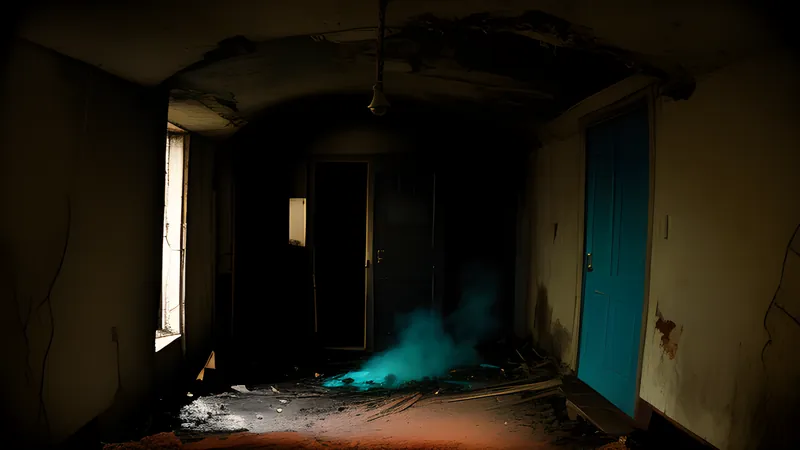
Approach it as a nightmare and every one of those failures becomes a feature. Fulci and his co-writers were reaching for the texture of a bad dream — the way a dream will shift location without warning, populate itself with figures who know your fears, and follow an emotional logic that dissolves the moment you try to explain it aloud. The cinematographer Sergio Salvati shoots it all in soft, diffuse, unreal light, with slow zooms into eyes and faces that feel like the dreamer’s own drifting attention. Fabio Frizzi’s score — one of the great Italian horror soundtracks, a mournful, choral, prog-inflected lament — does not underscore events so much as hold the whole film in a single unbroken mood of dread. The parts do not connect because dreams do not connect. They accumulate.
This is a real and defensible artistic tradition — horror that abandons rationalism for pure oneiric image — and it is worth taking seriously rather than excusing. When Argento made Suspiria, he was doing a version of the same thing with colour and sound. What The Beyond proves is that the approach can survive even in a much cheaper, grubbier film, that the dream logic does not require a lavish budget, only a director willing to trust the image over the explanation.
The Louisiana of the mind
Fulci shot the film partly on location around New Orleans and Louisiana, and the choice does enormous work. The American Deep South, with its above-ground tombs, its swamps, its Spanish moss and its long association in the horror imagination with hoodoo and buried history, gives The Beyond a specificity that grounds its unreality. The Seven Doors Hotel is a rotting Gothic ruin in a landscape that already looks like it is decomposing, and the film draws on the region’s atmosphere of heat and damp and old death without ever quite committing to it as a real place. It is Louisiana as a state of mind — a threshold territory, appropriately, between the living world and the other one.
The forbidden book at the film’s centre, the Book of Eibon, is a nod to the pulp cosmic horror of Clark Ashton Smith and the Lovecraft circle, and that lineage matters. The Beyond is finally a Lovecraftian film — the horror here is a wrongness in the fabric of reality itself, a thin place where hell bleeds through, indifferent to the human beings who happen to be standing on it. No killer waits to be unmasked, no ghost nurses a grievance; there is only the breach. The zombies that shamble through the third act are less George Romero’s social metaphors, of the kind traced in George A. Romero: the dead as a social mirror, and more the risen damned, symptoms of a metaphysical breach. The dead walk because the door is open, and the door being open is the entire subject.
Why it endures
For years The Beyond was a bootleg legend, cut to ribbons by censors, seen mostly in murky nth-generation tapes traded among the devout. Its rehabilitation came in 1998, when Quentin Tarantino’s Rolling Thunder Pictures distribution arm gave it a theatrical re-release in the United States, uncut, and a generation of viewers finally saw Fulci’s images at full strength and in the intended dreamlike flow. The film’s reputation has only grown since. It now reads less like a disreputable gore quickie and more like what it always was — a flawed, cheap, magnificent piece of surrealist cinema that happens to be soaked in blood.
Its influence runs through everyone who has since tried to make horror that operates on atmosphere and image rather than plot mechanics, from the dream-drift of contemporary art horror back to the same well of illogical dread that Argento’s rationalist gialli, like Deep Red and Tenebrae, were always in tension with. Fulci went the other way from Argento entirely — he threw the puzzle-box out the window and kept only the nightmare. That gamble is why The Beyond still frightens when far tidier films have gone stale.
Spoilers below
The ending is one of the bleakest and most beautiful in the genre, and it retroactively explains the film’s entire method. After the hotel’s dead overrun the town and the hospital, the heroine Liza and the doctor John, having survived a running battle with the risen damned, flee down into the hospital’s basement in search of an exit. They descend a staircase — and step out, without transition, into a vast, grey, featureless plain under a dead sky, strewn with the bodies from the film. It is the landscape depicted in the painting by the artist Schweick, the damned man murdered in the film’s prologue, the image of hell itself.
There is no escape and there never was. The pair look out over the void and slowly go blind, their eyes clouding to blank white, echoing the film’s blind seer and its endless motif of ruined vision. The final shot holds on their sightless faces staring into the grey nothing, over Frizzi’s mournful theme, as the film simply stops. The whole picture, it turns out, has been a passage through the gate — every incoherence, every impossible corridor, every character who knew too much, was the disorientation of people who have already crossed over and do not yet understand it. To see clearly in The Beyond is to see the void, so the film ends by taking its survivors’ sight away. It is Fulci’s cruellest and most perfect image: hell is not fire and torment, it is a grey emptiness where you are conscious, and blind, forever.
Where to watch: track down Grindhouse Releasing’s restoration, the definitive presentation, which finally does justice to Salvati’s photography and Frizzi’s score. Watch it late, half-asleep, and let it wash over you as the dream it is — chasing its plot is the one guaranteed way to miss the film entirely.
Related Content