The B-Movie Double Bill and the Economics of Fear
How a flat rental fee and a 68-minute ceiling designed the shape of the horror film
Contents
Ask why classic horror films are so short and the usual answer is that audiences had less patience, or that the stories were simpler. Both are wrong, and the real answer is a contract term.
Through the 1930s and 1940s an American exhibitor rented an A picture on a percentage of the box office — the studio took a cut of whatever came through the door, so a hit paid the studio more. The second feature on the bill rented for a flat fee. Fixed money, agreed in advance, regardless of whether one person or four hundred sat through it. That single difference in how the paper was written determined everything about the B picture: since no amount of quality could increase the revenue, the only variable a producer could move was cost. Cap the cost, hit the delivery date, ship it. And since a double bill plus a newsreel plus a cartoon plus a serial had to fit inside a session an exhibitor could turn over three times a day, the B picture got the leftover time. Somewhere between 60 and 70 minutes.
Horror lived in that slot for two decades. The genre’s compression, its refusal to explain itself, its habit of starting with the situation already underway — those are the fingerprints of a flat rental fee and a running-time ceiling.
How the double bill happened
The practice spread during the Depression, and the logic was the exhibitor’s rather than the studio’s. Attendance collapsed after 1930, and a theatre with empty seats offered more film for the same ticket. Two features for a quarter. Dish nights, bank nights and giveaway china sat alongside it in the same desperate arithmetic.
The studios hated it at first and then discovered they liked it enormously, because they owned the theatres. A vertically integrated major could guarantee itself a market for a cheap picture by simply booking it into its own chain, and block booking meant an independent exhibitor who wanted the prestige title had to take the programmers along with it. Every major set up a B unit. Universal had one. RKO had one, and it is the one that matters most to this desk.
Universal’s B unit is the clearest illustration of what the slot did to a franchise. Once the monsters had been demoted from A pictures to programmers, the economics pushed them together. Frankenstein Meets the Wolf Man (1943) exists because two properties in one 74-minute feature costs barely more than one, and House of Frankenstein (1944) and House of Dracula (1945) stacked the Monster, the Wolf Man, Dracula and a mad doctor into films running about 70 minutes apiece. The modern shared universe, with its crossovers and its cameo economy, was invented on a second-feature budget in the 1940s because throwing another monster in was the cheapest possible way to make a poster look bigger.
Below the majors sat Poverty Row: Monogram, Republic from 1935, PRC, and a shifting population of outfits that rented space on Gower Street and vanished. They had no theatres, so they sold into the independent and small-town market, and their economics were the same logic taken to its terminus. The democracy of the cheap horror film is a genuine phenomenon rather than a nostalgic one — when a film costs almost nothing, almost anyone can make one, including people the majors would never have hired.
The numbers that made the aesthetic
Take Val Lewton’s RKO unit, which is the cleanest experiment the genre has ever run because the constraints were written down.
RKO hired Lewton in 1942 with three conditions, and they are famous for good reason: the films had to come in under a specified budget in the region of $150,000, they had to run about 70 minutes, and the titles would be handed down by the front office based on what the marketing department thought would sell. Lewton got the title Cat People and had to make a film to fit it. He got I Walked with a Zombie — a phrase from a magazine serial the studio had bought — and turned it into a Caribbean rewrite of Jane Eyre.
What the unit did with those constraints is the reason we are still talking about it. A budget that forbids a monster forces you to build dread from light, sound and the edge of the frame. Cat People, directed by Jacques Tourneur and photographed by Nicholas Musuraca, cost a fraction of an A picture and reportedly returned many times its cost — the figure usually quoted is in the millions, and whatever the exact number, the film’s performance is credited with steadying RKO’s books after the Citizen Kane years. A seventy-minute ceiling forces you to open with the situation already live. I Walked with a Zombie has no first act in the modern sense. The nurse arrives, the house is already wrong, and the film simply begins.
The same arithmetic produced the bleakest American film of the decade. Edgar G. Ulmer made Detour (1945) for PRC on a schedule usually reported as somewhere under two weeks, with sets so thin the film uses rear projection for a road trip across a continent and a single diner set doing double duty. The result is a 68-minute nightmare with a narrator you cannot trust, and the poverty is legible in every frame and works entirely in the film’s favour. The fog is there because a fogged frame hides an empty backlot. The fog is also the best thing in the film.
The mechanic: what compression actually does
This is the part worth taking seriously as craft rather than as trivia.
A 68-minute film has no room for reassurance. In a two-hour horror picture there is time for a rhythm — threat, relief, threat, relief — and the relief passages are where an audience recovers and where a filmmaker rebuilds tension. Remove forty minutes and the relief goes first, because the plot cannot be cut and the scares are the selling point. What remains is a film that starts uneasy and gets worse, with a slope rather than a wave.
Compression also kills the explanation. A B horror film cannot afford the twelve-minute scene in which a professor sets out the rules of the curse, so it delivers the rules in fragments while something else is happening, or leaves them out. The audience arrives in the middle of a system it never gets to fully understand, which is a far more frightening place to stand. Half the mystique of the Lewton films comes from material the schedule simply would not accommodate.
There is a structural consequence in the writing too. A 70-minute film runs to roughly 70 pages, and a horror plot needs its setup, its escalation and its resolution regardless of length, so the compression falls disproportionately on character. B horror characters therefore arrive pre-formed — the sceptical doctor, the frightened wife, the sensible nurse — and the shorthand is usually mistaken for laziness. It is closer to a load-bearing convention. The audience recognises the type in four seconds, the film banks the time saved, and it spends the surplus on the thing it is actually selling. Every economical genre film since has run the same trade, and the ones that lose their nerve and stop to build a backstory are the ones that stall.
Third, the flat fee removed the incentive to please. A percentage picture must not offend, because offence costs money at the door. A flat-rate picture has already been paid. That is why the strange, the sour and the downbeat cluster in the B slot, and why the endings down there are so much nastier than anything the A unit would sign off.
What killed it, and what it became
The Supreme Court ended it. The 1948 Paramount decision forced the majors to divest their theatre chains and outlawed block booking, which removed the guaranteed market that made a B unit rational. Television then took the audience for cheap programme filler and took it permanently. By the mid-1950s the studio B unit was gone.
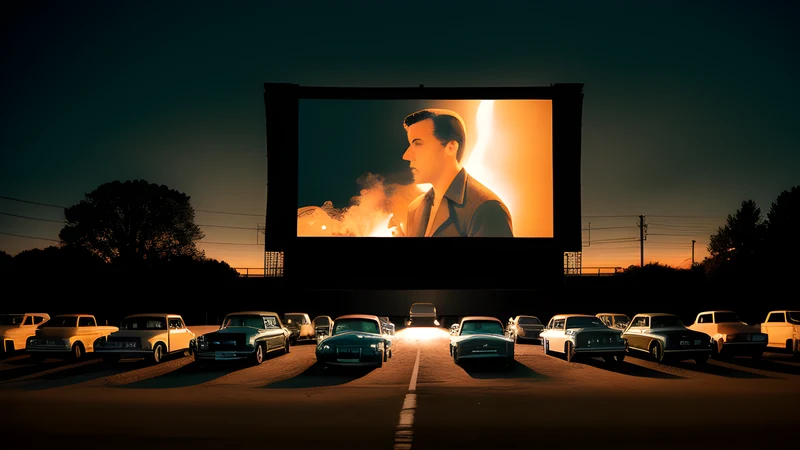
The slot survived by moving outdoors. The drive-in needed product that the majors would not supply, and independents stepped straight into the vacancy. American International Pictures, founded by James H. Nicholson and Samuel Z. Arkoff in 1954 and renamed to AIP in 1956, took the double bill’s logic and inverted it with one brilliant move: rather than supplying the second feature, they supplied both halves, packaged, at a price the exhibitor could plan around. AIP’s assembly line is the B unit reborn as an independent, and Roger Corman’s genius inside it was scheduling — two features shot on overlapping crews, sets standing from one production to the next.
The final mutation was urban and grubbier. When the drive-in declined, the same economics reappeared on 42nd Street and in the grindhouses, where a flat-rate print played continuously to whoever came in, and the films got correspondingly more extreme because there was nothing left to protect.
The honest objection
Most B pictures are terrible, and the survivorship bias here is enormous. For every Cat People the same system produced hundreds of inert programmers that nobody has watched voluntarily since 1946, and the constraint that sharpened Lewton simply flattened everybody else. Compression only produces intensity when there is an intelligence deciding what to cut. Absent that, it produces a film that is merely short.
The counter-case is that the good ones are not accidents. Lewton, Tourneur, Ulmer, Robert Wise, Mark Robson — the system reliably surfaced people who could think under a stopwatch, and it surfaced them because there was no other route in. That is a real virtue of a cheap tier, and the genre has been reproducing it ever since, from Corman’s payroll through to the modern low-budget horror model, which is the same trade in different clothes: a hard budget cap, creative freedom underneath it, and a distributor who has already done the sums.
Watch Cat People and Detour back to back some evening. Both under seventy minutes, both made for money that would not cover a modern establishing shot, and both still moving at a speed that most contemporary horror cannot manage. The clock was the collaborator.
Related Content