The Autopsy of Jane Doe: The Body on the Table Tells the Story
André Øvredal builds a whole horror film out of one corpse and two coroners
Contents
Most horror films spend their first act getting characters into the trap. The Autopsy of Jane Doe (2016) starts with everyone already inside it, and then makes the trap the mystery. André Øvredal’s film is a chamber piece of almost mathematical economy: two coroners, one basement morgue, one unidentified female corpse, and a single night in which they cut into her and the night cuts back. It is one of the best single-location horror films of the last decade, and it works because it understands that the scariest object in any room is a body that will not explain itself.
Øvredal, the Norwegian director who made the found-footage creature film Trollhunter, here shows a completely different register — controlled, classical, patient. The screenplay by Ian Goldberg and Richard Naing gives him a premise that doubles as a structure: an autopsy is a story told backwards, an investigation that reads a life from its end, and the film lets each incision reveal a new impossible detail until the mystery becomes a siege.
Two coroners and a corpse
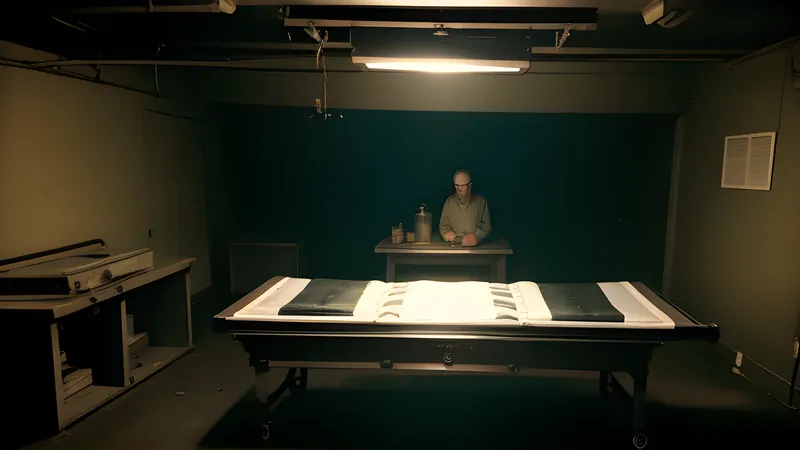
Tommy Tilden and his son Austin run a family mortuary and morgue in a small American town — the business is in the basement of the house, which is its own quiet horror. Brian Cox plays Tommy with a weathered, kindly competence, a man who has read a thousand bodies and taught his son to do the same; Emile Hirsch is Austin, who wants a life beyond the family trade and a night off to see his girlfriend. The dynamic is established with unusual efficiency, and it matters, because the film’s tension is finally about whether a father and son can keep faith with each other when the ground stops making sense.
Late in the evening the sheriff brings in a body recovered from the scene of a violent multiple murder, a house full of dead with no clear cause and no explanation for how they died. At the centre of it, buried in the basement, was a young woman — unmarked, undamaged, beautiful, with no identity. The sheriff wants a cause of death by morning. Tommy and Austin begin the autopsy.
And the body starts to lie. Or rather, it tells a story that cannot be true. The exterior is pristine; the interior is a catalogue of catastrophic injury. Her wrists and ankles are shattered beneath unbroken skin. Her lungs are blackened as though burned, though she never breathed smoke. Her tongue has been cut out. There is a cloth in her stomach and something worse wrapped inside it. Each finding contradicts the last, and the coroners’ professional calm — the film’s great asset — slowly curdles as the corpse refuses every explanation the science offers.
Why it works — the procedural is the horror
The masterstroke of The Autopsy of Jane Doe is that it makes the autopsy itself the engine of dread. Most horror treats the dead body as a shock delivery — a jolt when it moves, a gross-out when it opens. Øvredal treats it as a text, and lets his two experts read it in real time. Because Tommy and Austin are so credibly good at their jobs, every impossible finding lands as a genuine puzzle rather than a gimmick, and because they narrate their reasoning aloud in the flat, procedural language of the trade, the audience is doing forensic detective work alongside them right up to the point where detection fails.
That structure builds a beautiful escalation. The film starts as a competent medical procedural and slides, incision by incision, into the supernatural, so gradually that you cannot name the frame where one becomes the other. Øvredal earns each step. The corpse of Jane Doe — played with total, eerie stillness by Olwen Kelly, who reportedly used breathing techniques to hold the deathlike composure — is the film’s masterpiece of casting: a body so convincingly inert that its passivity becomes the most menacing thing on screen. She never moves, and the film makes her stillness unbearable.
The other craft achievement is the geography of dread. The basement morgue is mapped with care — the drawers, the corridor, the lift, the bell tied to the corpse’s toe as an old superstition against premature burial — so that when the film turns and the space becomes hostile, we know it intimately, and the storm outside seals the trap. Øvredal is working the oldest chamber-horror principle: establish the room, then poison it.
The real ancestors
The film Øvredal is descended from most directly is the tradition of the isolated professional whose expertise fails against the inexplicable — and the purest recent example is Session 9, Brad Anderson’s asbestos-removal crew slowly unravelling inside a decommissioned asylum. Both films trust a workplace, a set of tools, and a group of competent men, and both let the dread rise from the ordinary rhythms of a job rather than from jump scares. The Autopsy of Jane Doe is that film compressed to two people and one table.
It also belongs to the lineage of hauntings that argue with their own explanations. Like The Entity, it stages the clash between the rational investigator and a force that defies investigation, and it draws its charge from watching sceptical, intelligent people run out of theories. And in its careful, escalating dread and its brilliant late-film use of a bell as an instrument of terror, it is a close relative of The Changeling, the classical ghost story that also builds its scares from sound, patience and a house that answers back. Anyone who admires the mock-documentary grief of Lake Mungo will recognise the same instinct here — the horror of a body that carries a secret nobody living can read.
Verdict
The Autopsy of Jane Doe is a small film that does one thing with near-perfect control: it makes you afraid of a corpse that never moves, by making you believe completely in the two people trying to understand it. It is smart, tense, well acted, and disciplined enough to keep its central mystery genuinely mysterious for most of its length. Where it is weaker is the final stretch, when the film has to convert atmosphere into action and some of the eerie ambiguity hardens into more conventional horror mechanics — the ending is effective, though it cannot quite match the dread of the setup. That is a common failing of the sub-genre, and it does not undo the achievement. For anyone who wants to see a single-location horror built with real craft, this is essential.
Where to watch: it streams widely and is available on disc; watch it alone, at night, and pay attention to the autopsy the way Tommy tells Austin to — every detail is a clue, and the film plays fair with all of them.
Spoilers below
The genius of the mystery is that Jane Doe’s body is a confession written in wounds, and the coroners are decoding a case of historical witch-persecution. As Tommy and Austin work deeper, the impossible findings assemble into a coherent, horrible story: the shattered bones, the burned lungs, the excised tongue, the cloth in the stomach printed with numbers from the Book of Leviticus, the roman numeral carved inside her, the tooth wrapped in the cloth. These are the marks of torture inflicted on a woman during a witch trial in colonial New England — the very rituals meant to destroy a suspected witch, applied to a girl who was almost certainly innocent.
The film’s cruel irony is that the persecution created the thing it feared. The attempt to kill a witch made one; the tortures intended to break her power instead bound a curse into her preserved, undecaying body. Everyone who has autopsied her — the previous household, and now the Tildens — becomes a target, because the corpse visits her own injuries back upon the living. As Tommy and Austin cut, matching wounds and afflictions begin appearing on them and on Austin’s girlfriend, who arrives and is killed; the storm traps them, the lights fail, and the reanimated dead of the morgue turn on the pair.
The gut-punch is Tommy’s bargain. Believing the curse will lift if he offers the corpse the suffering it wants, he confesses aloud everything the autopsy revealed and offers his own body in place of his son’s, letting himself be destroyed so Austin can escape. It does not work. Austin is caught in the lift, his neck broken in the same manner the film has been foreshadowing, and both Tildens die. The final scene is the quiet horror the whole film was building toward: the sheriff arrives in the morning, the bodies are catalogued, and Jane Doe — still pristine, still unmarked, her toe bell faintly ringing — is loaded into another van and driven to the next morgue, to begin again. The autopsy never ends. That is the curse. She will always have another story for someone to read, and reading it is what kills you.
Related Content