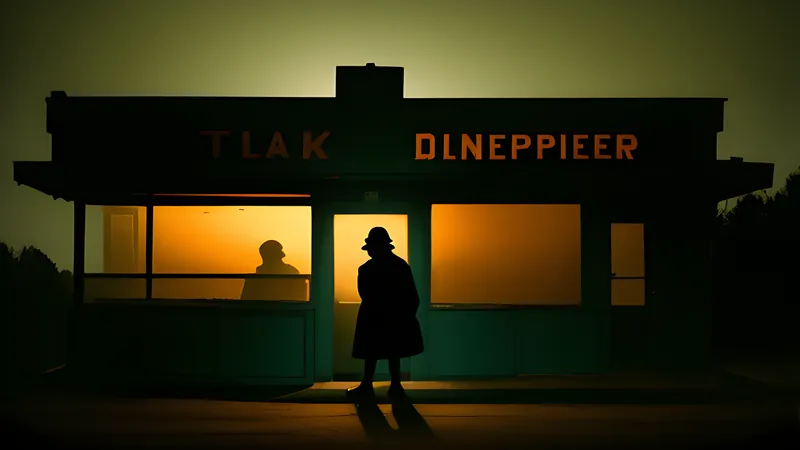
The American Friend: Wenders's Hamburg Ripley
Dennis Hopper in a cowboy hat, Bruno Ganz with months to live, and a Highsmith thriller rebuilt as a study in loneliness

Contents
Patricia Highsmith did not want Dennis Hopper. By most accounts she thought the casting was a category error, and on paper she was obviously correct. Her Tom Ripley is a man of exquisite control, a social chameleon who kills to protect an aesthetic. Hopper in 1977 was a walking wreck — post-Easy Rider, mid-collapse, a person visibly held together by weather. Putting him in Ripley’s suit is like casting a car crash as a butler.
Wim Wenders did it anyway, and Der amerikanische Freund (1977) is the best Highsmith adaptation ever made, precisely because it gets the character wrong on purpose. Highsmith reportedly came round after seeing it, which is the correct reaction and also a slightly embarrassing one, because what Wenders found was a Ripley she had not written and could not have: an American who has won, who has the money and the house and the art and the European life, and who has absolutely no idea what any of it is for.
The set-up
Ripley lives in a Hamburg house he is filling with expensive things. There is a jukebox in it, and a cowboy hat, and he lies on a pool table talking into a cassette recorder because there is nobody else. He is running an art-forgery operation with a painter who has arranged to be dead, and it is going well, and he is bored in a way that has stopped being a mood and become a condition.
Jonathan Zimmermann is a picture framer with a wife, a small son, a shop in the old town and a blood disease that is going to kill him. He is Ripley’s opposite in every respect that matters: local, decent, rooted, held. At an auction the two men are introduced, and Jonathan — who has heard a rumour about Ripley’s business — declines the handshake. It is a small snub, delivered in seconds, and Ripley files it.
Then a Frenchman turns up with a proposition for Jonathan. A great deal of money for a dying man’s family, in exchange for one act. And the reason Jonathan’s name reached the Frenchman at all is a thing Ripley did, casually, out of wounded vanity, weeks earlier.
That is Highsmith’s Ripley’s Game (1974), and Wenders keeps its cruel machinery intact. What he adds is a second story running underneath: Ripley, having built this trap for a stranger who was rude to him, falls in love with him. Not romantically, and not redemptively. He simply discovers, far too late, that he has manufactured the only friend he has and is watching him die.
Two acting traditions in one room
The film’s central pleasure is watching Hopper and Bruno Ganz work in styles that have no business coexisting. Ganz is doing European interiority — small, exact, physically truthful, a man whose fear lives in his hands and his breathing. Hopper is doing whatever Hopper did, which is closer to improvised jazz: unpredictable rhythms, sudden stillness, lines arriving from angles nobody signposted. In theory they should cancel out.
Instead the mismatch becomes the subject. Ganz’s Jonathan is a man with a place in the world who is being evicted from it by his own body. Hopper’s Ripley has no place in the world and never did, and the American’s rootlessness reads as a kind of contagion. When they finally share extended scenes, Ganz keeps flinching at the wrong moments and Hopper keeps offering warmth that arrives sideways, and you watch a friendship assemble itself out of two men who are both, in different ways, already gone.
Wenders was making a film about America colonising Europe — a running preoccupation of his, made explicit by the title. The joke is that his American conqueror is a lost man in a hat he does not suit, in a house he cannot fill, playing a jukebox nobody else can hear.
The craft: Robby Müller’s poison
Robby Müller shot this, and it is one of the great arguments for the cinematographer as author. Müller lights Hamburg in colours that feel medically wrong — sodium orange, hospital green, a red that pulses out of neon and blood tests alike. The palette is doing diagnostic work. Jonathan’s illness is invisible, unfilmable, a number on a lab report, so Müller puts it in the air. Every room the man walks through looks faintly infected.
The other craft decision is Wenders’s refusal to build tension the way thrillers build it. Jürgen Knieper’s score is sparse and often absent. Scenes run past their functional end. A sequence will hold on a man waiting on a platform, doing nothing, for far longer than the plot needs, and the effect is dread’s older cousin: the sense that time is passing and cannot be got back, which for this protagonist is the literal problem. Wenders came to this film straight from his road-movie period, and he shoots crime the way he shot travel — as duration.
The collector’s footnote: the directors in the cast
Wenders filled the picture with filmmakers, and it is not a stunt. Nicholas Ray — the man who made In a Lonely Place and Rebel Without a Cause, and by 1977 a one-eyed legend in decline — plays the painter who has faked his own death and is quietly producing his own forgeries. Samuel Fuller, the great B-movie brawler, turns up as an American gangster. Gérard Blain, a French actor-director who had been a Chabrol lead, plays the man who recruits Jonathan.
Casting American cinema’s ruined patriarchs as the corrupting influences in a German film about American corruption is a joke with real teeth, and it is also affection. Wenders loved these men and their films, and put them in his own picture as ghosts who forge things. Ray playing a painter faking his death while making his own fakes is the most loaded piece of casting in 1970s European cinema.
The bloodline
Start with René Clément’s Purple Noon, which gave us a young Ripley clawing his way up in blazing sun; Wenders gives us the same man twenty years on, having got everything, in permanent overcast. The two films together are a complete argument about ambition. Liliana Cavani filmed the same novel in 2002 as Ripley’s Game with John Malkovich, and the comparison is instructive: Malkovich plays the Ripley Highsmith wrote, in control, and the film is good and much smaller for it.
Sideways, the obvious relative is Le Samouraï, another study of a professional whose ritual is the only thing standing between him and nothing — Melville’s man has the code Ripley lacks, which is why one of them is serene and the other is lying on a pool table talking to a tape machine. For the European art film curdling into crime, Lars von Trier’s The Element of Crime picks up Müller’s poisoned palette and drowns it, and Bertolucci’s The Conformist gets at the same thing Wenders is after: a man who does something monstrous mainly because he wants to belong somewhere.
The case against
It is baggy, and some of the bagginess is just Wenders indulging himself. The New York material adds atmosphere and little else. The film’s treatment of Marianne, Jonathan’s wife, is a familiar failure — she exists to be lied to and to be right — and Lisa Kreuzer plays a woman with more going on than the script bothers to write. And the plotting genuinely creaks in the middle third; Wenders is so much more interested in mood than mechanism that the thriller occasionally has to stop and remind itself of its own rules. If you want Highsmith’s clockwork, Cavani built it better. Wenders was building something else.
Where to find it
Restored, on disc from the specialist labels, and a regular on the arthouse platforms. Watch it after Purple Noon and before Cavani’s version, and give it a proper screen — Müller’s colour dies on a phone.
Spoilers below
Jonathan takes the job. The first killing happens in a Paris Métro station, and Wenders shoots it as pure incompetence: a dying framer with no training, sweating, following a stranger through tiled corridors, getting it done badly and then having to walk out through a crowd. There is no craft on display, no professionalism, none of the balletic competence the genre trades in. It is a man being sick with fear in public. The film’s honesty here is brutal.
The train is the set piece everyone remembers, and it earns it. Jonathan is sent to kill a second man aboard a moving express, alone, and it goes wrong immediately — and then Ripley appears. Unbidden, unpaid, uninvited. He simply turns up in the corridor because he could not stay away, and the two of them commit the murder together in a cramped lavatory, badly, with a garrotte, in a scene that lasts an eternity and is filmed like manual labour in a confined space. Wenders holds on it until it stops being a thriller sequence and becomes the thing it actually is: two men doing something obscene to a stranger with their hands.
And afterwards, on the train, they eat. Ripley is happy. Genuinely, uncomplicatedly happy, for the only time in the film, because for twenty minutes he has not been alone. Hopper plays it with a lightness that is almost unbearable, and the moral horror of the picture lands right there: the friendship is real, and Ripley built it by handing a dying man a gun.
The last movement, on a beach, with an ambulance and a car and the mob closing in, resolves nothing cleanly. Jonathan dies at the wheel, and Ripley is left standing on sand with his hat, having got exactly what he wanted twice over — the money, and the friend — and having destroyed the second to get the first. He walks off alone, and the film simply stops. Highsmith’s Ripley would have gone home and had a nice lunch. Wenders’s Ripley has nowhere to go, and that, finally, is the reading Highsmith did not write and could not argue with once she had seen it.
Related Content