Terror Train: The Costume-Party Slasher
Kubrick's cinematographer, Peckinpah's editor and a killer who changes clothes
Contents
The best idea in Terror Train takes about four seconds to explain and holds up an entire film: the killer takes his victims’ costumes. Everyone on this train is in fancy dress. The murderer kills someone, puts on what they were wearing, and walks back into the party. Nobody notices, because nobody has seen anyone’s face all night.
It is the sort of premise that sounds like a gimmick and turns out to be a machine. Every masked figure in every wide shot becomes a question. The film does not need to tell you where the killer is, because he could be any of the twenty people in the frame, and the audience does the work of scanning that the direction would otherwise have to force. Roger Spottiswoode understood exactly what he had and spends the film’s second half quietly cashing it.
I met this one on a rental tape with a cover that oversold the train and undersold everything else. That was the standard deal on that shelf, and it was usually a warning. Terror Train is one of the rare cases where the film underneath the lurid sleeve is being made by people who were, by any reasonable measure, overqualified.
Look at who made this
Spottiswoode was directing his first feature. Before that he had been an editor, and specifically an editor for Sam Peckinpah — he cut Straw Dogs, The Getaway and Pat Garrett and Billy the Kid. That is an education in violence as rhythm, and it is visible. The kills in Terror Train are cut short and cut early. They land and stop. There is very little lingering, which in 1980 was almost a political position.
The cinematographer is John Alcott. That is Stanley Kubrick’s cinematographer — A Clockwork Orange, Barry Lyndon, The Shining. He shot The Shining and then he shot this. The result is a Canadian tax-shelter slasher that is photographed like a real film, and the gap between the material’s budget and the image’s quality is the first thing anyone notices on a decent transfer.
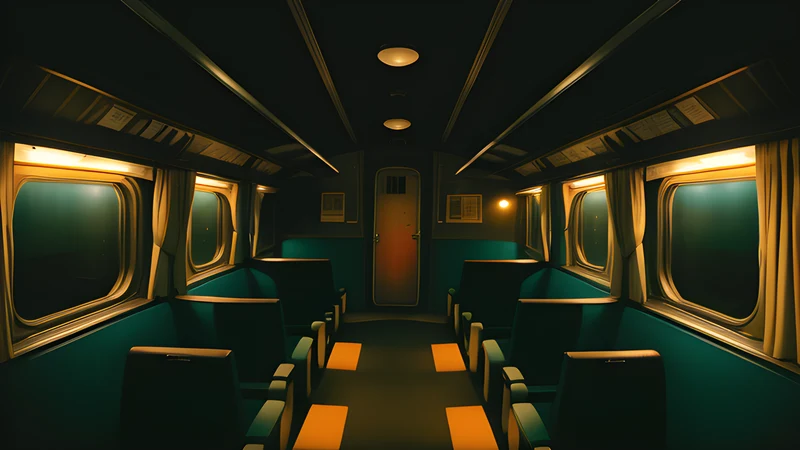
What Alcott does with a train is worth naming precisely, because it is the craft argument for the whole picture. A carriage is a tube: long, narrow, and impossible to shoot without the walls squeezing the frame. He leans into it. The compositions are deep and cramped at once, the party lights inside the carriages give him coloured practicals to work with, and the aisles turn into corridors of receding light where the far end of the shot is always slightly indistinct. The audience spends the film staring down tubes at figures who might be anyone.
And the geography is honest. You always know which carriage you are in and which way the door is. That sounds like a small thing. It is the reason the tension works, because a chase only frightens you if you understand the map.
The mask is the horror, not the knife
The costume mechanic pays off because Spottiswoode is disciplined about it. He does not cheat. He does not cut to a reaction that tells you who is under the mask. He shoots the party as a party — bodies, drink, noise, a lot of people in Groucho glasses and lizard heads — and lets the killer walk through it.
There is a specific pleasure to a film that trusts its own idea this much. Once the audience has grasped the rules, the film can generate dread from a shot of a corridor with a masked person standing at the end of it doing nothing at all. Nothing needs to happen. The rules do the work. That is economical filmmaking in the most literal sense.
Ben Johnson gives the film something else it needs. As Carne, the conductor, he is the only adult on the train, and Johnson — a former stuntman, an Oscar winner for The Last Picture Show, a man who had spent a career in Ford and Peckinpah westerns — plays him with a weary decency that gives the students something to be young against. The film is better whenever he is in it. He is the closest thing 1980 offered to a slasher with an actual grown-up in the cast, and unlike most such casting, the film does not treat him as a joke.
The other piece of stunt casting is stranger and works better than it should: David Copperfield, the illusionist, playing an illusionist. He was twenty-three and already a television name, and he performs real routines on camera in character. That decision is thematically exact for a film about a person who makes his identity disappear — a magician is the one professional aboard whose entire job is misdirection, and the film enjoys the suspicion that generates without labouring it.
Jamie Lee Curtis, mid-coronation
This is Curtis’s fourth genre film in about two years. Halloween, The Fog, Prom Night, then this — released in October 1980, the same year as two of the others. She is twenty-one and being typed at speed, and the interesting thing about Terror Train is that she is visibly aware of it and pushing against it.
Her Alana is complicit. She took part in the prank that set the plot going, and the film keeps her guilt live rather than absolving her in the first reel. Curtis plays that as a low-grade dread that predates the killing — she is having a bad night before the night gets bad. It gives her something to act other than fear, and the performance has a hardness to it that Laurie Strode never needed.
She also, crucially, is not required to discover the plot through screaming. Alana works it out. The film gives her a deduction and lets her make it, and the last act is her competence against the killer’s, which is a better fight than the genre usually staged.
The real ancestor is Italian
The obvious lineage is Halloween — the producer credit on the poster, Curtis, the date. The real ancestor of the costume-swap is Blood and Black Lace, where Mario Bava dressed his killer in a featureless white mask and a black coat and thereby invented the idea that a murderer’s blankness is more frightening than any face. Bava’s insight was that a killer with no identity is a killer who could be anyone in the room, and Bava’s fashion house full of suspects is Terror Train’s costume party with a different set dressing.
The second ancestor is Agatha Christie, unembarrassed. A closed circle of suspects, a moving train, a past crime that the present crime avenges, an authority figure trying to hold the passengers together — Murder on the Orient Express is in this film’s blood, and the film knows it. Spottiswoode is running a whodunnit with a body count, which is what the giallo had been doing for a decade and what most American slashers had by 1980 abandoned in favour of an unstoppable shape.
That is the reason Terror Train feels different from its shelf-mates. It has a solution. It wants you to guess.
The honest case against it
The prank that starts everything is staged in the prologue and it is genuinely nasty, which is the point — but the film then asks you to spend ninety minutes with the people who did it, and it has not done enough work to make you want to. Alana has an interior life. The rest of the fraternity are drawn thin enough that their deaths arrive as arithmetic.
The mystery is also solvable early, and if you get there ahead of the film, the last twenty minutes are a wait. Spottiswoode plays fair, which is admirable and also means the clues are there to be caught.
And the middle sags in a way that Alcott’s photography disguises rather than fixes. There is a long stretch of party that mistakes duration for build. A twenty-minute tighter cut of this film would be very hard to fault.
Where to find it
It has been restored properly — Scream Factory’s disc gives Alcott’s work the resolution it was always owed, and the difference from a tape is not subtle, because his images live in the dark parts. Watch it on the best copy you can find, at night, and pay attention to the wide shots at the party. That is where the film hides its whole method.
The verdict: Terror Train is the 1980 slasher that was made by people from a better neighbourhood and never quite admits it. The premise is a magician’s premise, the photography is Kubrick’s photography, the cutting is Peckinpah’s cutting, and the film they add up to is a tight, cold, genuinely clever little whodunnit that has been filed under gore for forty-five years by people who never watched it. It deserves the promotion.
Spoilers below
The killer is Kenny Hampson, the boy from the prologue — the fraternity’s prank put him in bed with a corpse, and it broke him. The reveal that he has been aboard the whole time, cycling through the costumes of everyone he kills, is set up honestly: the film shows you the swaps as they happen, so the mechanism is never a cheat.
The best-executed piece of the ending is the Groucho mask misdirection, and it works because the film has taught you to read masks as evidence rather than decoration. By the last act you have been trained to identify people by costume — the film built that reflex deliberately — and then it uses the reflex against you.
The lizard mask sequences are the film’s most Bava-like passages, and the moment Alana understands that the mask she trusts is wrong is the moment Curtis earns the picture. Her final confrontation is physical and unglamorous, and Carne’s involvement gives the ending a weight most slashers of the year could not manage, because Johnson has spent the film being the one person who actually cared what happened to these idiots.
The last beat leaves Alana ashore and alive, and the film has the sense to end there. The prank is not forgiven and the film does not pretend otherwise. She survives carrying it, which is a harder and better ending than absolution.
Related Content