Symbol: Matsumoto's Cosmic Absurdist Puzzle
A man in polka-dot pyjamas, a featureless white room, and one of the most rigorous pieces of comic construction Japanese cinema has produced
Contents
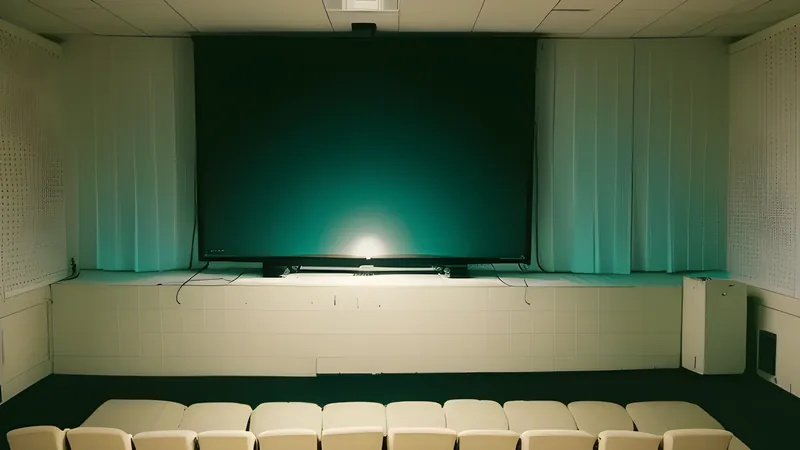
A man wakes up in a white room. The room has no doors, no windows, no furniture and no visible light source. He is wearing polka-dot pyjamas. He does not know how he got here and the film has no intention of telling him.
Then things start protruding from the walls — small cherubic appendages, arranged apparently at random across every surface, which do something when pressed. What they do is dispense objects. A toothbrush. A vase. A piece of sushi. There is no correspondence between the appendage and the object, no pattern the man can discern, and no obvious way any of it helps.
Symbol (2009) is Hitoshi Matsumoto’s second feature, following the deadpan kaiju mockumentary he made two years earlier, and it is a considerably stranger object than that description suggests, because roughly every ten minutes it cuts away to Mexico, where a luchador called Escargot Man is preparing for a wrestling match with his wife and son. The two stories have nothing to do with each other. The film is entirely confident that they do.
This is a revisit, so how the room works and how the strands connect are below the spoiler line. Above it, the case for the most underrated comic construction in modern Japanese cinema.
Who Matsumoto is, and why it matters
Context is load-bearing here. Hitoshi Matsumoto is one half of Downtown, a comedy duo who have been among the most famous people in Japan for decades — a television institution on a scale with no clean British equivalent. He came to filmmaking as an established comic mind with a very particular obsession: the mechanics of the sustained bit, the joke that runs long past the point of comfort and out the other side.
That background explains everything about Symbol. This is a film made by someone who has thought harder about comic escalation than almost anyone directing features, and who has been handed a camera and asked what he would do with two hours and no obligation to be likeable. What he does is build a machine.
Matsumoto plays the man in the room himself, and the performance is the film’s engine. It is pure physical comedy of a kind that has been out of fashion for eighty years — a body against an environment, with almost no dialogue and no one to react to. He is very, very good at it.
Why the room works
The white room is a comic engine, and the engineering deserves the attention that reviews of this film almost never give it.
Start with the space. It is featureless, evenly lit, and shot mostly flat and wide. That is a deliberately hostile choice: with no shadows, no depth cues and no visual variety, the room offers the audience nothing to look at except the man. Every laugh has to be generated by his behaviour, which strips comedy back to its oldest apparatus. Matsumoto has removed the safety net on purpose.
Next, the rule-making. The film’s discipline is total. Each appendage does one thing. The things are random. The man must learn the system by experiment, and the film shows the experiments — the failures, the wasted presses, the slow accumulation of useless objects on a blank floor. This is the structure of a video game rendered as slapstick, and Matsumoto plays it absolutely straight, which is why it is funny. The comedy comes from watching a rational person apply rational method to an insane premise, and being defeated by it repeatedly.
Then the escalation. Objects accumulate. Options multiply. The problem gets harder as the man’s resources increase, which is a beautiful inversion — most puzzle films make the protagonist stronger over time, and Matsumoto makes him more encumbered. His growing pile of junk becomes its own obstacle.
And underpinning all of it: duration. Matsumoto holds. He holds long past the point where a normal comedy would cut, and the shot goes through boredom and comes out somewhere unhinged. This is the specific Downtown technique — the bit that survives its own death — transplanted to cinema, and it is why the film divides audiences so cleanly. If you have the patience, the payoffs are enormous. If you do not, you will find it interminable, and that is a fair response to a film that is deliberately testing exactly that.
The Mexican material serves as the room’s counterweight. It is warm where the room is cold, populated where the room is empty, shot handheld and naturalistic in a domestic register — an actual family with actual problems. Cutting between the two gives the film a pulse it would otherwise lack, and it keeps the audience holding a question they cannot put down.
One more piece of craft is worth naming, because it is nearly invisible: the sound. The room has an acoustic. Matsumoto and his team gave the space a dry, close, slightly dead reverb, and every object that lands on the floor lands with a specific, over-recorded thud. In a set with no visual information, the audio is doing all the work of establishing size, hardness and distance. Mute the film and the room becomes a blank rectangle; restore the sound and it becomes a place, with dimensions you could estimate. That is expensive, unshowy work in service of a joke about a toothbrush.
The collector’s ancestor
Everyone reaches for Cube, and that is the wrong shelf. Symbol has no interest in threat, no body count and no mechanism for tension.
The real ancestor is silent comedy, and specifically Buster Keaton. Keaton built his best work on a single premise: put a man in an environment that is indifferent to him and governed by rules he did not agree to, and let him solve it with his body. The house in One Week. The theatre in The Playhouse. The comedy comes from method — the character is always the most rational thing in frame, and the world is always more inventive than he is. Symbol is that structure, held for a feature, with the ingenuity dialled up to something approaching the metaphysical. Matsumoto’s man is Keaton’s man in a room Keaton could not have afforded.
The other lineage worth naming is the European absurdist tradition of the wordless human body against a system. The wordless French anarchy comedy Themroc is the closest cousin here — a film that abolishes dialogue entirely and lets physical behaviour carry an argument, and one that shares Matsumoto’s willingness to bore you as part of the method. For the parallel-narrative structure and its refusal to explain itself, the nested-story cult epic The Saragossa Manuscript is the deep ancestor, and Maya Deren’s dream loop is where the film’s logic of recurring, meaningless objects ultimately comes from.
Within Japanese cult cinema, the sibling is the sketch-comedy fever dream Funky Forest — same era, same appetite for pure absurdity at feature length, opposite method. That film is shapeless by design. Symbol is one of the most rigidly structured comedies ever made and looks shapeless, which is a much harder trick.
The case against
The Mexican strand is the film’s weakest limb. It is charming, it is well-observed, and for most of the running time it is doing nothing except delaying the room. When the connection arrives it justifies the strand retrospectively — and retrospective justification is a thin reward for forty minutes of patience, and a viewer who checks out during the wrestling material has a case.
The final act is where the film loses people, and I understand why. Matsumoto’s escalation runs to a place so far outside the film’s established register that it reads to some as a cop-out and to others as a punchline of genuine grandeur. I fall on the grandeur side. I would not argue hard with the other camp.
And the film has no emotional content whatsoever. That is a choice, and the choice has a cost: nothing here stays with you the way an actual character would. Symbol is an object to admire.
The verdict
Symbol is the most rigorous comedy Japanese cinema produced in its decade, and it hides that rigour under a surface so silly that most viewers never look for it. It is a film about method — about the human compulsion to find a system in randomness, and about what happens if you actually succeed. Matsumoto’s physical performance is a genuine feat, his editing rhythm is the work of someone who has spent thirty years measuring exactly how long an audience will sit with a joke, and the construction is airtight.
Watch it with people who will not check their phones, and watch it in one sitting, because the duration gags only work cumulatively. Then go straight to Big Man Japan and see the same mind attacking an entirely different problem. Streaming availability outside Japan has always been patchy; the disc is the reliable route.
Spoilers below
The man works out the system. The appendages are keyed to a logic he eventually decodes, and the objects he has accumulated can be assembled, laboriously and absurdly, into a device that gets him out. Watching him build it is the finest sustained sequence Matsumoto has directed: an entire act of problem-solving with no dialogue, played with the concentration of a man defusing a bomb.
What he escapes into is the film’s real move. The room turns out to have been a mechanism for producing coincidence in the wider world, and the objects he was dispensing were landing, causally, in other lives. Specifically, they were landing in Escargot Man’s. The luchador’s match — his luck, his family’s fortune, the thing the film has been quietly building next door for ninety minutes — is being determined by what a man in polka-dot pyjamas does with a wall of cherub buttons.
Matsumoto then goes further than the premise requires, which is the mark of the whole enterprise. The man ascends. He becomes the mechanism itself, running through a white infinity, dispensing chance into the universe at industrial scale, and the film closes on a vision of divinity as a job — an exhausting, absurd, unending shift performed by someone who did not apply for the post and cannot resign.
It is a cosmology built entirely out of a slapstick premise, and it holds. That is why the film is worth arguing about twenty years on.
Related Content