Sweet Sweetback's Baadasssss Song: The Film That Lit the Fuse
Melvin Van Peebles financed a revolution out of his own pocket in 1971
Contents
In 1971 a filmmaker named Melvin Van Peebles did something the American film industry had structurally arranged to be impossible. He wrote, directed, produced, edited, scored, and starred in a defiantly angry film about a Black man outrunning the police, financed it largely himself when no studio would touch it, released it through the cracks in the distribution system, and turned it into one of the highest-grossing independent films of its moment. Sweet Sweetback’s Baadasssss Song is a rough, wild, uneven picture, and it is one of the most consequential films ever made in the United States, because of what it proved and what it set off.
The word “blaxploitation” gets attached to everything that followed, and the label flattens a genuinely varied movement into a single lurid poster. Before we get to the film’s flaws — and it has them — it is worth being precise about the achievement, because Van Peebles was not making a genre picture. He was making a demonstration that a Black-authored film addressed to a Black audience, on its own terms and outside the studios, could reach that audience and make money doing it. Hollywood had spent decades insisting otherwise. He proved it in a single release, and the industry’s response reshaped the decade.
The gamble behind the camera
The production story is the stuff of independent-film legend, and most of it holds up. Van Peebles built the film on a shoestring budget, reported around the low six figures, cobbled together from his own money and loans — including, famously, a sum borrowed from Bill Cosby when the financing ran short. He shot fast and cheap with a small, largely non-union crew, and the guerrilla methods he used to keep costs down and unions off his back have become part of the film’s mythology, some of it burnished by Van Peebles himself in the telling.
What is not myth is the ingenuity. When money ran out, more money had to be conjured, and Van Peebles turned every obstacle into a tactic. When the ratings board handed the film an X, he printed it on the poster as a boast, advertising it as “rated X by an all-white jury” and turning a censorship penalty into the sharpest marketing line of the year. The film’s dedication, addressed to all the Black people who have had enough, tells you the register: this was a picture made in fury and released as a provocation, and the provocation was aimed squarely at an America that had never let a film like it exist.
It is worth pausing on how total Van Peebles’ authorship was, because it is the film’s deepest argument. He did not merely direct. He held nearly every creative role at once, which meant the finished picture answered to no committee, no studio note, no nervous financier softening its edges. Every choice on screen, from the fractured editing to the raw content to the triumphant close, is one man’s decision. That concentration of control is precisely what the studio system had denied Black filmmakers for half a century, and reclaiming it was as much the point as anything in the plot.
The score is its own landmark. The music was performed by a then-little-known group called Earth, Wind & Fire, and the soundtrack album was released ahead of the film to build word of mouth in Black communities — an early, canny use of a record as a marketing spearhead. The propulsive, funk-driven sound became one of the defining textures of the movement Van Peebles was about to trigger, and the strategy of selling the album to sell the film was copied for years afterward.
What the film actually is
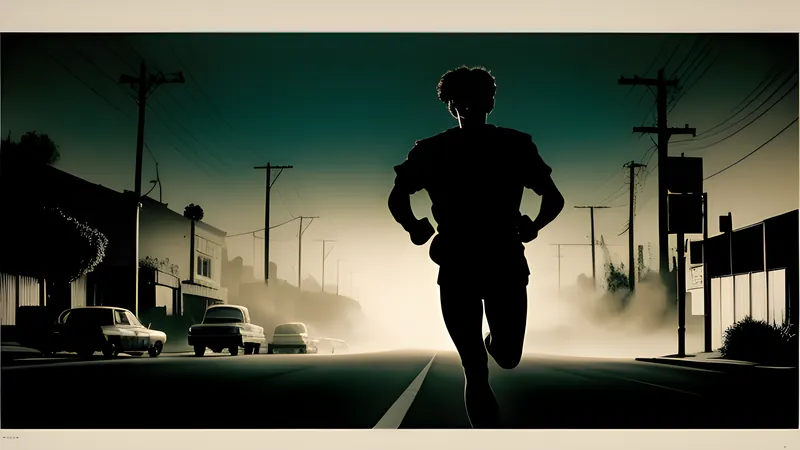
Told plainly, Sweet Sweetback follows its title character, a man raised in and working at a brothel, who intervenes when two white police officers are beating a young Black activist in their custody. Sweetback turns on the officers, and the rest of the film is a long, hallucinatory chase as he flees toward the Mexican border, pursued by a police force determined to make an example of him. Van Peebles plays Sweetback himself, and his young son Mario Van Peebles — later a director in his own right — appears as the character as a boy.
As a piece of storytelling it is deliberately raw. Van Peebles fractures the film with experimental techniques: superimpositions, jarring edits, repeated and distorted images, freeze-frames, a soundtrack that argues with the picture. Some of this is avant-garde ambition and some is the necessity of a filmmaker working without a net, and the film’s power comes partly from the fact that you cannot always tell which is which. It has the urgency of something made by a man who might not get another chance and knew it.
The content is frank, including the sexual material tied to Sweetback’s world, and it was exactly this frankness that the ratings board seized on. Handled as film history, the point to keep in view is that Van Peebles was insisting on depicting Black life, sexuality, and rage without the sanitising oversight that Hollywood had always demanded. The rawness was the argument. A polite version of this film would have proved nothing.
The fuse it lit
The film’s commercial success was the shot heard through every studio boardroom. When Sweet Sweetback made real money from an audience the studios had ignored, Hollywood did what Hollywood does and moved to capture the market Van Peebles had exposed. Within months, studio-backed pictures were chasing the same audience, and the blaxploitation cycle was under way in earnest — a wave of films, some exploitative and some genuinely fine, that gave Black actors leading roles and Black audiences heroes at a scale American cinema had never offered.
That lineage is the reason this film matters to the whole desk. The action heroines and vigilante avengers who followed owe a direct debt to the door Van Peebles kicked open, which is why Coffy and the birth of the action heroine belongs in the same conversation, and why the gangster-as-social-fury tradition runs straight through Black Caesar. Van Peebles built the road; those films drove down it and refined the vehicle.
There is a crucial distinction, though, and it is the source of a long argument. Sweet Sweetback was independent, Black-authored, and politically incendiary; the Black Panther Party reportedly made it required viewing, and Huey Newton devoted an issue-length essay to it. Much of the studio blaxploitation that followed was made by white-owned companies chasing profit, and critics at the time — including within Black communities — split hard over whether the wave uplifted or caricatured. Van Peebles’ film sits at the head of the movement while standing apart from most of it, an authentic radical statement that a commercial industry promptly turned into a formula.
Where it stands, and where to watch it
Sweet Sweetback is not an easy film to love in the way a polished classic is. It is jagged, sometimes tedious, occasionally incoherent, and its politics and sexual content have aged into genuine debate. That is the honest assessment. Its importance is not diminished by any of it, because the film was never trying to be well-behaved. It was trying to prove a point about who could make films and who they could be for, and it won that argument so completely that the industry spent the next several years imitating it.
Watch it as the origin document it is, ideally alongside the movement it spawned. It is available through the Criterion Collection, which restored it and framed it as the historically vital object it is, and that presentation — with its context and its care — is the way to meet it. Pair it with Ganja & Hess, Bill Gunn’s extraordinary and equally uncompromising Black-authored art film from a couple of years later, and you get a picture of the era’s radical fringe that the studio product never captures. Both films were made by artists who wanted to say something the industry did not want said, and both paid for it in obscurity before the reassessment arrived.
Spoilers below
The ending is the film’s manifesto, and it is why the picture became a rallying point rather than a tragedy. Sweetback survives. After a punishing flight across the desert, evading the dogs and the manhunt, he reaches the border and escapes, and the film closes on a promise instead of a death: a title card announcing that Sweetback is coming back to collect a debt. The convention Van Peebles was breaking is the older one in which the defiant Black protagonist is punished, caught, or killed to restore order. Sweetback refuses that ending.
That refusal is the whole point. Van Peebles understood that letting his hero win — letting a Black man beat the police and vanish free — was itself the radical act, a rejection of every narrative that required such a figure to be brought down before the credits. Audiences in 1971 responded to exactly that, and the film’s triumphant close is inseparable from its cultural detonation.
Seen now, the survival of Sweetback reads as the seed of everything that followed: the Black hero who wins, who is competent and dangerous and free, who walks out of the frame alive. It is a rough film with a clear idea, and the idea outlived every rough edge. Van Peebles lit the fuse, and cinema was different on the other side of the blast.
Related Content