Suspiria (2018): The Remake That Chose Dread Over Dazzle
Guadagnino answers Argento's fairy tale with mud, snow, and the German Autumn
Contents
The smartest thing Luca Guadagnino’s Suspiria does, it does before a single witch appears: it looks at Dario Argento’s 1977 original — a film built entirely out of saturated colour and screaming music — and decides to have almost none of either. Where Argento drenched his ballet school in impossible reds and greens, Guadagnino shoots his in the colour of a wet Berlin pavement: greys, browns, dishwater whites, the odd smear of dull crimson. Where Goblin’s score never let you breathe, Thom Yorke’s does almost the opposite, drifting and mournful. This is a cover version by a musician who understands that the way to honour a song is to play it in a different key. It works far more often than it has any right to, and where it fails, it fails interestingly.
I should declare the difficulty up front, because it is the whole story of the film’s reception. If you come to Suspiria (2018) wanting the original’s delirious highs, you will spend two and a half hours feeling starved. It is long, cold, deliberately unpleasant, and structured as “six acts and an epilogue set in divided Berlin, 1977,” a title card that tells you exactly how much homework the film intends to make you do. But taken on its own terms — as a film about bodies, power, and a country refusing to look at its own past — it is one of the most ambitious horror pictures of its decade, and the ambition is legible in every choice.
The city is the monster
Argento’s Freiburg was a fairy-tale nowhere, a location chosen for its Art Nouveau strangeness. Guadagnino moves the story to a specific, bleeding Berlin in the autumn of 1977 — the Deutscher Herbst, the “German Autumn,” when the Red Army Faction’s kidnappings and the Lufthansa hijacking had the divided city in a state of siege. The dance academy sits pressed against the Wall, and the film keeps cutting to news bulletins, protests, and the low grinding paranoia of a nation still not talking about what it did in the war and now tearing itself apart in the present.
This is the film’s central argument, and it is a real one: a coven of witches, hiding in plain sight, feeding on the young, protected by ritual and silence, is a metaphor for a Germany full of former Nazis who were never held to account. The older women who run the Markos Dance Academy are exactly the generation who would have been adults in the 1940s, and the film makes you count the years. It is a reading Argento never gestured at and it gives the remake a spine the original happily lived without. Whether horror needs a thesis this heavy is a fair question — and it is the same question you might ask of Hereditary, released the same year, which also buries a family tragedy under an occult mechanism. Both films are betting that the metaphor deepens the fear rather than diluting it.
Dance as violence
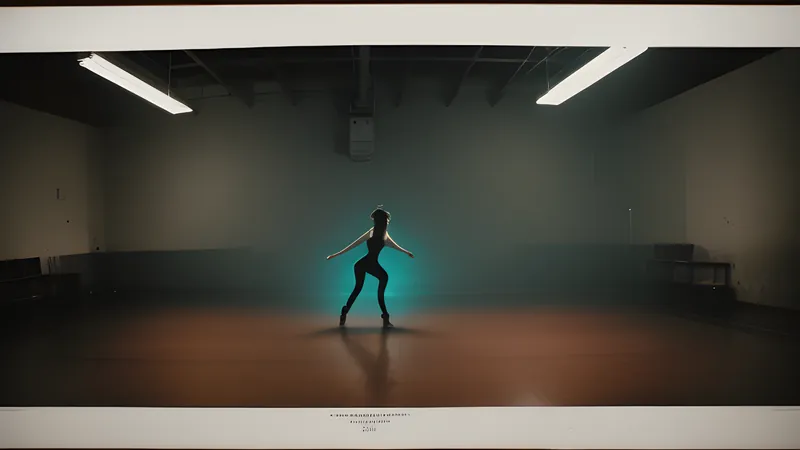
Here is where the remake fully justifies itself, and where its craft is most worth studying. Argento’s Suspiria was set at a dance academy but barely bothered to show any dancing. Guadagnino, working with the choreographer Damien Jalet, makes dance the film’s weapon. The company is rehearsing a piece called Volk, all stamping feet, jerking limbs, and clenched collective fury, and the film treats the choreography as a form of spellcasting — the dancers’ bodies are the instruments of the coven’s power.
The set-piece that announces this is one of the great horror sequences of the century, and I will keep it spoiler-free: a young woman dances in one studio while, in a mirrored room she cannot see, her body becomes the puppet that punishes another dancer. Guadagnino cross-cuts the two spaces, matching every leap and contraction to a corresponding snap and fold in the victim, and the editing rhythm turns art into torture in real time. It works because it is built on a real principle — that dance and physical horror share a vocabulary of the body pushed past what it should endure — and because Guadagnino refuses to look away or speed up. The camera holds; the sound design (bone, breath, tendon) does the rest. It helps that Olga, the dancer being broken, is played by Elena Fokina, a trained contortionist whose bends are largely performed rather than digitally faked, so the horror carries the authority of a real body doing a real thing. Cinematographer Sayombhu Mukdeeprom — Guadagnino’s collaborator on Call Me by Your Name the year before — shoots it on grainy, desaturated stock that lights the room like a fading memory, which is why the sequence feels excavated rather than staged. Argento’s violence was operatic and beautiful. This is clinical and anatomical, and in its way far harder to watch.
Tilda Swinton, three times
The film’s most talked-about stunt is also one of its best ideas: Tilda Swinton plays three roles. She is Madame Blanc, the academy’s magnetic lead choreographer; she is, under heavy prosthetics and a male pseudonym in the credits, the elderly psychoanalyst Dr. Josef Klemperer, an old man haunted by a wife lost to the Holocaust; and she takes a third role I will leave for below the line. Casting one actor as the artist, the witness, and the horror is not a gimmick — it knots the film’s themes into a single body, the same face wearing guilt, authority, and rot.
Dakota Johnson plays Susie Bannion, the American Mennonite who arrives from Ohio with an unexplained hunger to dance, and Johnson’s slightly opaque, watchful quality — which can read as blankness in lighter films — is deployed here with real purpose. She is being drawn toward something, and the film keeps you guessing whether she is prey, pupil, or something else entirely.
The verdict
Suspiria (2018) is a flawed, overreaching, genuinely singular film, and I would take an interesting failure over a safe success every time this one comes up. It is too long; the German Autumn material and the Klemperer subplot sometimes feel like two films competing for the same runtime; and the climax makes a swerve into blood-drunk excess that either crowns the whole thing or capsizes it, depending on the viewer. But the ambition is total, the dance horror is unmatched, and the decision to answer Argento’s dazzle with dread is the rarest thing a remake can offer — a real argument with its source rather than a photocopy of it.
Watch it directly after the 1977 original and the pairing becomes a seminar on what horror is for: sensation versus meaning, colour versus cold, the fairy tale versus the history book. If the folk-ritual dread is what hooks you, Midsommar makes the natural double bill — another horror film that drags the genre out of the shadows and into a pitiless, over-lit clarity, and another where a young woman finds a terrible belonging in a group that means to use her. The three together map the modern art-horror project better than any essay could.
Spoilers below
Safe above the line; endings below.
The third Swinton role is the payoff of the casting: she plays Mother Markos, the ancient, diseased witch who has been posing as one of the Three Mothers and hoarding the coven’s power to prolong her own ruined life. The film’s late revelation is that Susie is not the coven’s victim at all. She is Mater Suspiriorum, the true Mother of Sighs, arrived in the flesh — and the climactic Sabbath, a red-lit orgy of nudity and viscera that finally, deliberately, floods the drab film with Argento’s missing colour, is the moment she claims her authority.
That climax is the film’s great gamble. Susie descends into the coven’s chamber, exposes Markos as a fraud, and summons Death — a hooked, glistening figure — to slaughter the witches loyal to the pretender, sparing those who chose her. It is grotesque, ecstatic, and tonally miles from the austere film that preceded it, and the split-decision reaction is entirely earned; the sequence is either a magnificent release of everything the film withheld or a lurch into camp. I lean toward release, because of what follows: the coda.
Susie visits the grieving Dr. Klemperer, the old man the coven had used and tormented, and grants him mercy — she erases his memory of the horror and, crucially, of his wife’s death, taking his unbearable grief away as her first act of power. It reframes the whole film. The new Mother’s opening gesture is compassion toward the film’s one true innocent, the Holocaust widower who spent the story looking for a wife murdered by the last generation of monsters. The witches, the RAF, the war: everyone in this Berlin is haunted by an unpunished past, and the one force that offers relief is the ancient, amoral thing the movie called a monster. That is a far stranger and sadder ending than Argento’s grinning survivor walking out of the flames, and it is why, for all its bloat, the remake stays with me longer than it should.
Related Content