Sunset Boulevard: The Corpse Who Narrates
Wilder pointed Hollywood's own machinery at Hollywood, cast the wreckage as itself, and got away with it by opening on a dead man
Contents
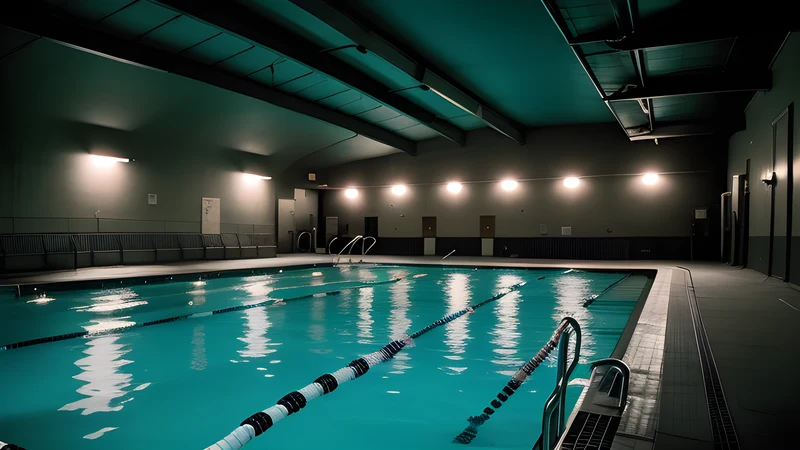
The narrator of Sunset Boulevard is face down in a swimming pool while he tells you the story. Billy Wilder announces this in the first two minutes — police cars on a Los Angeles street at dawn, a body in the water, a voice explaining with some amusement that the dead man is going to give you the facts before the columnists garble them. The gambit does what the confession into the dictaphone did in Double Indemnity six years earlier: it removes suspense so that the film can spend its energy on the mechanism instead. You are not watching to find out what happens. You are watching a man walk, knowingly and step by step, toward a pool he is already floating in.
It should have been unmakeable. A 1950 studio picture whose subject is the studio system’s habit of using people up and leaving them in the hills, financed by Paramount, shot on the Paramount lot, and starring the industry’s actual casualties playing versions of themselves. Louis B. Mayer reportedly told Wilder to his face that he had disgraced the industry that fed him. Mayer was, on the evidence, correct about the intent and wrong about everything else.
A hack, a mansion, and a car park with no exit
Joe Gillis (William Holden) is a screenwriter with no credits worth the name, three months behind on his car payments, and a talent for the plausible pitch. The film’s first act is one of the most accurate accounts of the writing trade ever filmed: Joe sits in a producer’s office selling a baseball story he does not believe in, is turned down by a reader who has seen through it, and drives away from the lot with men from the finance company on his tail. He is not a tragic artist. He is a man whose rent depends on a lie he cannot land.
The flat tyre is the film’s whole cosmology — an accident that puts him in a driveway on Sunset Boulevard, where a decaying mansion sits with an empty pool and a dead chimpanzee awaiting burial. Norma Desmond (Gloria Swanson) was a silent star. She has been out of pictures for twenty years, lives with her butler and her own films, and is writing an enormous unproduceable screenplay about Salome in which she will return. She needs someone to fix the script. Joe needs three hundred dollars and a room. The transaction that follows is the film’s engine, and Wilder’s precision about it is merciless: nothing in this house is romance, and both parties know the terms, and the awful thing is how quickly a man will take them.
Swanson’s Norma is not a caricature of a lunatic. She is a woman whose entire professional apparatus — the gestures, the eyes, the address to an audience — was rendered obsolete by a technical change, and who has never been told what to do with the equipment. Every mannerism that reads as madness is a silent-film skill deployed in a room, and the film’s deepest sympathy is for the fact that she is still, technically, magnificent. She is a Stradivarius in a house where nobody plays.
Why it works: the casting is the argument
The masterstroke is not the writing. It is the casting, which does argumentative work no dialogue could.
Erich von Stroheim plays Max von Mayerling, Norma’s butler and chauffeur, a formal and watchful presence who runs the house and answers her post. Von Stroheim himself was a great director, one of the most celebrated in Hollywood before the industry decided he was uncontrollable and gradually reduced him to acting in other men’s pictures. When Max screens one of Norma’s old films for her in the drawing room, the film they watch is Queen Kelly (1929) — a real Swanson picture, directed by von Stroheim, whose production collapsed and did lasting damage to both their careers. Wilder therefore has a ruined director, in a servant’s uniform, running a projector showing the ruined film he made with the ruined star, all three of them playing themselves at one remove. No line of dialogue could carry that. The film simply casts it, and what the arrangement means inside the story is something Wilder saves for much later.
The same method runs through the picture. Norma’s bridge partners are Buster Keaton, Anna Q. Nilsson and H. B. Warner — genuine silent-era figures, sitting at a card table, given almost nothing to say. Cecil B. DeMille plays himself on a soundstage, directing, and treats Norma with a courtesy that is more devastating than cruelty would be, because he is kind to her the way you are kind to the dead. Hedda Hopper appears as Hedda Hopper. Wilder built a film about Hollywood’s disposal of its own out of the disposed, and their presence in the frame is the evidence for the prosecution.
John F. Seitz, who had lit Double Indemnity, shoots the mansion as a haunted house — dust in the beams, hard shafts through shutters, an interior that has stopped being a home and become an exhibit. And the pool shot, the one everybody knows, is a piece of low-tech ingenuity: rather than put a camera under water, the production placed a mirror on the bottom of the pool and photographed the reflection from above, which is why the dead man appears to be looking up at you through the water. The image that opens the most sophisticated film ever made about the industry was achieved with a sheet of glass and a good idea.
Franz Waxman’s score does the last piece, keeping a romantic sweep going under scenes that have no romance in them, so the house always sounds like a picture that Norma is still starring in.
The opening they had to throw away
The film’s original opening was set in a morgue. Wilder shot a sequence in which Joe’s body is brought in and the corpses on the slabs — a drowned man, others — begin to talk to each other and tell their stories, from which Joe’s narration would emerge. It was previewed, and the audience laughed. Not nervously; they laughed the film off the screen, and Wilder said afterwards that he had lost the audience in the first reel and never got them back.
So he reshot it. The pool, the police, the voice. The lesson is worth keeping, because it is not that the morgue idea was bad — it is macabre and very Wilder, and on the page it is arguably wittier. It is that a film which is going to ask an audience to accept a dead narrator for two hours must sell that contract in a register the audience will not resist, and a body in a pool at dawn with sirens coming is beautiful, where a talking corpse is a joke. Wilder traded the cleverer opening for the one that worked. It is the single best-documented example in Hollywood history of a great director being saved by a preview card.
The real ancestor, and the heirs
The gothic bones are older than Hollywood: a great house, a woman preserved in the moment of her ruin, a young man trapped by an arrangement he entered voluntarily. Great Expectations’ Miss Havisham is in this room, and so is every haunted-mansion picture where the ghost is a person who has not been told they are finished.
Within the trade, its immediate company is A Star Is Born and The Bad and the Beautiful — films the industry could make about itself because they end in redemption or ambivalence. Sunset Boulevard offers neither, and Wilder went straight from it into Ace in the Hole, which turns the same contempt on the news trade and got him the punishment he had escaped here. The difference in reception is instructive: Hollywood will let you savage Hollywood, because being fascinating is the industry’s only real requirement. It will not let you savage the audience.
Downstream: Mulholland Drive is unthinkable without it, The Player is its comic descendant, and every film about a fading performer in a decaying house — a lineage running through What Ever Happened to Baby Jane? and out the other side into horror — is working the ground Wilder broke. Swanson’s Norma is the direct ancestor of an entire subgenre in which old glamour becomes monstrous, though almost none of the followers grant her the dignity Wilder does.
The honest case against
Betty Schaefer (Nancy Olson), the young script reader Joe falls for, is the film’s dead spot. She exists to give Joe an exit he can refuse, and Wilder — normally the most economical writer in the business — spends real screen time on a romance that never generates a volt. The film’s structure needs her; the film’s texture rejects her every time she appears, because she is the only person in it who is not damaged, and the picture has no idea what to do with health.
There is also a case, which I half believe, that Holden’s Joe is written slightly to the audience’s advantage: he narrates with such wised-up self-awareness that he is always a step ahead of his own venality, which lets us enjoy his company while he does contemptible things. Compare Tatum in Ace in the Hole, who is given no such cushion, and you can see what Wilder withheld here to keep the film palatable.
Where to find it: it is a permanent repertory fixture and available in an excellent restoration. See it with an audience if you can, and watch the room’s reaction when the bridge table comes into shot — half of it recognises Keaton, and the half that does not is being told something anyway.
Spoilers below
Joe dies because he tells Norma the truth, and the truth is the one thing the house was built to keep out.
The last act turns on the letters. Norma has been receiving fan mail, and it has been keeping her upright — evidence that the public still wants her, that the return is real. Max writes them. He has been writing them for years, forging an audience for a woman who has none, and he is unembarrassed when it comes out: he was the first of her three husbands and the director who made her, and having lost the ability to give her a career, he has been manufacturing the only thing she still needs. That is the most extraordinary act of love in any film of the period, and Wilder never once calls it that. He plays it as a man explaining a system he maintains.
The other truth is DeMille’s. The studio has been telephoning the mansion, and Norma believes they want Salome. They want the car — Norma’s antique Isotta-Fraschini, wanted as a prop, for a fee. DeMille, learning this, is decent enough to hide it from her, and the film lets him: he sends the underling away and gives her an afternoon on a soundstage instead. It is the only mercy anyone in the industry extends to anybody in two hours, and it is a lie.
When Joe finally lays out the arithmetic — no studio, no comeback, no audience, and the fan letters are Max’s — he is not being cruel, exactly. He is trying to leave, and he has worked out that the only way out is to take the house apart. She shoots him in the back on the way to his car, and he goes into the pool that has been floodlit and waiting since the first reel.
Then the newsreel cameras arrive for the murder, and Norma comes down the staircase into the lights. Max, in his last act of service, stands beside the camera and directs her, and she plays the scene — the descent, the address, the enormous silent-era face filling a frame she cannot see the edges of. She is not confused about the cameras. She is a professional doing the only thing she was ever taught, for the only audience that ever came back for her, which is the press at a crime scene. The film’s final joke is that it works. She is, for thirty seconds, exactly as magnificent as she has been claiming, and the industry that discarded her is filming it for the front page.
Related Content