Street Trash: The Melt Movie as Reagan-Era Fable
A case of poisoned wine, a junkyard full of the forgotten, and the goriest social satire of 1987
Contents
There is a small, disreputable genre of 1980s horror that fans call the melt movie, and Street Trash is its filthy masterpiece. The premise is a one-line joke: a liquor-store owner finds a dusty case of wine called Tenafly Viper walled up in his cellar, sells it for a dollar a bottle to the homeless men living in a junkyard, and the wine dissolves anyone who drinks it into a puddle of glowing coloured slime. That is the whole engine. What makes the film worth a revisit almost forty years on is that Jim Muro and writer-producer Roy Frumkes built something around that joke — a genuinely angry, genuinely funny fable about who American prosperity decided was disposable, told in the most tasteless idiom available.
The dollar-a-bottle apocalypse
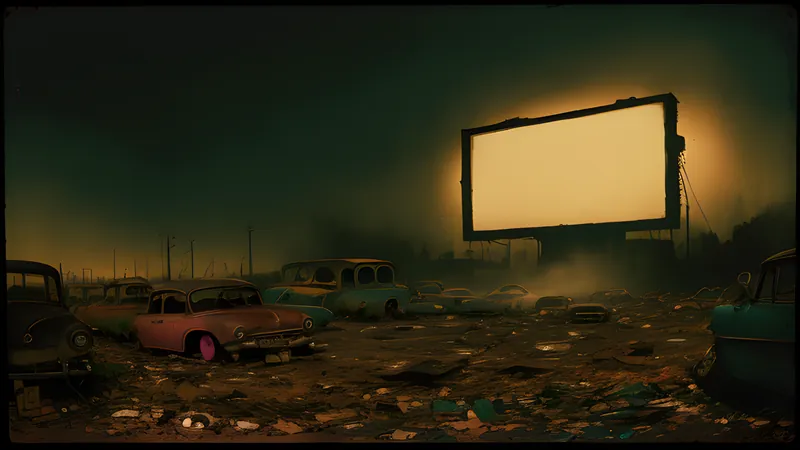
The setting is a wrecking yard in Queens, a shantytown of the discarded ruled over by Bronson, a Vietnam veteran whose war never ended and who has appointed himself warlord of the dump. Into this world Muro drops two brothers, Fred and Kevin, scavenging to survive, and a supporting cast of the city’s cast-offs. The Viper wine arrives like a plague with a price tag. The first victim climbs into a toilet as his body liquefies, and Muro films the melt as a hallucinatory eruption of chartreuse and magenta, the human body reduced to a fizzing chemical spill. It should be unwatchable and instead it is oddly beautiful, a candy-coloured death that treats dissolution as spectacle.
The film keeps this up for ninety minutes and never once loses its nerve or its grin. There is a plot of sorts — Bronson’s tyranny, a detective circling the yard, a wedding-ring subplot, a nightwatchman running an extortion racket — but the structure is closer to a poison spreading through a community than to a story with a hero. People drink, people melt, and the survivors keep scrounging, because the alternative to the yard is nothing at all.
Why the effects still land when the CGI era’s do not
The melts are the reason anyone remembers Street Trash, and they hold up for a specific, teachable reason: they are physical, they are in the room, and light behaves correctly on them. Muro’s crew built the dissolutions out of coloured gels, wax, air bladders and a great deal of ingenuity on a budget reported at around half a million dollars. Because the goo is really there, it catches the light, pools on real surfaces, and casts real shadows, and your eye reads it as matter even when your brain knows it is a gag. That physical presence is exactly what most digital gore of later decades fails to buy at any price, because rendered fluid tends to sit on top of the image rather than inside it.
Then there is the camera, which is the film’s secret weapon and the real story of its afterlife. Street Trash was Jim Muro’s calling card, and he moves it constantly — low, gliding, restless, prowling the junkyard in long unbroken takes. Muro was an early master of the Steadicam, and he went on to operate the camera on some of the most physically ambitious American films of the following decades. His later credits read like a syllabus of hard-to-shoot studio cinema — the battlefield sweeps of Dances with Wolves, the molten steel-mill climax of Terminator 2: Judgment Day, the prowling floors of Scorsese’s Casino. The grammar is already fully present in the junkyard: the operator finds a moving eye-level for chaos, keeps the horizon alive, and lets the camera discover the gore in a single gliding take. A melt filmed that way reads as an event happening in real space, and that spatial honesty is exactly what sells the illusion. You can watch him teaching himself here, using a piece of grimy no-budget exploitation as a laboratory for a virtuoso technique. The film glides through squalor with a grace its subject matter actively insults, and that tension — elegant motion, degraded content — is a large part of why it feels alive rather than merely gross.
The fable under the sludge
Frumkes wrote Street Trash as satire, and the satire is sharper than the reputation suggests. This is a 1987 film about the people Reagan-era America had agreed to stop seeing: the homeless, the addicted, the veterans discarded after the war, the men living in the literal refuse of a boom economy. The joke of the killer wine is that it is cheap, it is aimed squarely at the poor, and it destroys them for a dollar while everyone with money looks away. The film is disgusted, and its disgust is pointed upward even as its imagery wallows in the gutter. It uses the melt movie’s licence for anything-goes bad taste to say something no respectable social-issue drama of the period would touch: that the safety net had a hole in it exactly the size of these men, and the culture found that funny.
That is the collector’s key to Street Trash. It belongs to a lineage of splatter films that smuggle real venom inside the viscera. Its closest sibling in craft and comic timing is Peter Jackson’s Dead Alive, made a few years later on the other side of the planet, another film that pushes practical gore past the point of horror and into a kind of delirious slapstick. Its closest sibling in intent is Society, Brian Yuzna’s 1989 body-horror satire, which uses melting flesh to attack the American ruling class from the top down while Street Trash attacks the same system from the bottom up. Watch the three together and you have a small, oozing history of how horror in the late 1980s did the political commentary that prestige cinema was too polite to attempt.
The problem with the film, and why it survives anyway
Street Trash is not a film I can recommend without warnings, and the warnings are real. It is casually cruel in ways that were provocation in 1987 and read as ugliness now — the treatment of its women characters in particular is nasty, and the infamous game of keep-away with a severed body part is exactly as juvenile as it sounds. There is a mean streak that runs alongside the satire, and at times the film indulges the very contempt it claims to critique. An honest revisit has to hold both things at once: the movie is smarter than its reputation and also genuinely tasteless, and it does not always know the difference between attacking cruelty and enjoying it.
There is also a structural looseness that a defender has to concede. Street Trash was expanded from a short film, and the seams show — the detective subplot drifts, the extortion racket at the newsstand feels imported from a different picture, and the tone lurches between genuine satire and pure gross-out gag with no warning. A tighter film would have chosen. What you get instead is a sketchbook, a young director throwing every idea he had at the wall of a junkyard set and filming the ones that stuck with more energy than the material could reasonably support. The messiness is part of the texture, and it is also, honestly, a flaw. Both things are true at once, and pretending otherwise would be the wrong kind of advocacy.
What redeems it is conviction and craft. Muro clearly loves these ruined men, gives them faces and grievances and jokes, and films their world with more care than the world ever gave them. The satire has teeth. The effects are a lost art performed at a very high level for no money at all. And the whole thing moves with a confidence that a lot of better-behaved films would envy. If you come to Street Trash expecting only a gross-out and stay for the fable underneath, you will understand why the melt movie, that most disreputable of little genres, occasionally produced something that deserves the word cinema. For the wilder, funnier extreme of the same impulse, the film to reach for next is Dead Alive, where the blood stops being a metaphor and becomes an ocean.
Spoilers below
The film’s most surprising move is how far it lets its villain go before ending him. Bronson, the deranged veteran, is revealed across the film as the true monster of the junkyard — his war flashbacks curdling into full psychosis, culminating in a wedding-day rampage where he takes a hostage and murders his way toward a final confrontation. Muro plays the reveal patiently, letting the Viper wine feel like the film’s threat for its first hour before making clear that the chemical plague is almost incidental next to the human one. The melting men are victims of a poisoned economy; Bronson is what that economy grew in one of its casualties.
The ending refuses catharsis. Fred survives, more or less, but the film grants no cleansing and no justice worth the name — the yard remains, the poison has run its course, and the world outside has learned nothing and noticed nothing. The last image lands the fable: these lives ended in coloured slime and a dumpster, and the city rolls on above them without a pause. Street Trash spends ninety minutes making you laugh at the disposal of human beings, then leaves you sitting in the silence of having done exactly that. The cruelty is the argument. That is either the film’s failure or its dirtiest triumph, and after four decades I have come around to the second reading.
Related Content