Stalker: The Zone as a Test of Faith
Tarkovsky's ruined pilgrimage and the room that grants your deepest wish
Contents
Somewhere in an unnamed country there is a forbidden, fenced-off region called the Zone, where an unexplained event — a meteorite, an alien visitation, no one knows — has left the ordinary laws of the world unstable. At the heart of the Zone is a Room, and the Room is said to grant the deepest wish of anyone who enters it. Guides called Stalkers smuggle desperate people past the soldiers and the wire, through the shifting traps, toward the Room. That is the entire plot of Andrei Tarkovsky’s Stalker (1979), and it takes roughly two hours and forty minutes, and almost nothing in it is what a synopsis would lead you to expect.
Stalker is science fiction in the way a cathedral is architecture: technically the category fits, and it misses everything that matters. Tarkovsky took a lean, ironic adventure novel by the Strugatsky brothers and slowed it into a pilgrimage, a religious parable filmed in the drowned, rusting, overgrown ruins of the industrial world. It is one of the hardest films the genre has produced and one of the most rewarding, and it nearly killed everyone who made it.
The impossible production
You cannot separate Stalker from the ordeal of its making, because the ordeal is visible in every frame. Tarkovsky shot an entire version of the film first, and the footage was ruined in the lab — a processing disaster, blamed variously on faulty stock or mishandling, that destroyed months of work and much of the budget. He started again, effectively remaking the whole film, with a new cinematographer (Alexander Knyazhinsky, after a bitter split with Georgy Rerberg) and a changed conception.
They filmed near Tallinn in Estonia, in and around a derelict hydroelectric station and a river downstream from a chemical plant. The locations were toxic. Crew members waded through polluted water for weeks. Several people involved in the production, including Tarkovsky himself and his wife Larisa and the actor Anatoly Solonitsyn, later died of cancers, and while no one can prove the causal chain, the suspicion has hung over the film for decades and is impossible to shake once you have heard it. The ruined, poisoned world on screen was a ruined, poisoned world in fact. That knowledge changes how you watch the water pooling over tiled floors and the moss climbing the machinery — you are looking at real decay, filmed by people it may have been killing.
The three men and the crossing
The film follows three characters, none given proper names. The Stalker (Alexander Kaidanovsky), gaunt and shaven-headed, is the guide, a believer who treats the Zone as sacred and smuggling pilgrims to the Room as a vocation he cannot give up despite a prison record and a despairing wife. He leads two clients. The Writer (Anatoly Solonitsyn) is a cynic in a leather coat who has lost his inspiration and his faith in his own talent, sardonic about the whole enterprise. The Professor (Nikolai Grinko) is a scientist with a rucksack and a hidden agenda, the rationalist of the group.
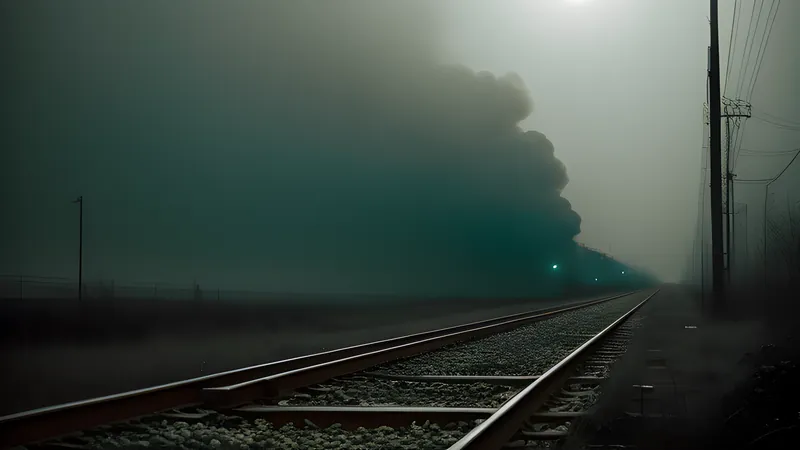
Tarkovsky’s most famous formal choice governs the crossing: the scenes in the ordinary world outside the Zone are shot in a sickly monochrome sepia, and when the three men finally reach the Zone, the film blooms into colour. Rust-green, water-grey, the wet green of overgrowth. It is the exact inversion of the cliché — the forbidden, dangerous, unstable place is the only place that is fully alive, while the safe human world is drained and dead. The Zone is beautiful and the traps are invisible, and the Stalker refuses to walk in straight lines, throwing metal nuts tied with rags to test the path, insisting that the way is never direct and never the same twice, because the Zone responds to who you are and punishes the arrogant.
Why the Room is the terror
The engine of the whole film is the Room’s promise, and Tarkovsky sharpens it into a horror while pretending to offer a gift. The Room does not grant your stated wish. It grants your deepest, truest, most secret desire, the one beneath the one you would admit to. And so the closer the men get, the more terrifying the Room becomes, because none of them can be certain what their deepest wish actually is, or whether they could survive seeing it revealed.
The Stalker tells a story about a legendary predecessor, nicknamed Porcupine, who entered the Room hoping to bring back a dead brother and instead came out suddenly, inexplicably rich — and then hanged himself, because the Room had shown him that his truest desire was money rather than his brother, and he could not live with the knowledge of what he really was. That is the trap the whole pilgrimage walks toward. The Room is a machine for stripping away self-deception, and self-deception is the only thing holding most people together.
This is the craft mechanism that makes Stalker endure. Tarkovsky spends two and a half hours making you long, alongside the characters, to reach a place that could destroy you by telling you the truth about yourself, and then he stages the arrival as an anticlimax so charged that it becomes the most suspenseful passage in the film despite nothing physical happening. The suspense is entirely internal. The threat is knowledge. I will keep the threshold below the line.
The real ancestor of this
Stalker has an obvious sibling in Tarkovsky’s own Solaris, which also uses a science-fiction premise — an alien intelligence, a machine that materialises your inner life — as a route to a spiritual and moral crisis. Where Solaris is watery and mournful, Stalker is earthbound and ascetic, but they are the two halves of Tarkovsky’s argument that the genre’s job is to turn the human gaze inward.
The deeper ancestor is older than cinema. Stalker is a Grail quest — three flawed men journeying toward a sacred site that will test their worthiness — grafted onto the Russian tradition of the yurodivy, the holy fool, which the Stalker embodies completely: despised, ragged, apparently mad, and closer to grace than the clever men he guides. Bunyan’s Pilgrim’s Progress is in its bones; so is the Book of Job. The Strugatskys’ Roadside Picnic supplied the machinery, and it is a fine, wry novel worth reading precisely to see how radically Tarkovsky transfigured it, keeping the Zone and the Room and discarding almost everything else.
You can also draw a straight line forward to every serious slow-cinema science-fiction film since: the pilgrimages of Denis Villeneuve’s Arrival and Blade Runner 2049 both carry Tarkovsky’s DNA in their bloodstream, the conviction that a long held shot and a patient camera can do metaphysical work no amount of spectacle can touch.
Spoilers below
They reach the threshold of the Room, and none of them go in. That is the film’s devastating pivot. After the whole arduous journey, the three men stand at the doorway of the thing they crossed the Zone to reach, and each finds a reason to refuse.
The Professor’s hidden agenda is revealed first: he has been carrying a bomb, intending to destroy the Room so that no one — no tyrant, no madman — can ever use it to inflict their deepest desire on the world. It is a rationalist’s terror of the irrational, the scientist deciding the wishing-place is too dangerous to exist. The Writer talks him out of it, and in the same conversation talks himself out of entering, because the Writer has understood the Porcupine story too well. To enter the Room is to learn what you truly want, and the Writer suspects that what he truly wants would shame him, that his desire for artistic greatness is really a hunger for fame and validation, and he would rather not know. So he refuses out of cowardice dressed as wisdom, or wisdom dressed as cowardice; the film will not tell you which.
The Professor dismantles the bomb. Nobody wishes. The men sit at the threshold, exhausted, and go home. The Room’s power is never tested, and that is the point: faith that goes untested stays intact, and these men would rather keep their comfortable uncertainty than risk the truth. The Stalker is broken by it, weeping at home that he has led people who did not believe, who had no faith to bring to the sacred place, for whom the miracle was wasted.
Then Tarkovsky delivers the ending that reframes everything. Back in the sepia world, the Stalker’s daughter — nicknamed Monkey, disabled, apparently unable to walk — sits at a table, and in the film’s final shot she appears to move a glass across the surface with her gaze alone, telekinesis, while a train rumbles past and Beethoven surfaces on the soundtrack. The Zone’s strangeness has come home, or the child is herself the miracle, the one being who did not need to make the journey because she carries the faith and the grace the three men lacked. The film ends on the impossible made quiet and domestic, a girl and a glass and the suggestion that the sacred was in the ordinary world all along, unlooked-for.
My verdict: Stalker is the summit of Tarkovsky’s cinema and one of the hardest ascents the genre asks you to make, a film that converts the pulp materials of forbidden zones and wish-granting rooms into a genuine work of religious art. It demands surrender rather than attention, and it does not care whether you are entertained. Give it the full runtime and no distractions; watch Solaris first if you have not, so that Tarkovsky’s method is familiar before you attempt its most rigorous expression. Then read the Strugatskys, and understand that you have seen the film against which contemplative science fiction still measures itself.
Related Content