StageFright: Soavi's Owl-Masked Slasher Ballet
A first-time director takes a cheap Italian body count and choreographs it
Contents
Michele Soavi was thirty when Deliria went before the cameras in 1987, and he had already spent most of the decade standing just off frame in other people’s horror films. He took small acting parts for Lucio Fulci and for Lamberto Bava in A Blade in the Dark. He assisted Dario Argento on Phenomena and worked on Demons for Argento and Bava. In 1985 he directed Dario Argento’s World of Horror, a documentary that amounts to a young man’s fan letter shot with a professional crew. When he finally got a picture of his own, it came from Filmirage — Joe D’Amato’s company, the least prestigious address in Italian genre production, an outfit built to turn cheap negatives into foreign pre-sales.
The lineage predicts nothing about the film that arrived. StageFright — it also travelled as Aquarius, StageFright: Aquarius and, in some territories, Bloody Bird, which tells you how much confidence the sales agents had — is one of the most controlled debuts in European horror. The script came from Luigi Montefiori, the actor better known as George Eastman, writing here under the name Lew Cooper. Renato Tafuri shot it. Simon Boswell and Stefano Mainetti split the score. Everything about the paperwork says disposable. The film that emerged is a piece of formal control.
The setup is a trap with the lid welded on
A theatre company is rehearsing a musical about a real mass murderer, the Night Owl, in the kind of 1980s stage production where dancers in leotards make shapes around a man in an enormous feathered bird’s head. The lead, Alicia — Barbara Cupisti, who would become Soavi’s recurring anchor — twists her ankle. She and the wardrobe mistress slip out to the nearest place with a doctor, which happens to be a psychiatric hospital, because the film needs that coincidence and has the nerve to make it in the first reel.
Inside that hospital is Irving Wallace, an actor who killed sixteen people and has been sitting quietly ever since. He gets out. He gets into the theatre. And Peter, the director — David Brandon, playing him as a man who has read one interview with a great auteur and internalised only the cruelty — decides that a murder on the premises is the best publicity the show will ever get, locks the company in for an all-night rehearsal, and has the only key hidden.
That is the whole engine. Soavi discards the giallo’s central pleasure, the whodunnit, within twenty minutes: you know who the killer is, you know he is inside, you know the door is locked. The suspense becomes geometric. Where is he standing, where is the key, how many metres to the exit, and who has just walked into the wrong wing of the building. Argento built careers on the audience squinting at a memory of a painting. Soavi builds his on the audience counting doors.
Why it works: the tableau
The film’s reputation rests on a single sequence, and it earns it.
Midway through, the killer takes the stage. He puts on the giant owl head from the production. He arranges the bodies of the people he has murdered around the set like a director blocking a scene — seated, posed, lit. Then he sits down in the middle of them, in the mask, and waits. Feathers drift through the air from the wrecked costumes. A cat wanders across the boards. Boswell’s theme plays. The camera cranes back and holds.
It is the most audacious thing in the film because it stops the film. A slasher’s contract is momentum: kill, react, run, kill. Soavi puts the machine in neutral for minutes at a time and asks you to look at the composition — which is exactly what the killer is asking, too. The man in the owl mask has made a tableau, and the film shoots it as a tableau, and the two acts of authorship sit on top of each other. Soavi’s cynical director wanted a spectacle out of the deaths. The killer delivers one, and does it with better taste.
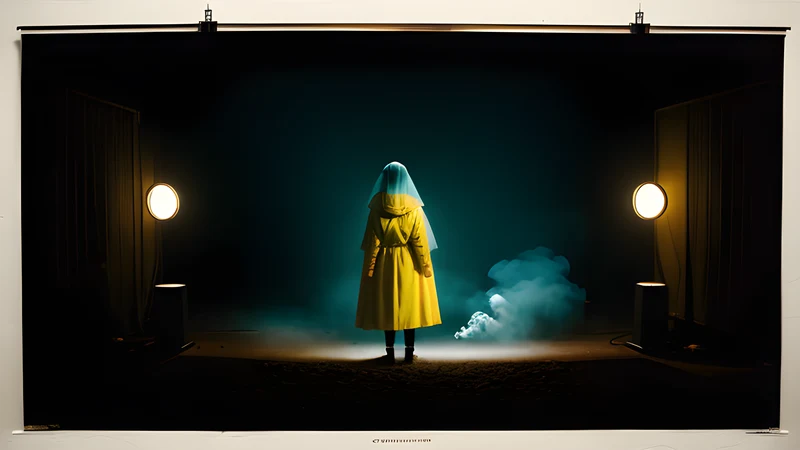
The craft holds up under the idea. Tafuri lights the stage with hard theatrical sources — followspot whites against black flats — so the corpses read as figures in a set, the gore subordinate to the composition. The owl head is a masterstroke of design economy: huge, matte, blank, with the eyes fixed forward, so the actor inside cannot signal anything. Every other slasher mask of the decade borrowed a human face and drained it. This one borrows a bird and keeps the bird’s indifference. When the head turns, it turns the way a real owl’s does, in a snap, and it is genuinely unpleasant.
The real ancestor is older than Argento
Everyone files this under Argento, and the surface invites it — the gloved violence, the saturated lighting, the Italian musician on the synthesiser. Argento’s own Opera came out the same year, also set in a theatre, also about art and murder sharing a building.
Look further back, though. The true ancestor is Mario Bava’s Blood and Black Lace from 1964, the film that invented the modern body count by removing the detective from his own genre. Bava put a faceless white mask in a fashion house and let the killings become the plot; the mannequins in that film do what the posed corpses do here. Soavi.s real inheritance runs through Bava, and the tableau on the stage is a direct descendant of Bava’s shop-window horror — beauty arranged around a corpse until you cannot separate the two.
The other ancestor is American and unfashionable to admit: the theatre slasher of the early eighties, the locked-building pictures that followed Halloween. Soavi takes that grammar seriously enough to execute it properly, which almost nobody in Italy bothered to do. If you want the wider argument about how the giallo’s fingerprints got onto the American slasher and then came home again, the desk has it in the giallo’s fingerprints on the modern slasher, and Bava’s founding move is unpacked in Blood and Black Lace.
What Soavi did next, and why it matters here
StageFright was the audition. Two years later Soavi made The Church, a project that began life as a third Demons film and turned into a cathedral-set fever dream with a budget behind it. In 1994 he made Dellamorte Dellamore — Cemetery Man — which is the best film anyone in Italian horror made after 1985 and which uses the same trick as the tableau here: stop the horror, hold the frame, let the image become an argument. Then he largely left the genre, working in television and returning to features with crime material.
He also went straight from this to assisting Terry Gilliam on The Adventures of Baron Munchausen, which explains a great deal about the theatricality. Soavi came out of Filmirage and walked into one of the most extravagant productions of the decade, and you can see the appetite for staged unreality already fully formed in the owl sequence.
Where to find it: StageFright has been well served on disc by the boutique labels, restored from the negative and running around ninety minutes. Avoid anything sourced from the old tape masters under the Bloody Bird title, which crush the blacks that the whole third act depends on. The film lives or dies on being able to see into a dark wing of a theatre.
The verdict: this is a minor genre with a major director inside it. The script is thin, the characters exist to be arranged, and Peter the director is a cartoon of artistic vanity. All of that is true, and none of it matters, because Soavi understood something his contemporaries did not — that a slasher is a performance, that the killer is a stager of scenes, and that a film willing to say so out loud can hold a single image for ninety seconds and own you completely. Giovanni Lombardo Radice, credited as John Morghen and best known for being mutilated in the nastiest films of the previous decade, gets to play an actual character for once, and does it well. That is the sort of small mercy that separates a craftsman from a hack.
Spoilers below
The kills are the least interesting thing in the film, which is a strange sentence to write about a Filmirage production. Wallace works through the company with whatever the theatre provides — an axe, a drill, the chainsaw that the poster art always led with — and Soavi shoots them fast and close, getting them out of the way so he can get back to the staging.
The last act is where the geometry pays off. Alicia, hiding beneath the stage, has to retrieve the key that Peter had squirrelled away — and the key is on the wrong side of the room where Wallace is sitting in the owl mask among his arrangement. The sequence is nearly wordless. She crawls, the boards creak, he is nine feet away and facing the auditorium, and the film simply lets you watch the distance close. It is a suspense set piece built entirely from a floor plan the film taught you in the first twenty minutes, which is why it works and why so many locked-building horrors fail: Soavi paid the setup cost.
Peter dies on his own stage, which is the film’s one real joke landing exactly where it was aimed. The man who locked everyone in for the publicity becomes part of the composition.
Alicia gets out. And then the film does the thing every 1987 horror film had to do, the sting — the body that will not stay a body, one last twitch as the authorities stand around congratulating themselves. It is a genre obligation and Soavi discharges it with a shrug. The film’s real ending happened earlier, on the stage, with the feathers coming down.
If you want more of this exact temperature, go to Argento’s Tenebrae for the same argument about critics and killers made by the man Soavi was apprenticed to, then to Demons for the film Soavi helped build before he built his own.
Related Content