Split Second: Rutger Hauer Versus the Beast in Flooded London
A drowned 2008, a heart-eating monster, and the most quotable line in British direct-to-video science fiction
Contents
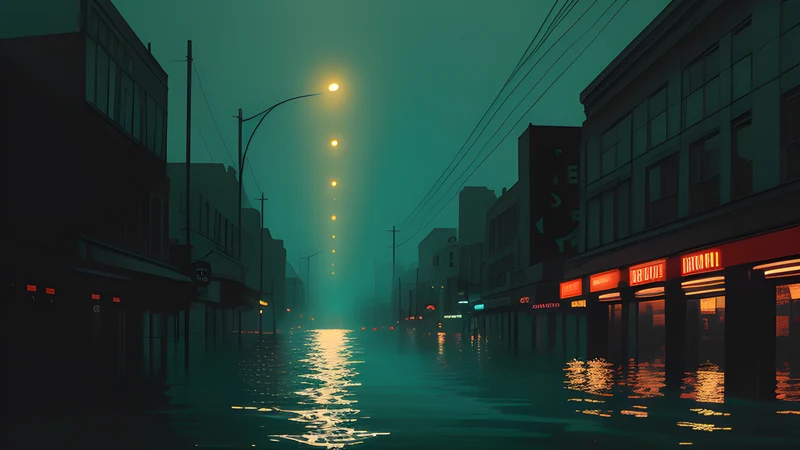
London, 2008. The water has come up and stayed up. Rats in the flooded Underground, boats where the traffic used to be, permanent rain, and a detective called Harley Stone drinking coffee at a rate that his own colleagues consider a medical event. Something is killing people and taking their hearts, and it has been doing it for years, and Stone is the only officer who takes the pattern seriously because it took his partner.
Split Second was released in 1992, directed by Tony Maylam, and it is a film assembled almost entirely from other films. The dystopia is Blade Runner’s rain with the budget removed. The monster is an Alien silhouette with a Predator posture. The structure is the burnt-out-cop procedural that Hollywood had been running since Dirty Harry. There is not one original element in it.
It is also enormously enjoyable, and it has outlived a great many original films, and the reason is a subject worth taking seriously: the specific pleasure of a genre picture that has no ambition beyond being exactly the thing it advertised.
Rutger Hauer is doing all the work
Hauer is the film. That sounds like faint praise and is meant as the opposite.
By 1992 he had been the most interesting thing in a long run of pictures that did not deserve him — a decade on from Blade Runner, where he had taken a supporting antagonist and walked off with the entire movie’s afterlife. What Hauer brought to lower-tier material was a refusal to condescend to it. He plays Harley Stone as a man with a genuine internal weather system: exhausted, funny, half-feral, visibly carrying something that predates the plot. The performance would sit comfortably in a film four times the budget.
Watch what he does with the coffee. Stone’s chemical intake is written as a joke — the character drinks and smokes continuously, and colleagues comment on it. Hauer plays it as a symptom. The man is not being quirky; he has stopped sleeping since his partner died, and the caffeine is the only structure his day has. None of that is in the dialogue. It is entirely in how he holds himself in a chair.
Around him the film assembles a supporting cast far better than it needed. Alastair Duncan plays Dick Durkin, the Oxford-educated new partner who is assigned to Stone as a minder and spends the film being appalled. Kim Cattrall is Michelle, the partner’s widow, in a role the script never quite finishes. Michael J. Pollard turns up as a rat catcher. Pete Postlethwaite is in it, four years before Brassed Off and Romeo + Juliet made him a face everyone recognised. Ian Dury — the Blockheads’ Ian Dury — plays a bar owner. That is a lot of quality standing around in the rain of a film about a heart-eating monster.
Why the flooded London works
The setting is the film’s one genuinely good idea, and it is good for a reason that has nothing to do with prophecy.
The screenplay, by Gary Scott Thompson — his first produced feature, nearly a decade before he wrote The Fast and the Furious — sets the story in a London where sea levels have risen and the city has adapted rather than evacuated. People still work. The police still investigate. The tube is a canal and everyone has got used to it. The film is uninterested in explaining the mechanism, which turns out to be the right call: the flood functions as texture, and the texture is doing three jobs at once. It justifies the darkness, because everything is shot at night in the wet and wet streets return light beautifully. It justifies the decay, because a production designer with no money can dress a flooded set far more cheaply than a clean future. And it makes the monster’s habitat make sense — the thing moves through water and tunnels, and the city has obligingly filled with both.
This is the Hardware lesson, learned properly. Richard Stanley had shown two years earlier, in Hardware, that a British production with almost nothing could build a convincing ruined future by never once cutting to a wide establishing shot. Carpenter had established the principle a decade before that in Escape from New York: show a corridor, imply a city. Split Second follows the rule with discipline. You are never shown the skyline of drowned London. You are shown one street, one dock, one flooded basement, and your own head builds the rest.
The monster you barely see
The creature is a rubber suit, and the film knows it.
Maylam shoots the thing the way you shoot a rubber suit you cannot afford to expose: in fragments, in the dark, in strobing light, behind steam, always moving, always at the edge of the frame. The design is an unembarrassed composite — long skull, articulated limbs, too many teeth — and if you freeze a frame it collapses immediately. So the film never gives you a frame to freeze. It is the Jaws discipline applied out of poverty rather than out of Spielberg’s mechanical shark problems, and it produces the same result, because the restriction and the technique are identical no matter what causes them.
The film’s other creature trick is heart-forward. The thing takes hearts, and the film keeps putting hearts on screen — in the crime scenes, in the dialogue, in the imagery — until the audience understands what the monster wants without a single line of exposition explaining its biology. That is a genuinely economical piece of screenwriting. The film that best exploits the same buddy-cop-plus-inhuman-predator collision is Jack Sholder’s The Hidden, from 1987, which is the real ancestor here: a police procedural where the thing being investigated is not remotely human and the cops adapt to that fact with unnerving speed. Split Second has none of Sholder’s tightness. It has considerably more attitude.
And it has the line. Stone, having spent the whole film being told he is unstable and over-armed, arrives at his conclusion about the appropriate response to the situation, and the delivery of “we need bigger guns” is the reason a generation of viewers can name this film at all. It is the entire picture’s philosophy in four words, delivered by a man who has stopped negotiating.
The case against
The film is a mess. The plot has a mid-section that simply stops moving; characters explain things to each other that they have already explained; the Michelle strand exists to give the third act a hostage and is dropped whenever it is inconvenient. There is a supernatural-astrological thread involving the monster’s timing that the film introduces with great portent and never resolves into anything coherent. Production was reportedly troubled — Maylam has the credit and Ian Sharp did substantial uncredited work on the picture — and the seams show in a tonal wobble between grim procedural and outright comedy that the film never settles.
The wider case against is more damning: nothing here is new. If you have seen Blade Runner, Alien and any 1980s cop film, you have seen every component of Split Second in better condition elsewhere.
The defence is that assembly is a craft. Genre cinema has always run on recombination, and the films that survive the process are the ones that recombine with conviction. Split Second commits absolutely to its silly premise, hires an actor who refuses to play down to it, drowns a city because drowning it is cheaper and better-looking than building it, and gets out in ninety minutes. The 1990s produced an enormous quantity of direct-to-video science fiction with exactly this shape. Almost all of it is unwatchable now. This one is a good Friday night, and the difference is Hauer, doing serious work in the rain for a film that could never have deserved him.
Find the widest transfer you can — the film is nearly monochrome in the dark and cheap copies turn it to sludge.
Spoilers below
The heart-eating is the tell, and the film pays it off in the one way it was always going to: the creature is building itself. Stone’s investigation establishes that the thing has been taking specific organs from specific people across years, that it has a relationship with Stone in particular, and that some of what it has consumed is now part of it. When the film finally shows the creature whole in the climactic sequence, the design carries the accumulated history of what it has eaten — which is the payoff for all those crime-scene close-ups, and the only genuinely clever structural idea in the screenplay.
The finale takes place in a flooded lower level of the city, and it is where the film cashes its cheque. Stone and Durkin arm themselves with weaponry of a scale that no police force would issue, having spent the entire film establishing that Durkin thinks Stone is dangerously unhinged and Stone thinks Durkin is a child. The joke, and it is a good one, is that Durkin converts. The Oxford man who spent two acts recoiling from Stone’s methods ends up beside him with something enormous in his hands, entirely persuaded. That conversion, played straight, is what makes the ending land — the film’s clear-eyed sceptic looks at the evidence and concludes that the correct response really is bigger guns.
What the film never explains, and what its defenders and detractors have been arguing about ever since, is what the creature actually is. There are gestures toward the occult, toward the astrological, toward the thing being a manifestation of something rather than a species. None of it resolves. Rewatching, I have come round to thinking the vagueness costs it very little. The film is a horror-shaped object about a man who cannot let go of a death, and the monster is legible entirely as a thing that took his partner and has been circling him ever since. Explaining it further would have required a better screenplay than anyone involved was being paid to write.
Related Content