Spirits of the Dead: The Poe Anthology With Fellini's Toby Dammit
Two thirds of a curiosity, one third of the best short horror film ever made
Contents
Anthology films are almost always unequal, and the honest way to write about them is to say so. Histoires extraordinaires — Tre passi nel delirio in Italy, Spirits of the Dead in English — was a 1968 French-Italian production that handed one Edgar Allan Poe story each to Roger Vadim, Louis Malle and Federico Fellini. The result is a film that limps for about eighty minutes and then produces forty of the greatest short-form cinema anyone has ever shot.
I am going to deal with the first two honestly and then spend the rest of this on Fellini, because that is the correct allocation of attention and every serious writer on this film has made the same decision for fifty-five years.
Vadim, and the horse
Roger Vadim took “Metzengerstein”, Poe’s 1832 story of a decadent aristocrat and a hereditary feud that resolves through a horse. Vadim cast Jane Fonda, then his wife, as the Countess Frederique, and Peter Fonda — her actual brother — as the object of her desire.
That casting is the segment’s only enduring feature and it tells you everything about the enterprise. Vadim was a man who understood provocation as a marketing category and had very little idea what to do with dread. Claude Renoir photographs it handsomely and the costumes are extravagant to the point of camp, and the whole thing plays as a fashion shoot with a plot attached. Poe’s story is about the terror of a debt you did not personally incur; Vadim’s film is about how good Jane Fonda looks on a battlement. There is a version of the sibling casting that is genuinely transgressive and disturbing. This is the version that is a press release.
Malle, and the double
Louis Malle took “William Wilson”, which is the doppelgänger story — the man pursued through his life by an identical figure who intervenes at exactly the moment he is about to commit a cruelty. Alain Delon plays Wilson. Brigitte Bardot, dark-haired, plays a woman he wrongs at a card table.
This one is a proper film. Malle was a serious director and he understands that Poe’s story is about conscience as an external persecution — the horror is having a witness. Tonino Delli Colli shoots it in a rich, oppressive Italian gloom, and Delon is well used: his beauty has always had something reptilian in it, and Malle points that at the camera.
It still does not quite work, and the reason is instructive. Malle films the doppelgänger literally, and a doppelgänger you can see is a plot device. The story’s power is that the double might be an idea. Once he is a man in a room, the segment becomes a well-mounted period piece about a bad man being followed, and the metaphysics leak out. Malle would go on to make several masterpieces. This is a good director doing homework.
Fellini, and the little girl
And then the film changes species.
“Toby Dammit” takes its cue from “Never Bet the Devil Your Head”, one of Poe’s slighter comic pieces, and Fellini keeps essentially the title and the wager. Terence Stamp plays Dammit, an English Shakespearean actor drinking himself into ruin, flown to Rome to star in what the producers describe as the first Catholic western. He is promised a Ferrari. He appears on television. He attends an awards ceremony. He drives away.
Stamp in 1968 was at a peak nobody has properly reckoned with — he made Pasolini’s Teorema the same year — and what he does here is beyond praise. He plays Dammit as a man whose surfaces have all failed simultaneously: the celebrity, the talent, the Englishness, the charm, all still nominally present and all visibly hollow. He is barely in control of his face. There is a long sequence at the awards ceremony where Stamp does almost nothing while Rome performs at him, and it is one of the great screen depictions of what it is to be the only sober thing in your own head at a party where you are the guest of honour and cannot remember agreeing to come.
Giuseppe Rotunno photographs it, and this is the bridge to Fellini Satyricon the following year: the colour is toxic, over-saturated, everything lit as though the room itself has a fever. Nino Rota scores it against the grain, with a lightness that makes the corruption worse.
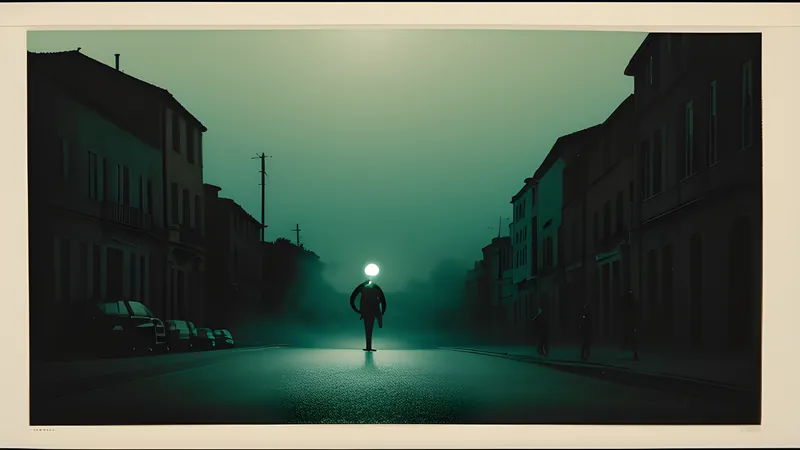
And the devil is a little girl. Pale, blonde, entirely serene, bouncing a white ball, standing at the far end of things and smiling with an amiability that has nothing behind it. That is the whole of Fellini’s theology in one image. The Devil is not horned or eloquent or interested in argument. The Devil is a child who is pleased to see you and has all the time in the world.
Where the little girl came from
Here is the collector’s point, and it is the reason this piece is worth writing.
Mario Bava got there first. In 1966, two years before Toby Dammit, Bava made Kill, Baby… Kill!, in which a village is terrorised by the ghost of a small blonde girl who appears, silent and smiling, bouncing a ball. Same child. Same ball. Same refusal to explain herself. Bava was working in a Carpathian-flavoured gothic with a budget you could fit in a hat, and he arrived at one of the most durable images in horror cinema two years before it appeared in a film by the most famous director in Europe.
The resemblance has been noted for decades and I am not going to accuse Fellini of anything, because the record does not support it and ideas do surface twice. What I will say is what happened next. Toby Dammit is on the syllabus. Kill, Baby… Kill! was, for years, a cult item passed around by people who had to explain who Bava was first. The ball-bouncing ghost child entered the general language of horror — she is everywhere now, in every haunted corridor in every country — and the credit for her attached to the art film rather than the genre picture that invented her.
That is the standard transaction. The genre does the invention and the prestige director does the collecting, and the histories are written by people who were watching the prestige. It is the exact process that Bava’s whole career documents. He built the faceless killer, the body count and the ghost child, and he died being described as a stylist.
The Poe problem
The other useful thing this film reveals is how badly Poe adapts, and why.
Poe’s stories are voice. The plots are thin, often absurd, and the terror lives in the narrator’s sentences — the diction, the escalating self-justification, the sense of a mind arguing with itself in front of you. Take that away and you have an anecdote about a horse. Vadim proves it. Malle nearly escapes it and then films the metaphor.
Fellini solves it by refusing to adapt anything. He takes Poe’s central proposition — a man makes a stupid wager with something he does not believe in — and rebuilds it from scratch out of his own materials, which in 1968 meant television, celebrity, Rome, Catholicism and the specific horror of being interviewed. The result is faithful to Poe in the only way that matters: it produces the sensation the prose produces, by completely different means.
Roger Corman had run the same experiment through the early sixties for AIP, and his solution was Vincent Price — hire a voice, and let the voice carry what the prose used to. That is a smarter answer than it sounds. The Amicus portmanteau films took the anthology structure in a different direction again, toward the punchline and the moral. Fellini’s answer is the least reproducible of the three and the best.
The case against, and where to watch
Two thirds of this film is a chore, and I decline to pretend a curiosity is a classic because it shares a reel with one. Vadim’s segment is close to unwatchable if you have any interest in Poe. Malle’s is respectable and inert. If you have ninety minutes and a choice, watch Toby Dammit on its own; it circulates separately and loses nothing.
The film has also been served badly by its own packaging over the years, cut and reordered by different distributors, with Fellini’s segment occasionally trimmed. It has been properly restored, and Rotunno’s colour is the whole event — a flat transfer turns the fever into beige.
For the Poe lineage into the Italian thriller, Short Night of Glass Dolls is the essential follow-up: a film built entirely on the premature-burial terror, made three years later, by a first-timer with none of Fellini’s resources and rather more nerve.
Spoilers below
Dammit drives. That is the ending, and everything in the segment has been arranged to make it inevitable: the Ferrari he was promised, the drink, the ruin, the road out of a city that has spent the evening consuming him on television.
The bridge is out. He accelerates anyway, and there is a wire across the gap, and Fellini gives you the aftermath rather than the act — the girl, the ball, and the thing she has come to collect, held up with the same mild pleasure she has shown throughout. She was never chasing him. She has been waiting at the end of the road since the first frame, and Dammit’s whole evening — the interview, the ceremony, the applause — was the walk toward her.
The wager in Poe’s story is a joke about a man betting his head. Fellini takes the joke absolutely literally and makes it the least funny thing imaginable, which is a manoeuvre of some genius. The Devil takes the bet. The Devil always intended to take the bet. And the reason the image has outlived the film around it is that Fellini understood the one thing that makes the ball-bouncing child unbearable: she is not menacing anyone. She is friendly. She is a small blonde girl at the end of a Roman street at dusk, smiling, holding out her hands, delighted that you have finally arrived.
Bava knew it two years earlier and half a dozen people noticed. Fellini did it once and the image belongs to the language now. Watch both, in order, and see who was actually building the thing.
Related Content