Sorcerer: Friedkin's Cursed Masterpiece About Four Damned Men
The most expensive suspense film of its decade, buried alive by Star Wars and rescued forty years late
Contents
There is a film about four men driving two rotting lorries loaded with unstable dynamite across a Latin American jungle, and for roughly two decades it was easier to describe than to see. Sorcerer opened in June 1977, cost somewhere north of twenty million dollars, and died so completely at the box office that William Friedkin — the man who had just made The French Connection and The Exorcist back to back — spent years afterwards being asked what went wrong. The answer was partly a title that promised sorcery and delivered sweat, and partly a small science-fiction picture that had opened a few weeks earlier and eaten the culture whole. The film itself is one of the great suspense machines American cinema ever built.
The wages of fear, paid in full
Start with the lineage, because Sorcerer is a remake and Friedkin never pretended otherwise. The source is Georges Arnaud’s 1950 novel Le Salaire de la peur, filmed in 1953 by Henri-Georges Clouzot as The Wages of Fear — a black-and-white monument of European suspense in which desperate men truck nitroglycerine to an oil-well fire for a payout that might let them escape a dead-end town. Clouzot’s version is the ancestor here, and any honest account of Friedkin’s film has to concede that the older one is a masterpiece in its own right, tighter and crueller in its social contempt.
What Friedkin does with the material improves on a straight cover version. He spends the first forty minutes refusing to get into the trucks at all. Instead he builds four separate prologues in four cities — a mob getaway gone wrong in Elizabeth, New Jersey; a bombing in Jerusalem; a collapsing bank fraud in Paris; a contract killing in Veracruz — and only then funnels all four fugitives into the same fictional oil town, Porvenir, a place of mud and diesel where men with no papers work themselves toward death for wages that will never add up to a way out. The structure is a slow-loading gun. By the time the dynamite appears, you know exactly how little each of these men has to lose, and you know it in four different languages, none of them subtitled generously. Friedkin trusts the pictures to carry the despair, and they do.
Why the tension actually works
Suspense on film is a craft problem before it is an emotional one, and Sorcerer solves it with a patience that borders on sadism. Friedkin understood that fear scales with duration, so he stretches every hazard past the point a modern thriller would cut away. The engine misfires. The road crumbles. The cargo, we are told and shown, has been leaking, so that the nitroglycerine has begun to crystallise and can detonate from a jolt. Then he makes the men drive over ruts.
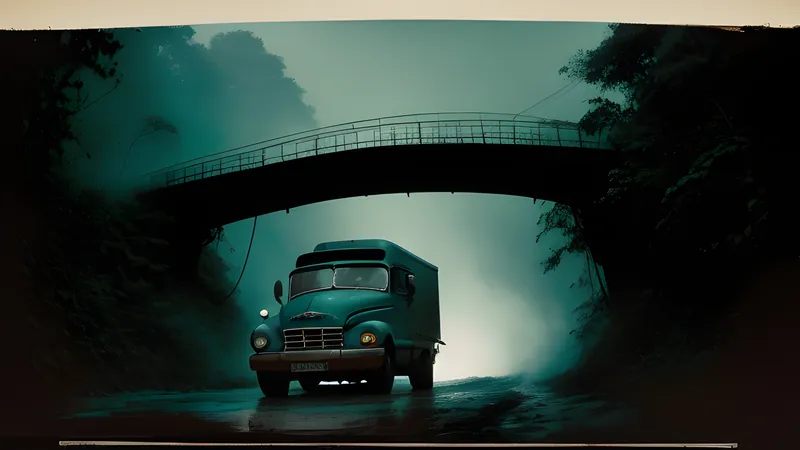
The centrepiece is a river crossing on a rope-and-plank suspension bridge in a rainstorm, and it remains one of the most physically convincing set-pieces of its era precisely because it is physically real. Friedkin built a working bridge, rigged it on hydraulics, and shot the trucks lurching across a swollen river while the whole span heaved beneath them. The production famously moved between the Dominican Republic and Mexico chasing the right water, and nearly drowned the schedule doing it. You feel that cost on screen. There is no clean geography, no reassuring cutaway to a map; the camera stays low and close and wet, and the electronic score by Tangerine Dream throbs under it like a migraine, one of the earliest and best marriages of synthesiser and celluloid dread. There is a purity to shooting a stunt for real that no digital river can fake: the actors flinch because the bridge is actually failing, and the audience flinches with them. Friedkin was reaching for the same documentary immediacy that made the car chase in The French Connection feel stolen rather than staged, and here he applies it to a world that does not exist.
The performances are deliberately unglamorous. Roy Scheider, fresh off Jaws, plays the New Jersey wheelman as a hollowed-out survivor with nothing behind the eyes but the next hundred metres of road. Bruno Cremer, Francisco Rabal and Amidou fill out the crew as men who have already stopped expecting rescue. Nobody in this film gets a speech about hope. That withholding is the point, and it is a discipline most modern thrillers cannot manage; they must have their hero crack a joke to reassure us he will live. Friedkin reassures us of nothing.
A title that killed it, and a rescue that saved it
The commercial catastrophe is now part of the legend, and it is worth being precise about it rather than romantic. Sorcerer arrived weeks after Star Wars and into a market that had abruptly decided what it wanted from a summer, and it did not want two hours of grimy fatalism from men speaking four languages. The title compounded the problem: audiences primed by The Exorcist turned up expecting the supernatural and got a lorry. The word “Sorcerer” is in fact the name painted on one of the trucks, a small grim joke about the illusion that any of these men can conjure their way out of the mud.
For decades the film was hard to see in a decent print, tangled in a rights dispute between two studios that let it rot. Friedkin himself eventually sued, won, supervised a full restoration, and premiered it out of competition at Venice in 2013 before a clean Blu-ray release. He went to his death in 2023 calling it his best film. That is a director’s vanity talking, perhaps, but the restoration made the claim arguable in a way it had never been when the movie was a smeared rumour on late-night television.
The cross-reference worth chasing is not only Clouzot. Sorcerer belongs to a small, bleak school of American genre film-making that treats crime and violence as a losing bet against an indifferent universe — the same cold arithmetic that runs through the Coens’ No Country for Old Men, where a satchel of money is a death sentence rather than a prize. It shares, too, the professional’s fatalism of Jean-Pierre Melville’s underworld, the sense that a job is a ritual performed by the already-doomed; anyone moved by Sorcerer should sit next with Le Samouraï, where the coldness is the whole philosophy. What unites the three is a refusal to promise that competence will save you.
Spoilers below
Everything from here assumes you have seen the film.
The cruelty of Sorcerer is arithmetic. Two trucks set out; the audience does the maths early and correctly. Nilo and Kassem die first, their vehicle detonated on a fallen tree that blocks the road — the explosion so total that there is nothing to bury. Then Victor is killed in an ambush by bandits, leaving Scanlon alone with the surviving truck across the final stretch of ruined ground.
Here Friedkin plays his best hand. The last leg of Scanlon’s drive tips into something close to hallucination, the road dissolving into a lunar surface of cracked earth and hard light, the sound design fraying, the Tangerine Dream score curdling into pure abstraction as exhaustion and terror strip the film of its realism. It is the one moment where the promised “sorcery” arrives, inside the driver’s collapsing mind rather than in the plot. He gets the nitroglycerine to the fire. He has done the impossible thing.
Then the film denies him the payoff entirely. Scanlon walks back into the cantina in Porvenir, alive and owed his wages, and asks a woman to dance. The camera holds on him. Outside, a car pulls up carrying the hitmen who have been hunting one of the crew since the New Jersey prologue, come at last to collect. Friedkin cuts before the trigger, over a scratchy record of an old standard, and lets the credits fall on a man who survived every hazard the jungle could invent only to be caught by the past he thought he had outrun. The nitro was never the danger. The danger was that a man like Scanlon could ever be allowed to stop running.
That ending is the whole argument of the film compressed into ninety seconds. Competence buys nothing; the road was never the trap, the town at either end of it was. It is a bleaker close than Clouzot’s, and it is the reason Sorcerer has outlasted its own disaster to become the film Friedkin always said it was — the one he would be remembered by, once anyone could finally see it.
Where to watch: the 2013 Friedkin-supervised restoration is the only version worth your time; seek it on Blu-ray or wherever that master streams. Refuse the muddy old transfers — this is a film that lives or dies on texture.
Related Content