Songs from the Second Floor: Andersson's Deadpan Tableaux
Twenty-five years in the wilderness, and then this: a comedy about the end of everything
Contents
Roy Andersson made his second feature, Giliap, in 1975. It went badly enough — over budget, poorly received, a professional catastrophe — that he did not make another for twenty-five years. He spent the interval running Studio 24 in Stockholm and shooting commercials, hundreds of them, and became by most accounts the best advertising director in Europe. Then in 2000 he came back with Songs from the Second Floor, took the Jury Prize at Cannes, and it turned out he had spent a quarter of a century inventing an entirely new way to point a camera.
I first saw it on a scuffed rental disc some years after release, expecting Nordic gloom. What I got was one of the funniest films I have ever watched, about the collapse of civilisation, performed by people who look like they have been dead for a fortnight.
What it is
There is no plot in the sense a synopsis could carry. The film is a sequence of self-contained tableaux — a few dozen of them, each a single fixed shot, most running two to four minutes — that share a city, a mood and a handful of recurring characters.
The nearest thing to a lead is Kalle (Lars Nordh), a heavy, sweating, permanently soot-blackened man who has just burnt down his own furniture shop for the insurance money. He has two sons. One of them, Tomas, is in a psychiatric hospital; the family’s explanation is that he went mad from writing poetry, and this is delivered as a straightforward medical diagnosis. The other has problems of his own.
Around them the city is seizing up. There is a traffic jam that appears in the first act and never resolves — cars stationary, drivers standing beside them, an entire economy stalled in the road. There is a man being made redundant after thirty years who will not let go of his manager’s leg and is dragged down a corridor. There is a magician who saws a volunteer in half and gets it wrong. There are flagellants. There is a centenary celebration nobody can quite justify. And there is a growing sense, never explained, that the ledger has been closed on this whole society and somebody is going through the arithmetic.
The film opens with a line from César Vallejo — beloved be the one who sits down — and that turns out to be the entire thesis. Andersson is making a film about ordinary people who are being punished, and he is on their side.
Why it works: the mechanics of the tableau
This is the most technically interesting European film of its decade and the technique can be described precisely.
The camera never moves and never cuts within a scene. One shot, one scene, no coverage. That means Andersson cannot use editing to tell you where to look, which sounds like a handicap and is actually the engine. Your eye roams the frame. You find the gag yourself, in the background, forty seconds after the scene began, and the discovery is what makes you laugh. A cut would have handed it to you.
The lens is wide and the focus is deep. Everything from the actor’s nose to the wall thirty feet behind is sharp. In conventional cinema, shallow focus is a moral instrument: it tells you this person matters and that person is furniture. Andersson refuses to make that judgement. The man in the back of the shot is as in-focus as the protagonist, which is a democratic decision disguised as a technical one, and it is why the film’s compassion never has to be stated in dialogue. The form already contains it.
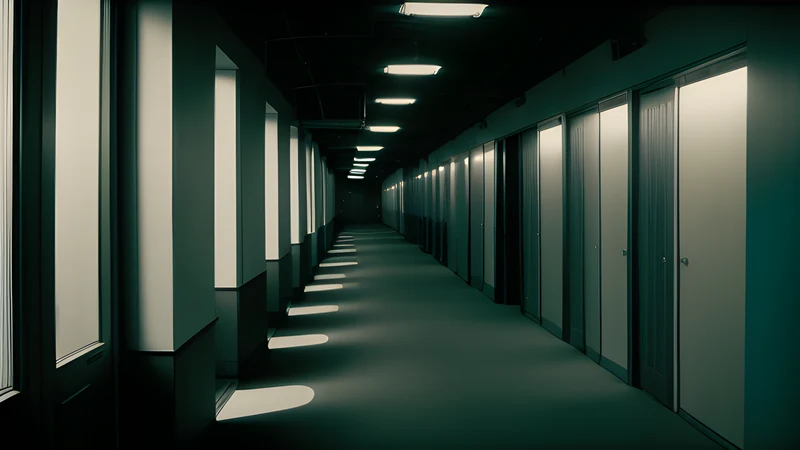
The sets are built from scratch. Almost every location was constructed in his Stockholm studio, and Andersson uses forced perspective to fake depth that isn’t there. The interiors have a specific grey-green pallor — the walls, the light and the actors’ skin all pushed toward the same drained tone with heavy makeup on faces already cast for their ordinariness. The result is that people and rooms become one substance. Nobody stands out from the wallpaper, because nobody in this world does.
The performances are timed like music. Andersson works with non-professionals and rehearses for weeks to get a single shot, and the thing he is drilling is delay. Everyone in this film responds about half a second late. That lag is the whole comic architecture: it reads as exhaustion, stupidity and grief simultaneously, and it makes even a simple line of dialogue land like a stone in mud.
The joke and the horror arrive in the same frame because there is only one frame. That is the literal consequence of refusing to cut.
The real ancestor
Everyone reaches for Bergman because Andersson is Swedish, and it is the least useful comparison available. Bergman’s camera is intimate, faces fill the frame, and the drama is interior. Andersson’s camera is at the far end of the room and the drama is architectural.
The real ancestor is Jacques Tati, and specifically Playtime (1967). Tati built a city in a field outside Paris, shot it in wide static compositions with everything in focus, filled each frame with six or seven simultaneous gags, and refused to point at any of them. He also drove himself into bankruptcy doing it. Andersson took that grammar — the constructed world, the democratic frame, the gag you have to go and find — and swapped Tati’s sunny bewilderment for a diagnosis of late capitalism. The mechanism is identical. Watch Playtime’s restaurant sequence and then Andersson’s traffic jam, and the debt is architectural.
The second ancestor is painting rather than film. Andersson has talked repeatedly about Bruegel and about the Weimar-era German painters — Otto Dix, George Grosz — and it shows in every composition: the crowded plane, the grotesque made ordinary, the catastrophe happening in the corner of a scene about something else. Bruegel put the fall of Icarus in the background of a farming picture. Andersson has been doing that shot for twenty-five years.
Then there is Buñuel, for the logic. The Exterminating Angel establishes an inexplicable rule — the guests cannot leave the room — and never explains it, because the explanation would be smaller than the dread. Andersson’s traffic jam is that same trick, done in a Swedish suburb.
The shelf around it: You, the Living is the direct sequel in method and the warmer film; Themroc shares the wordless-absurdist-revolt DNA at far higher volume; The Turin Horse and Sátántangó are the Hungarian branch of the same anti-cutting philosophy; and The Phantom Carriage is the ancestor Swedish cinema keeps returning to whenever it wants the dead to walk about in daylight.
The case against
The method has a ceiling and Andersson hits it. By the last third, the reveal of each tableau becomes predictable — you learn the rhythm, you know a shot will hold, you start scanning the background early, and the discoveries stop being discoveries. A film built entirely on one device eventually explains its own trick.
There is also a real question of cruelty. Andersson casts faces — heavy, blotched, unbeautiful faces — precisely because they are unglamorous, and then holds them in unflattering light for four minutes while they suffer. He would say the compassion is in the holding. A less charitable reading is that the film is inviting you to find these people funny because of how they look, and I do not think that reading can be entirely dismissed.
And the apocalyptic apparatus — the flagellants, the sacrifices, the ash falling — is the least interesting material in the picture. The traffic jam is a devastating image of a society that has stopped. The men whipping themselves is a student’s idea of one.
The verdict
Songs from the Second Floor is a film about economic collapse made by a man who spent twenty-five years selling things on television, and that biography is not incidental. Andersson learnt in advertising exactly how a single held image sells an idea, and he turned the skill against the client. The film’s argument — that a society will always find someone to blame and someone to sacrifice, and that the someone will always be the person least able to object — is delivered without a speech, in rooms, by people who are too tired to move.
It is bleak, it is hilarious, and it has aged into something close to prophecy. Twenty-five years on, the traffic jam has not moved.
It streams on the arthouse services and has had good disc releases; watch it in one sitting, on the largest screen you can get, because the whole film lives in the parts of the frame you would otherwise ignore.
Spoilers below
The film’s centrepiece is the sacrifice. A procession of the great and the good — generals in dress uniform, bishops, businessmen, a decorated academic in a wheelchair, all the people who run things — walks a small girl in white to the edge of a cliff, in daylight, in front of a seated crowd of dignitaries, and pushes her off. There is a stumble in the arrangements; somebody nearly ruins it; the ceremony proceeds anyway. Andersson holds the shot. Nobody in the crowd objects and nobody in the crowd enjoys it. They are simply attending, the way you attend a colleague’s leaving do.
He never explains what the sacrifice is meant to achieve. That is correct. The point is that a functioning society will produce a ritual to appease whatever it thinks is angry with it, and will find perfectly serious men to conduct it, and the only thing anybody will remember afterwards is that the arrangements went slightly wrong.
Kalle’s plot resolves in the film’s other great image. He has been trying to shift a stock of life-size crucifixes and has finally accepted there is no market. He hauls one out to a rubbish tip and dumps it, muttering about a crucified loser, and the phrase is unbearable: it is contempt for the merchandise, it is a man describing himself, and it is a whole culture disposing of an idea it no longer believes and never replaced.
The last movement gives Kalle a retinue. The dead walk with him now — the people the film has been quietly accumulating in its margins, the ones somebody’s arithmetic wrote off — trailing him across a wasteland in the same drained light as everything else. They do not accuse him. They just come along.
That is Vallejo’s line paid off. Beloved be the one who sits down, because the one who sits down is the one who has stopped participating. Andersson’s ghosts are there because he is going the same way they went, and somebody should walk with him.
Related Content