Snowpiercer: Bong's Class War on Rails
The English-language debut that put the whole social order inside a train and set it moving
Contents
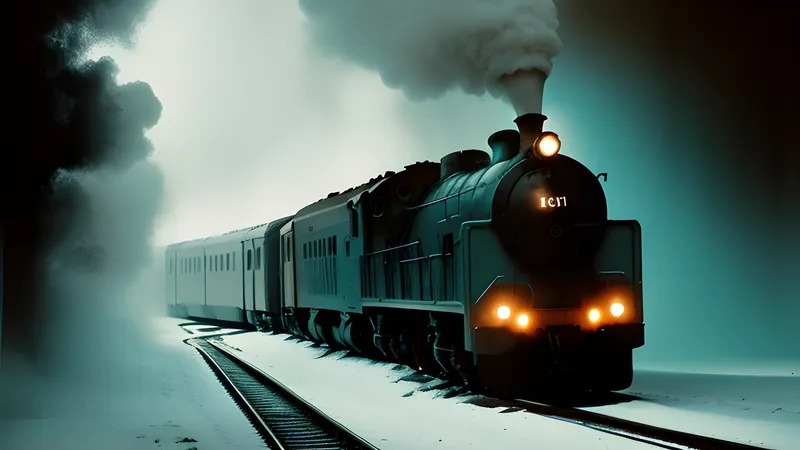
The premise of Snowpiercer (2013) is so blunt it sounds like a parable a child would invent. The Earth has frozen solid after a botched attempt to reverse global warming; the last of humanity survives aboard a single perpetual-motion train that circles the dead planet once a year; and the train is divided by class, the wretched packed into the filthy tail and the wealthy lounging up front, with a rigid order enforced by soldiers and ideology. Bong Joon-ho, adapting the French graphic novel Le Transperceneige by Jacques Lob and Jean-Marc Rochette for his first English-language film, does not soften the metaphor. He sharpens it into a straight line, points it forward, and lets a revolution walk down it car by car.
That directness is a trap the film springs on you slowly. Snowpiercer begins as the most legible allegory imaginable and ends somewhere far stranger and more troubling, having quietly argued that the metaphor itself — the neat forward march from oppression to liberation — is a lie the system tells to keep the train running. Bong is the great smuggler of Korean cinema, the director who hides a philosophical hand grenade inside a genre package, and here the package is a brutal, kinetic, side-scrolling action film that happens to be about how revolts get co-opted.
The train as a whole world
The design is the argument. Production designer Ondřej Nekvasil built each carriage as a distinct ecosystem, so that moving forward through the train is a journey up the social ladder rendered in physical space. The tail is a lightless slum of bunk stacks and gruel; then come the engine of production — a car of soldiers, a horrifying protein-bar factory, an aquarium, a greenhouse, a butcher, a sauna, a nightclub, a schoolroom where children are indoctrinated with hymns to the train’s engineer. Every door breached reveals another layer of the world the tail never knew was above them, and Bong stages the rebellion’s advance as a series of escalating dioramas, each with its own light, its own rules, its own grotesque comforts.
Chris Evans, cast against his Captain America wholesomeness, plays Curtis, the reluctant leader of the tail’s uprising, and he gives the performance of his career precisely because Bong refuses to let him be clean. Curtis is haunted, closed-off, carrying a secret about the early days aboard the train that the film withholds until it can do maximum damage. Around him Bong assembles a gallery of specifics: John Hurt as the crippled elder Gilliam, Jamie Bell and Octavia Spencer as fellow tail-dwellers, Song Kang-ho — Bong’s great collaborator — as Namgoong Minsoo, the addicted security expert who designed the train’s gates, and his daughter Yona (Ko Asung), clairvoyant and train-born. And presiding over the whole spectacle, Tilda Swinton as Mason, the front’s grotesque enforcer, a Thatcher-by-way-of-Yorkshire ghoul in oversized dentures and a fur coat, delivering the film’s central sermon: everyone must keep to their preordained place, the shoe does not belong on the head.
Why the sideways motion matters
Most action films move the camera in and out — toward a threat, back from an explosion. Snowpiercer moves relentlessly in one direction, left to right, tail to engine, and that constraint is the source of its peculiar power. The train cannot go anywhere but forward, the rebels cannot retreat because the tail is behind them and there is nothing there, and so the film has the merciless momentum of a thing that physically cannot stop. Bong choreographs its set-pieces around the geometry: a pitch-black massacre in which the front’s soldiers wear night-vision goggles and the tail fights blind, a New Year’s gunfight staged across a curve in the track so that both ends can fire at each other through the windows as the train bends. The single-direction rule turns a limitation into a style.
Bong’s tonal control is the other marvel. He swings from slaughter to slapstick to grief inside a single carriage, holds the audience off-balance, and never lets the film settle into the earnest rhythm its subject might invite. This is the same instrument he plays across his filmography, the sudden gearshift that makes his films feel alive and unpredictable, and it is on full display in the domestic-scaled masterwork Memories of Murder and dissected across his whole career in Bong Joon-ho: Genre as Scalpel. Snowpiercer is the film where he first proved the method could scale up to a blockbuster budget in a second language without losing its edge.
The fight to keep it whole
The film’s release became its own parable about who controls the story. Harvey Weinstein’s company held the North American rights and pushed Bong to cut around twenty minutes and add explanatory voiceover to make it more palatable to a mainstream audience. Bong refused. The standoff meant Snowpiercer opened in the United States on a limited platform release in 2014 rather than the wide rollout its scale deserved, while much of the world had already seen the director’s full version. The irony was not lost on anyone: a film about a ruthless overclass dictating terms to the people who actually did the work nearly had its own tail car cut off by a distributor. The uncut version survived, and it is the only one worth watching.
The verdict, spoiler-free
Snowpiercer is the film that announced Bong to Western audiences six years before Parasite made the argument impossible to ignore, and it remains his most purely propulsive work — a dystopia you can feel in your legs as you climb it. It is louder and pulpier than the arthouse dystopias it shares a shelf with, closer in spirit to the black comedy of Brazil than to the icy despair of 12 Monkeys, and it earns its bluntness by being smart enough to turn its own bluntness into the subject.
Watch it, and then watch what Bong did next with the same class engine and a domestic setting. The train is the rough draft of the staircase in Parasite; the vertical world of the house is this horizontal one stood on its end. For the wider lineage of the dystopia-as-comedy, Brazil is the essential companion piece, and for Bong’s own beginnings, Memories of Murder shows the tonal control fully formed a decade earlier.
Spoilers below
Curtis’s rebellion succeeds at every door and fails at the only one that matters. He fights his way to the front, loses Gilliam and most of his people, and finally reaches the sacred engine to confront Wilford (Ed Harris), the train’s inventor and god, expecting a monster and finding a tired old man over a steak dinner. Wilford’s revelation is the film’s real detonation. The rebellions, he explains, are not aberrations the system suffers — they are a management tool the system requires. The train’s ecology depends on a precisely maintained population, and periodically Wilford and the tail’s own leaders, Gilliam among them, secretly collude to stage an uprising that will cull the numbers and vent the pressure. Curtis’s heroic revolt was scheduled. His grief, his righteousness, his dead friends: all of it was demographic maintenance, and Gilliam, the beloved elder, was in on it.
Then Wilford offers Curtis the engine. The logic of the train demands a new god to keep it running, and Wilford, dying, has selected his own successor from among the strongest of the rebels. Curtis is invited to sit down, take the controls, and become the very thing he crossed the entire train to destroy — to accept that the order is eternal and merely change hands. This is Bong’s masterstroke, the moment the neat allegory turns on the audience: the revolution’s reward is the chance to run the machine.
The secret Curtis has been carrying finally surfaces here. In the starving early days aboard, the tail resorted to cannibalism, and Curtis confesses that he was about to kill and eat an infant when Gilliam stopped him by offering his own arm instead — the origin of Gilliam’s missing limbs, and the source of Curtis’s self-loathing. It is why he cannot bear to look at his own hand, and why the film has kept him at arm’s length from heroism.
What breaks the cycle comes from Yona and Namgoong rather than from Curtis. Namgoong has spent the journey hoarding the industrial explosive Kronole for a single reason: he alone has noticed the snow outside is beginning to melt — the world is thawing, and the train’s closed logic is a prison that need not be permanent. Curtis, given the god-seat, instead discovers that the engine’s missing parts have been replaced by small children from the tail, worked to death in the machinery, and the sight of a tail child under the floor decides him. He and Namgoong detonate the door, the blast triggers an avalanche that derails the entire train, and nearly everyone dies.
The final image is the argument’s last turn. Two survivors climb from the wreckage into the snow: Yona, the train-born girl who has never touched the outside, and Timmy, a small tail child. They see, at the edge of the white waste, a living polar bear. Life persists outside the train. The whole ideology of the perpetual engine — that the order must be preserved at any cost because there is nothing beyond it — was a lie told by the men who profited from it. Bong ends with two children of the underclass stepping off the tracks entirely, into a world the system swore was uninhabitable, and no fist is raised in the engine room at all. The revolution that wins is the one that stops trying to run the train and walks away from it.
Related Content