Sleeper: Woody Allen's Sci-Fi Slapstick
The funniest film of 1973 is also the most carefully built piece of production design in American comedy
Contents
Miles Monroe goes into a Greenwich Village hospital in 1973 for a routine ulcer operation and wakes up two centuries later, wrapped in foil, thawed by revolutionaries in a country governed by a man nobody has seen. The premise has grey hair. Washington Irving used it, H.G. Wells industrialised it in The Sleeper Awakes, and dozens of pulp writers wore it smooth in between. Allen took it for the most practical reason available: a man from 1973 stranded in 2173 has an excuse to fall over for ninety minutes, and nobody in the audience will ask why.
Sleeper was Allen’s fourth film as director, written with Marshall Brickman, and it arrived at the exact point where he stopped being a stand-up who happened to be pointing a camera and became a director who happened to be very funny. Everything he does afterwards is downstream of the decision he made here, which was to stop cutting to the joke and start staging it.
The premise is a delivery system
The plot is thin on purpose. Miles, part-owner of the Happy Carrot health food restaurant, is revived illegally by scientists who need someone with no biometric record in a state that has one for everybody else. He is the only unregistered human being alive. From there the film is a chase: Miles disguises himself as a domestic robot, is bought by the poet Luna Schlosser (Diane Keaton), gets unmasked, drags her into the countryside, and the two of them stumble towards the underground.
What matters is that every plot beat exists to open a door onto a set piece. The robot disguise exists so Allen can do a servant routine. The escape exists so he can do a chase. The unregistered-man conceit exists so the film has a reason to keep him running. Allen has never been coy about this. He wanted to make a two-reeler and he needed 89 minutes of scaffolding to hang it on.
The satire is aimed at 1973 and hits it squarely. The health-food obsessive wakes into a future where doctors have established that deep fat, steak and hot fudge are the things that are actually good for you. The sexual revolution has arrived at the Orgasmatron, a phone box that does the job in seconds and makes conversation redundant. Nobody remembers what anything meant: Miles is shown artefacts of the twentieth century and asked to explain them, and his explanations are lies, because the past is only as accurate as the last person who remembers it. That gag is the sharpest thing in the film and Allen throws it away in a couple of minutes.
The house in the valley
Here is the part that surprises people who come to Sleeper expecting a cheap gag machine: it is one of the best-looking American comedies of its decade, and it achieves that almost entirely by refusing to build anything.
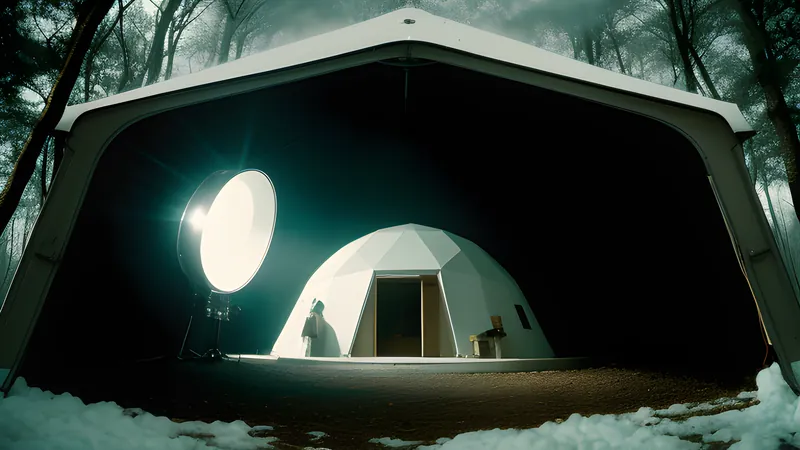
Allen and production designer Dale Hennesy shot the future on location in Colorado. The gleaming white curves of Luna’s house are the Sculptured House, Charles Deaton’s 1963 clamshell on Genesee Mountain — a real building that had sat unfinished for a decade, looking like a spacecraft that had settled into the pines and decided to stay. The government facility interiors are the National Center for Atmospheric Research on the mesa above Boulder, I.M. Pei’s slab-sided concrete laboratory, which needs no dressing at all to read as an institution that has forgotten how to be humane. Denver’s botanical conservatory supplies the greenhouse. The costume design, by a young Joel Schumacher some years before he started directing, dresses the future in silver quilting and dishes of nonsense that look expensive and cost nothing.
The effect of shooting real modernist architecture rather than fabricating sets is that the future has weight. When Miles slips, he slips on a floor that exists. When he runs down a corridor, the corridor has the specific gloom of poured concrete on an overcast day. Compare this to almost any other low-budget future of the period, where the walls flex when an actor leans on them. The Colorado locations gave Allen something no set could: hard surfaces to fall onto.
What the silents taught him
The craft argument for Sleeper is the staging, and it is worth watching the film with the sound down for five minutes to see it.
Allen’s earlier pictures cut constantly. A gag would be set up in one shot and paid off in another, because that is how a stand-up thinks — the punchline is a separate unit from the premise. In Sleeper, cinematographer David M. Walsh keeps the camera back and lets the frame do the work. The comedy is played wide, in long takes, with Allen’s whole body in shot and the joke resolving inside a single composition. That is Keaton’s grammar, and Chaplin’s, and Lloyd’s, and Allen adopted it deliberately: he has said for fifty years that these are the people he was stealing from.
The giant banana peel is the clearest demonstration. A normal director shoots the peel, then the foot, then the fall — three shots, three beats, laugh. Allen shoots it in one, at a distance, so that you can see the peel and the man and the space between them at the same moment, and the anticipation does most of the work. The physical comedy of the hovering chair, the runaway inflatable, the pudding that will not stop growing, and the whole tailor-shop routine all obey the same rule. Wide, long, no cheating.
The other thing he learned from the silents is that a body is funnier when it is genuinely trying. Miles is not doing bits. He is a coward attempting competence and failing at speed, which is exactly what Keaton’s stone-faced engineers were doing, and it is why the film is still funny at a distance of fifty years while most topical satire from 1973 is archaeology.
The clarinet
The score is Allen playing New Orleans jazz with the Preservation Hall Jazz Band and the New Orleans Funeral and Ragtime Orchestra, and it is the most eccentric choice in the picture. A film set in 2173 is scored entirely with music from 1917.
It works because it refuses the obvious. Science fiction of the period reached automatically for electronics — for the shimmer and the drone that told you this was tomorrow. Allen’s ragtime does the opposite: it drags the future backwards into the register of an old comedy, and the mismatch tells you exactly how seriously to take the world on screen. The music is also relentlessly forward-moving, which suits a film that is essentially a series of chases. A clarinet line has no time for portent. Put it under a man being pursued across a mesa by security in white jumpsuits and the whole sequence turns into a two-reeler from 1924 with better sunlight.
The real ancestor
The collector’s answer to “what is this descended from?” is not the science fiction of the 1950s. It is Wells, filtered through Chaplin.
Wells’ The Sleeper Awakes (1899) supplies the machinery: a man sleeps, wakes into a stratified future state, discovers he is a symbol to a resistance he did not ask to join, and finds the utopia is a management structure. Allen keeps every load-bearing beam of that and detonates the tone. Where Wells is furious, Allen is exasperated. Where Wells wants a thesis, Allen wants a chase across a rooftop.
There is a straighter line to draw, too. Things to Come is the film that codified the Wellsian visual future — the white surfaces, the clean geometry, the belief that architecture is a moral position — and Sleeper is that iconography with a man falling over inside it. The joke only lands because the audience has been trained by forty years of solemn white futures. Allen is not parodying science fiction in general. He is parodying one specific tradition, and he needs it to be intact in order to knock it down.
For the other half of the pedigree, watch Dark Star, made at almost the same moment by a student in California with a fraction of the money. Carpenter and Allen arrived independently at the same discovery: the future is funniest when it is administered by bored people using equipment that does not quite work. And if you want to see the machinery Allen is mocking played dead straight, Logan’s Run came along three years later and built the whole white-domed managed utopia without a single knowing look at the camera.
The case against
Sleeper sags in its middle third. Once Luna and Miles are on the run, the film has to invent obstacles for them, and the invention is uneven — some sequences are inspired, others are just business. Keaton is given a character who exists mostly to be wrong about things, and while she plays the vapid poet with real precision, the writing does not extend her the same generosity it extends Miles.
The satire has also aged into two piles. The material about health fads, sexual convenience and the unreliability of historical memory is still live. The material that depends on you recognising a 1973 celebrity is inert, and there is more of it than you remember. And the film’s politics are a shrug — every institution is silly, every rebel is also silly, which is a comfortable position for a comedian and a thin one for a satirist.
None of that touches the achievement. Allen made a physical comedy in a decade that had stopped making them, shot it in real modernist buildings so the falls would hurt, staged it in the grammar of 1925, and scored it with a clarinet. It should not cohere. It does.
Where to watch: it circulates on the usual rental platforms and turns up in Allen’s back catalogue on disc. Any decent transfer will do — this is a film about wide shots and white surfaces, and it rewards a screen large enough to let Allen be small in the frame.
Spoilers below
The Leader is the film’s best joke and its most patient one. He is invoked constantly, revered, feared, and never seen, and when the resistance finally reaches the object of all that devotion it turns out that a bomb ten months earlier reduced the great man to his nose. The state has been keeping the nose alive with the intention of cloning the rest of him from it. Miles and Luna’s mission is to steal the nose and destroy it, which they accomplish by running it over with a steamroller.
That is a genuinely radical piece of political comedy dressed as a gag. The regime is not defeated by an idea or a revolution. It is defeated because the thing at the centre of it was always physically trivial, and the only reason it held power was that nobody had checked. Wells would have written a speech. Allen writes a steamroller.
The reprogramming sequence in the hospital is the film’s other peak: Miles, captured, is put through a re-education machine and comes out as a beauty-pageant contestant, then as a Jewish mother, then as Blanche DuBois, with Keaton pressed into playing Stanley Kowalski opposite him. It is a music-hall turn parachuted into a science fiction film and it has no business working. It works because Allen has spent an hour teaching you that this future has no memory, so a man whose personality can be overwritten by a machine is the logical endpoint of a society that has already lost the meaning of everything it inherited.
The ending refuses both available exits. Luna, radicalised, wants to believe the revolution will fix things. Miles tells her it will not — that the new lot will be the old lot with different jumpsuits, and that the only things he believes in are sex and death, one of which he can at least be sure of. Then they kiss and the film stops. Allen declines the utopia and declines the dystopia, and leaves two people standing in a field in 2173 with nothing settled. For a film that spends most of its running time slipping on a banana, that is a remarkably unsentimental last word.
Related Content