Simon of the Desert: Buñuel's Pillar-Saint Short
Forty-five minutes, one column, and the funniest thing ever made about holiness
Contents
Simon of the Desert runs forty-five minutes because Luis Buñuel ran out of money. That is the whole production history in one sentence, and it is worth stating up front, because the film’s most celebrated quality — its abruptness, the way it stops rather than concludes — is usually written up as a masterstroke of surrealist audacity when it began as an accounting problem. Buñuel planned a feature. The financing collapsed partway through. He improvised an ending, delivered forty-five minutes, took it to Venice in 1965 and came home with a jury prize for a film that had been amputated. Some directors are lucky. Buñuel had spent thirty-six years training himself to be lucky in exactly this way.
It was his last Mexican picture, and the third and final collaboration with the producer Gustavo Alatriste and the actress Silvia Pinal, following Viridiana in 1961 and The Exterminating Angel in 1962 — a run that took Buñuel from being a jobbing director of Mexican melodramas back to the front rank of world cinema. If you only ever watch one Buñuel to understand what he was doing, this is the one, because at forty-five minutes there is no room for anything except the method.
The premise, kept above the line
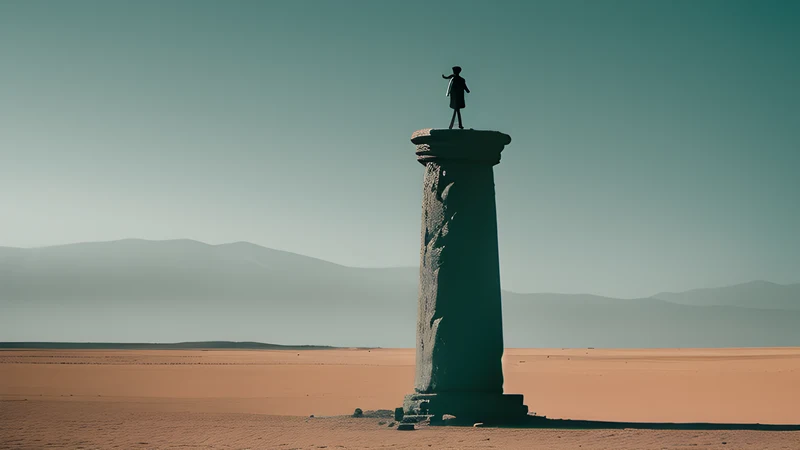
Simón (Claudio Brook) is a fifth-century ascetic who has spent years standing on top of a stone column in the Syrian desert, praying, fasting, and refusing to come down. He is based on a real man: Simeon Stylites, who lived atop a pillar near Aleppo for something like thirty-seven years in the fifth century, drew crowds from across the Byzantine world, and founded a small industry of imitators who spent their lives on columns of their own. Buñuel invented none of this. The premise of his most absurd film is a documented fact of church history, and the recognition that it needed no exaggeration is the joke he builds everything else on.
The film opens with Simón being moved to a taller column, donated by a grateful man he once healed. At the foot of it are the monks of the local monastery, some devout and some frankly appalled; a small crowd of pilgrims and the sick; his mother, who has camped there rather than lose him; and a goatherd, who thinks the entire business is idiotic. And there is Silvia Pinal, who appears at intervals in a series of guises to tempt him down. Everything else is a matter of what happens on and around a stone column in a desert, filmed by Buñuel in bright, unforgiving, entirely undevotional daylight.
Why it works: literalism as demolition
The technique is the same one Buñuel used all his life, and here it is uncut by any plot. He takes a genuine article of religious belief and films it exactly as it would look. No reverence, no soft focus, no choir. Just a man on a pole in the sun, in the wind, with nothing to do.
The consequence is comic and, if you let it be, devastating. Holiness turns out to require an enormous amount of standing about. Simón blesses things because he has nothing else to do with his hands — food, an insect crawling near his foot, whatever presents itself — and the reflex renders the gesture meaningless within thirty seconds of screen time, which is a more thorough critique of ritual than any polemic. When he performs an actual miracle it is treated with the same unemphatic realism, and the crowd’s reaction is where Buñuel plants the knife: they are pleased, briefly, and then they get on with their day. A miracle, filmed truthfully, has all the social half-life of a good parking space.
The monks are the other half of the machinery. Buñuel gives them the small politics of any workplace — resentment of the man on the pillar, doubts about his motives, careful assessments of his standing. They are not villains and they are not hypocrites in any easy sense. They are colleagues. Placing ordinary office weather at the foot of a genuine ascetic saint is the film’s most generous idea, and it produces the picture’s real subject, which is that sanctity is unbearable to everybody in the vicinity of it, including the saint.
Why it works: the Devil as a professional
Pinal’s Devil is one of the great performances in Buñuel’s cinema and the reason the film has a heartbeat. She arrives in a succession of forms, each one a piece of pointed casting by a tempter who has clearly done this before and has a portfolio. She sings. She appears as innocence itself, in a schoolgirl’s outfit, which is the most disquieting of the guises precisely because Buñuel refuses to signal it. She turns up borne along in a coffin. She wears the trappings of the sacred when the profane fails.
The performance works because Pinal plays her without the slightest malevolence. She is bored, chatty, faintly professional, like a sales representative on a slow round, and she treats Simón’s resistance as a technical obstacle rather than a moral affront. That register — evil as an occupation with quotas — is far stranger and funnier than any hissing. It also sets up the film’s deepest suggestion, which is that the Devil in this picture is the only character having any fun, and the only one who talks to Simón as though he were a person.
Gabriel Figueroa shot it, and his contribution is easy to overlook because the images are so plain. Figueroa was the great cinematographer of Mexican cinema, capable of skies that look like opera; here he keeps the desert flat, hot and unlovely, and shoots the pillar from angles that make it look tall and pointless in the same frame. That restraint is a choice, and it is doing the same work as the flat lighting in Belle de Jour: whatever you were expecting a vision to look like, it looks like this instead.
The collector’s note
The essential companion is The Milky Way, made four years later, which is the feature-length version of this joke — the same refusal to distinguish the miraculous from the mundane, applied across six centuries of doctrinal history instead of one column. Simon is the sketch and The Milky Way is the fresco, and the sketch is better, because forty-five minutes cannot sag.
Chronologically the truer sibling is L’Age d’Or from 1930, which is where Buñuel first put a religious figure in a landscape and refused to be impressed, and which got its cinema attacked for the trouble. What thirty-five years bought him was calm. The 1930 film wants the church to bleed; the 1965 film finds the church slightly tiring, which is more insulting and much funnier.
For anyone chasing the register onwards, The Phantom of Liberty applies the identical method to bourgeois manners a decade later, and its dinner-party inversion is the direct descendant of Simón’s reflexive blessing: change one rule, film everything else as normal, let the normality accuse the audience.
The honest case against
The film is an incomplete work, and pretending otherwise is a fashion I would resist. There are threads that go nowhere because Buñuel never got to shoot the rest of them, the mother subplot in particular, and the picture’s middle stretch has the loose quality of a director covering himself for a longer cut that never arrived. The received wisdom that the truncation improved it is the received wisdom of people who cannot imagine what they never saw.
It is also a film with essentially one idea. A brilliant idea, executed with total economy, and one that Buñuel had already had. The pleasure is watching a master do something effortlessly at seventy-five that lesser directors could not manage in a lifetime, and that pleasure is real. It is not the same as being surprised.
The verdict, above the line
Forty-five minutes, one column, no fat, and a punchline that has been startling audiences for six decades. This is the most efficient thing Buñuel ever made and the best possible introduction to him, because it contains the whole method in a single sitting and asks almost nothing of your patience. It circulates in the boutique restorations of the Mexican period and is usually bundled with the other Alatriste productions, which is the right way to meet it.
Everything above this line is safe before watching. The ending is one of the great sucker punches in cinema, and it is now going below the line, where I would strongly advise leaving it until you have seen it.
Spoilers below
Simón, having refused every temptation on offer, is finally taken. The Devil arrives one last time and removes him from the desert — and Buñuel cuts, without transition or warning, from the fifth-century Syrian wasteland to a nightclub in modern New York, where teenagers are dancing to a screaming guitar tune under strobing lights.
Simón is sitting at a table in a turtleneck and a neat beard, smoking a pipe, watching the floor with the expression of a man at a conference he did not want to attend. The Devil, now in modish 1960s dress, is dancing. He asks what the dance is called. She names it. He says he wants to go home, back to his column. She tells him he cannot — someone else has the pillar now — and turns back to the floor, and the film informs him that this is the final dance, the last one, and it will not stop. And then the picture simply ends on the dancers, mid-song, going nowhere.
Twenty seconds of screen time, and it reorganises everything before it. The obvious reading is the cheap one: that modernity is hell, that the kids are damned, that Buñuel the old anticlerical had turned into a scold about pop music. That reading collapses on contact with the sequence, because the dancers are plainly having a wonderful time and Simón, the holy man, is the only one in the room who is suffering. He is in hell because he cannot participate, and he cannot participate because he spent his life on a pole learning not to. The Devil did not have to corrupt him. She only had to move him somewhere his discipline was worthless.
That is the joke Buñuel had been building towards for forty years, and he found it by accident with the money running out. Asceticism as a skill with no transferable value; sanctity as a form of unemployment. He never made another film in Mexico, went to France, and spent the last decade of his career refining this exact gag in drawing rooms. My verdict: the finest hour of his career takes forty-five minutes, and its greatest sequence was a budgetary emergency. Watch it, then watch The Milky Way and hear the same laugh at feature length. The band is still playing and Simón is still sitting there, wanting his pillar back.
Related Content