Silent Running: The Ecological Sci-Fi That Broke Hearts
Douglas Trumbull's one-man garden in orbit, and the film that taught robots to grieve
Contents
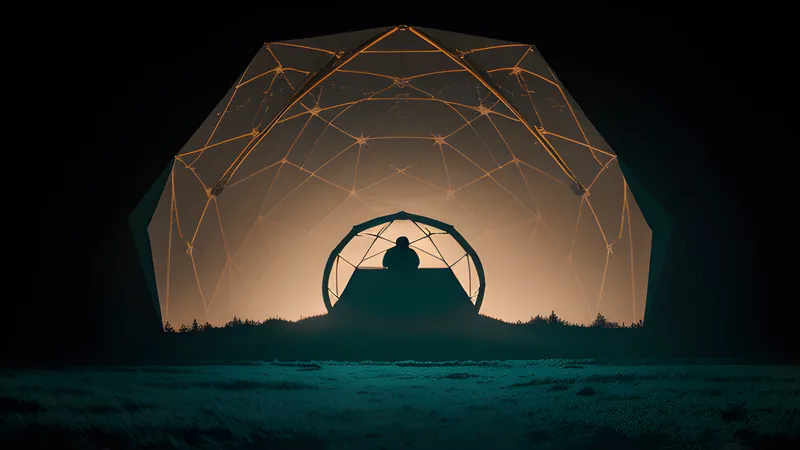
There is a shot early in Silent Running (1972) where Bruce Dern kneels in a forest, and the forest is inside a geodesic dome, and the dome is bolted to the side of a freighter drifting somewhere past Saturn. Everything about that image should feel like a stunt. Instead it feels like a held breath. Douglas Trumbull, who had just spent years bending light for 2001, made his directorial debut about the smallest possible thing — one man who cannot bear to let a garden die — and shot it as though the fate of the species hung on a stand of Douglas fir. Which, in the film’s arithmetic, it does.
A florist at the end of the world
The premise is delivered with almost brutal economy. Earth’s plant life is gone. The last specimens survive in enormous domes carried by a fleet of commercial freighters, the Valley Forge among them, tending their cargo out beyond the orbit of the giant planets while the corporation that owns the ships waits for a reason to bring them home. Freeman Lowell (Dern) is the crew botanist, and he is the only one of the four men aboard who actually cares. His shipmates play card games and drive little buggies around the cargo bay and dream of getting back to a planet that, by any sane reading, no longer has room for what he loves.
Then the order arrives: destroy the domes with nuclear charges, and return the ships to freight duty.
What Trumbull understands, and what the screenplay by Deric Washburn, Michael Cimino and Steven Bochco keeps sharpening, is that this is a story about a man whose values have become obsolete. Lowell is a crank, a bore, a lecturer who eats real cantaloupe while the others wolf processed paste and mocks them for not tasting the difference. Dern plays him without a shred of vanity — needling, self-righteous, a little unstable well before the plot gives him a reason to be. The film loves him and refuses to pretend he is easy company. That honesty is the first thing that makes the heartbreak land.
Why the drones work
The three service robots — Huey, Dewey and Louie, christened after Donald Duck’s nephews — are the reason people who saw this film as children never forget it. The engineering was as human as the theme. Trumbull cast bilateral amputee performers to walk inside the squat shells on their hands, which gave the drones a rolling, effortful gait no puppet rig could fake. They have no faces and almost no voices, a few chirps and a rudimentary console, and yet the film asks you to read tenderness into a waddling box the size of a filing cabinet. It works because Trumbull never begs. He simply gives the machines small tasks, lets Lowell teach them, and trusts that watching something learn is enough to make you care whether it survives.
Every subsequent lonely-robot film in this tradition owes a debt here. The most direct descendant is Duncan Jones’s Moon, which pairs its isolated man with a machine companion and mines the same seam of industrial melancholy — a solitary worker, a corporation that regards him as inventory, a spacecraft that feels lived-in and cheap in the best way. WALL-E’s whole silent-comedy grammar of a small robot tending dead greenery is Silent Running with the despair sweetened for a Saturday matinee. And the domes themselves, those glowing bubbles of stubborn life against the black, prefigure every fragile-biosphere image the genre has reached for since.
Trumbull’s economics of wonder
This is a roughly one-million-dollar film, and one of its quiet miracles is how much awe Trumbull buys with so little. He shot the ship interiors aboard a decommissioned aircraft carrier, the Valley Forge, which is where the freighter got its name — the corridors have real steel weight because they were real steel. The model work, front-projection and slit-scan trickery he had refined on Kubrick’s picture get repurposed here for a homelier scale: no star gates, just a working freighter that convinces you it hauls cargo for a living.
Set that craft beside its most obvious ancestor and the argument becomes clear. 2001: A Space Odyssey gave us the immaculate, indifferent cosmos, ships as sculpture, a universe that does not care. Trumbull, a chief architect of that vision, spent his debut answering it with feeling — the same photographic realism turned toward warmth, grief and a man weeping over conifers. Where Kubrick withholds, Silent Running pushes its emotion right to the surface, and sometimes past it: the Joan Baez songs draped over Peter Schickele’s score are the most dated thing in the picture, a folk sincerity that either disarms you completely or makes you wince. I lean toward disarmed. The film is so guileless about its own feelings that resisting it feels like bad manners.
The 1972 vintage
Silent Running belongs to a very specific moment. The first Earth Day was 1970; the Apollo photographs of the whole blue planet were fresh; and Hollywood was briefly convinced that science fiction’s proper subject was the coming ecological reckoning. Watch it beside its exact contemporaries and a whole worried decade comes into focus. Soylent Green arrived the following year with the same conviction that we were eating our way to oblivion, though it played the crisis as pulp thriller where Trumbull plays it as elegy. The Andromeda Strain shared the era’s faith that the threat would be biological and the response clinical. Placed among them, Silent Running is the tender one, the outlier that cares less about the mechanism of catastrophe than about what it costs one person to be the last to give a damn.
The contemplative, near-solo space picture it helped license runs straight through to Danny Boyle’s Sunshine, another film about a small crew, a doomed mission and a beauty the story cannot quite sustain. Where those later films tend to lose their nerve and reach for a monster, Trumbull keeps his nerve completely. The antagonist is a memo. The threat is indifference. The stakes are a handful of trees.
What holds up, and what doesn’t
The seams show. Some of the science is nonsense — the famous problem of the dying plants has a solution so simple that Lowell’s failure to think of it dents his credibility as a botanist, and the film has to lean on his unravelling state of mind to paper over the gap. The pacing sags in the middle stretch. The Baez interludes will test anyone allergic to early-seventies earnestness.
None of it matters much, because the thing the film is actually about — the ache of loving something the world has decided is worthless — is rendered with total conviction. Dern gives one of the great unglamorous sci-fi performances, a man talking to robots because they are the only listeners left who will not laugh at him. Half a century on, the ecological anxiety it dramatised has curdled from speculation into weather report, and the image of the last forest kept alive by a single obsessive has only grown heavier. If you want the origin point for the lonely-astronaut-and-his-machine subgenre, and a companion piece to the cold grandeur of 2001, it is here, waddling gently across a cargo bay with a watering can.
Spoilers below
The turn comes when Lowell chooses the domes over the men. Ordered to blow the forests, he kills his three crewmates — one in a struggle, the others by detonating a dome while they are inside it — and reports the deaths as an accident. It is a shocking act, and the film is brave enough to let it stay shocking; Lowell is a murderer for the rest of the runtime, and his gentleness with the drones reads ever after as the tenderness of a man who has traded his humanity for his principle. He reprograms Huey, Dewey and Louie to tend the plants, teaches them to plant and to play a rough game of poker, and as the pursuing fleet closes in he grows more isolated and more damaged, one drone lost and damaged in an accident he blames himself for.
The ending is the gut-punch that gives the film its reputation. Rather than surrender the last dome, Lowell jettisons it into deep space with the surviving drone, Dewey, aboard — rigging its lamps so the forest will live, sending it off with instructions to tend the garden alone. Then he destroys the Valley Forge and himself with it. The final image is the little dome drifting into the dark, and inside it the small battered robot moving among the trees with a dented watering can, keeping the last of Earth’s green alive for no one. It is one of the purest downer endings the genre ever committed to film, and its genius is the reassignment of hope: the human cannot survive his own choices, so the machine inherits the garden. Every reading of the drones as more human than the humans is earned in that last shot. It should be sentimental. Somehow, kneeling with Trumbull in that glowing bubble of leaves, it only breaks your heart.
Related Content