Sicario: Villeneuve's Border of No Rules
A procedural that watches its own protagonist lose the plot
Contents
There is a shot about a third of the way into Sicario that tells you what kind of film you are watching. A convoy of black SUVs crawls across the border bridge into Ciudad Juárez, and Roger Deakins holds on the traffic, the razor wire, the bodies strung from an overpass in the middle distance while nobody in the cars will explain why they are there. Emily Blunt’s FBI agent asks the only sane question — what is the objective? — and the men beside her simply don’t answer. That refusal is the whole movie. Denis Villeneuve made a crime thriller in 2015 that keeps its own heroine, and therefore its own audience, permanently one briefing behind.
I want to argue that Sicario is the sharpest thing Villeneuve did before Blade Runner 2049, and that its sharpness comes from a structural decision most thrillers are too frightened to make: it hands the point-of-view to the person with the least power in the room and then punishes her for wanting to understand.
The witness who isn’t allowed to see
Kate Macer, Blunt’s character, is good at her job. The opening raid on a kidnap house in Chandler, Arizona establishes her as competent, principled, the sort of agent who follows procedure because procedure is the thing that separates a policeman from the people he chases. Taylor Sheridan’s screenplay then recruits her into a hazily defined inter-agency task force run by Josh Brolin’s flip-flop-wearing spook Matt Graver, and the recruitment is the trap. Kate signs up expecting to prosecute a cartel. She is actually there to provide a legal fig leaf for an operation whose real author is somebody else entirely.
The craft move that makes this work is point-of-view discipline. Villeneuve and editor Joe Walker keep us welded to Kate. We learn what she learns, when she learns it, which means the film feels like a procedural while systematically withholding the procedure. Benicio del Toro’s Alejandro drifts through the edges of scenes, quiet, sad-eyed, clearly the most dangerous man present, and for a long stretch we know almost nothing about him because Kate knows almost nothing about him. That withholding is the source of the dread. This is the same trick Fincher pulls in Zodiac, where information arrives late, partial and unverifiable, and the film’s tension is really the tension of not being able to close the case.
Deakins, and the descent as a visual argument
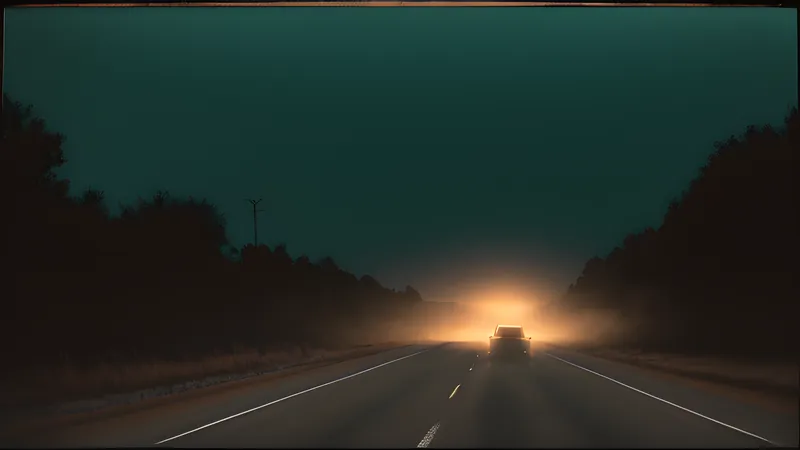
Roger Deakins earned one of his many Oscar nominations here, and the cinematography is doing thematic labour rather than mere prettiness. Watch how the film organises itself around descent. The border crossing is shot in flat, punishing desert daylight, all heat-haze and dust. Then comes the sequence everyone remembers: the task force, silhouetted against a bruised dusk sky, filing down into a smuggling tunnel, the human shapes swallowed by the black line of the earth. Deakins switches to thermal and night-vision, and the image degrades into ghostly green and grey. The visual grammar is a staircase going down — from daylight law into infrared lawlessness.
Jóhann Jóhannsson’s score works the same seam. That low, arterial pulse under the convoy scenes sounds like a heartbeat heard through a wall, or like heavy machinery you can feel in your teeth. It doesn’t score the action so much as score Kate’s rising sense that she has walked into something with no bottom. The collaboration between Villeneuve and Jóhannsson (they worked together again on Arrival, before the composer’s death) is one of the great director-composer marriages of the 2010s, and Sicario is its meanest expression.
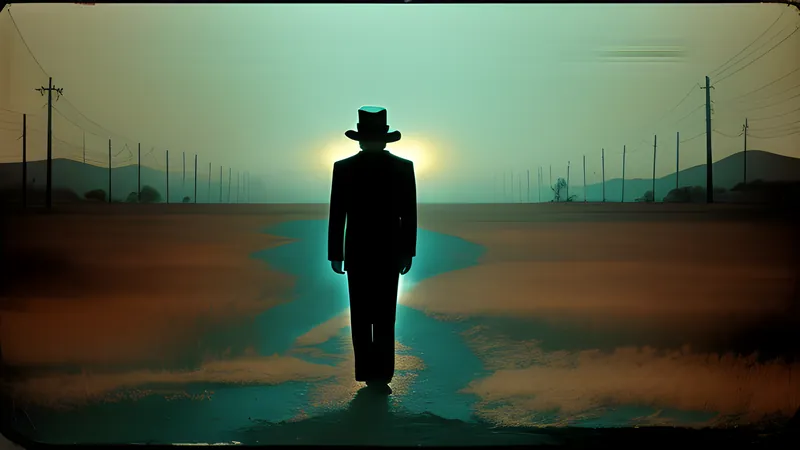
The single most famous image — the assault team as black cut-outs sinking into a blood-orange horizon — has been imitated to death in trailers and posters since, which tends to happen to a shot that solves a problem no marketing department knew it had. It compresses the film’s argument into one frame: figures walking, upright and orderly, straight down out of the light. Deakins doesn’t cut away to reassure you that they come back up. The composition itself is a moral statement, and it works because the whole picture has trained you to read every descent as a further step away from anything a court would recognise.
Why the “strong female lead” complaint misses it
Sicario took some criticism on release for sidelining Blunt, for building up a capable woman only to render her helpless and, in the end, largely irrelevant to the outcome. I think that reading has the film exactly backwards. Kate’s helplessness is the thesis. The movie is about an institution that needs the appearance of legality — a badge, a signature, a clean agent in the room — while doing something that has nothing to do with law at all. Blunt is cast to be sidelined. Her competence is the very thing being exploited and then discarded.
This is where Sicario rhymes with the best of the modern American crime film. The Coens’ No Country for Old Men also refuses the audience the catharsis a thriller is supposed to deliver, cutting away from the confrontations we’ve been promised and leaving its lawman defeated and baffled. Both films understand that the scariest thing you can tell a genre audience is that the machinery they trust — the investigation, the arrest, the reckoning — has quietly stopped working. Villeneuve had already rehearsed this despair in Prisoners, a film about a good man’s moral collapse inside a maze he can’t map, and the doubling and dread he explored in Enemy sharpen the same unease from a different angle. If you want the wider case for what makes his frame feel the way it does, I made it in the career overview.
The verdict
Sicario is a thriller that runs on subtraction. It gives you a hero and takes away her authority; it gives you a procedural and takes away the procedure; it gives you a target and reveals the target was never the point. What’s left is a mood of institutional rot rendered with some of the most controlled craft of the decade — Deakins framing the border as a threshold you cross in one direction only, Jóhannsson turning the soundtrack into a pulse, del Toro giving a performance of enormous stillness that curdles by the final act into something far worse.
It is not a comforting film, and it is not trying to be. The 2018 sequel, Day of the Soldado, directed by Stefano Sollima without Villeneuve, Deakins or Blunt, is instructive precisely because it keeps the world and loses the discipline — it becomes an action movie about the men who, in the first film, were the horror. The original knows better than to enjoy them.
If Sicario lands for you, the next stops are obvious enough: No Country for Old Men for the same refusal of catharsis, Zodiac for the procedural-as-obsession, and Villeneuve’s own Prisoners for the moral maze.
Spoilers below
Everything that follows assumes you’ve seen it.
The reveal that reorganises the film is Alejandro’s identity. He is a former prosecutor whose wife and daughter were murdered by the cartel boss Fausto Alarcón — the daughter, notoriously, beheaded — and the entire CIA operation exists to funnel him to his revenge. Graver’s task force isn’t trying to stop the drug trade. It is trying to restore a manageable monopoly by putting the Medellín-backed Alejandro back in a position to kill the man who wronged him, and Kate’s FBI presence is required only to make the border incursions technically legitimate.
That recontextualises the tunnel raid completely. On first watch it plays as a military operation; on second watch it’s a delivery mechanism, moving Alejandro toward Alarcón. The dinner-table killing at the climax is the film’s cruellest stroke — Alejandro murders Alarcón’s wife and sons at their own table before killing the man himself, making the revenge an exact, symmetrical horror. The war on drugs, the film says, is a way of choosing which cartel wins.
Then the final scene, which is where a lesser film would have flinched. Alejandro comes to Kate’s flat and forces her at gunpoint to sign a statement that everything was done by the book. She has a moment — she draws on him, she could pull the trigger — and she doesn’t, because she can’t, because he’s already told her the truth: this is the land of wolves now, and she is not a wolf. The last image is the children of Juárez playing football while gunfire rattles in the distance and they barely flinch. The violence has become weather. That is the bleakest possible ending, and Villeneuve earns it because he spent two hours teaching us to want the reckoning that the film then denies. The genre promises you a resolution. Sicario signs the paperwork and hands you nothing.
Related Content