Session 9: Asbestos, Silence, and the Empty Asylum
How a low-budget HD horror turned an abatement job into a haunting
Contents
There is a particular horror in being told to hurry inside a building that wants you to slow down. Session 9, Brad Anderson’s 2001 film, is built almost entirely from that tension. Five men in hazmat suits have a week to strip the asbestos from a vast abandoned mental hospital. They are behind schedule, underbid, over-caffeinated, and the walls around them are lousy with a century of other people’s suffering. Nobody is sure whether the thing pulling the crew apart is the place, the money, or something one of them carried in through the door.
The building is the budget
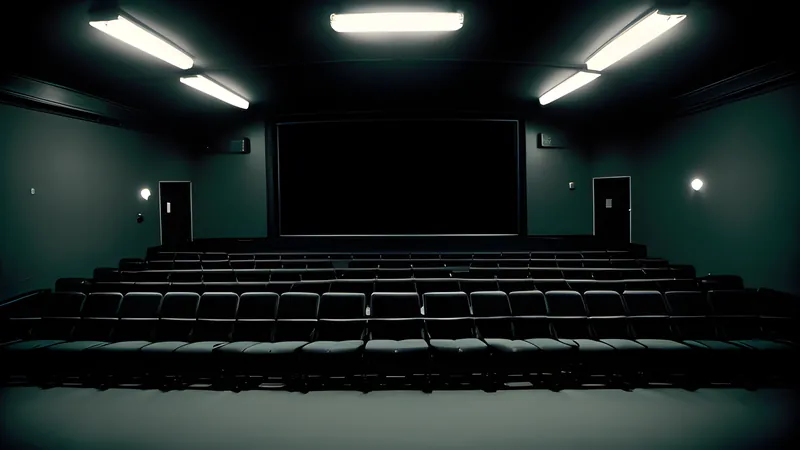
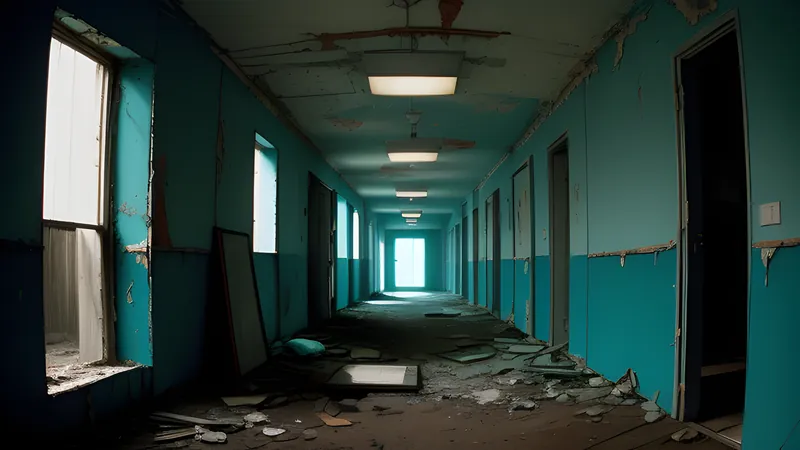
The first thing to say about Session 9 is that its greatest asset cost nothing to build, because it was already standing. The film was shot in the Kirkbride complex of Danvers State Hospital in Massachusetts, a genuine derelict asylum whose long, batwing wings and rotting wards Anderson uses as an unrepeatable set. You cannot fake that peeling paint, those miles of corridor, the light falling through broken glass onto floors that have been undisturbed for years. The production photographed the real thing before the developers arrived, and the building’s own decay does more atmospheric labour than any art department could afford.
What Anderson understood — and what makes this more than a location gimmick — is that the asylum’s scale imposes a rhythm. The men are dwarfed. They shout for each other and the sound dies in the plaster. When Gordon needs Mike, or Mike wanders off to explore a records room, the geography of the place turns simple errands into small expeditions into the dark. The horror is architectural before it is ever supernatural.
There is a lineage here worth naming, because Magpie is a collector and the collector’s instinct is to point backwards. The empty-institution horror descends from a very specific ancestor: the idea that a place can retain and replay trauma, that stone has memory. The Shining is the obvious grandfather, and Anderson knows it — the crew’s disintegration under a ticking deadline, the man whose grip on reality frays fastest, the sense that the building is casting rather than being visited. But Session 9 strips out Kubrick’s grandeur and replaces it with a working-class economic panic that feels closer to the bone.
Dread on a hard-drive deadline
Session 9 was made cheaply, and one of its quiet claims to a footnote in film history is that it was among the earliest features shot on Sony’s 24p high-definition video rather than film. In 2001 that was close to heresy for a theatrical horror picture, and the format could have looked like a liability. Anderson turned it into a texture. The HD image renders the asylum’s daylight interiors with a flat, clinical clarity — no romantic film grain to soften the ruin — so that when darkness comes it reads as a genuine absence of information rather than a stylised murk. The camera can sit in the gloom and simply wait.
And waiting is the film’s whole method. There is remarkably little that a trailer could isolate as a scare. The dread is accretive. It comes from Gordon’s frayed phone calls home, from the way a task as mundane as running a hose becomes freighted, from a crew whose banter curdles into suspicion as the money runs short and one man goes missing. Anderson keeps the supernatural apparatus almost entirely off-screen, which is the single smartest decision in the picture. You are never shown a rule you can rely on. That refusal to explain is the same engine that drives the best ambiguous ghost stories — the reason The Innocents still unsettles is that it never lets you decide whether the haunting is real or in the governess’s head, and Session 9 runs on exactly that uncertainty transplanted into a hard hat.
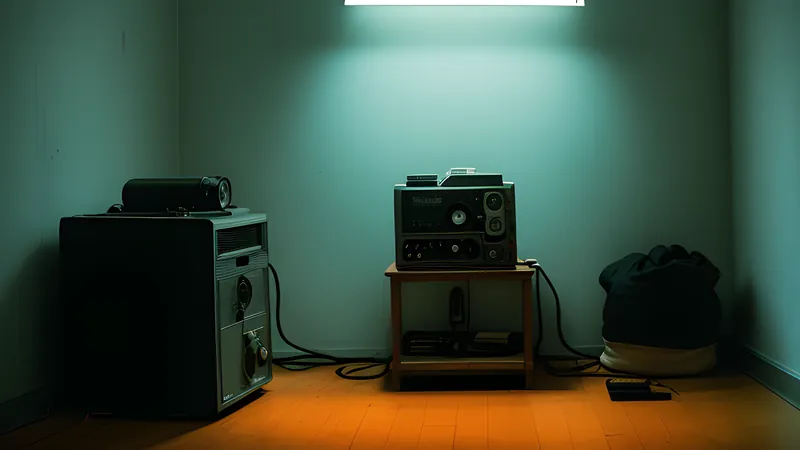
The title refers to a set of audio tapes. One of the crew, poking through the hospital’s abandoned patient records, finds reel-to-reel recordings of therapy sessions with a woman treated for dissociative identity disorder. He starts listening, session by session, drawn towards the ninth. The tapes function as the film’s second timeline, a voice speaking out of the building’s past, and the escalating menace on them shadows the escalating menace among the living men. It is an elegant structure: a haunting delivered as homework, a mystery the character chooses to solve at exactly the wrong pace.
The performances hold the floor
A slow-burn horror lives or dies on its actors, because there is no monster to cut away to. Session 9 is well cast for exactly this. Peter Mullan plays Gordon, the crew boss, as a man visibly held together with string; Mullan’s specific gift is a stillness that could tip into either exhaustion or violence, and the film lives in that ambiguity. David Caruso, a year or two before CSI: Miami rebranded him, plays Phil with a bruised, watchful pride. Josh Lucas is the cocky one, Stephen Gevedon (who co-wrote the screenplay with Anderson) is the one seduced by the tapes, and Brendan Sexton III is the nervy youngster picking his way through the dark.
What the ensemble gets right is the ordinariness. These are not investigators or teenagers who wandered in on a dare. They are tradesmen with families and debts, and their fear is braided with resentment about overtime and a bid that was too low. That grounding is why the film’s unease lands: horror is most effective when it arrives in a life that already had problems. The same instinct animates the domestic horror of Hereditary, where the supernatural is inseparable from a family that was already grieving and already fracturing. Anderson’s crew are haunted men before anything ghostly touches them.
Why it works
The craft lesson of Session 9 is restraint deployed as a weapon. Consider how Anderson handles sound. The mix keeps you inside the building’s acoustic — the drip, the hum of the generator, the far-off clatter that might be a colleague or might be nothing — so that a whispered voice on the tapes cuts through with disproportionate force. He rations his information. He never gives the audience a map of the supernatural rules, which means every scene can conceal a threat, because you cannot rule anything out.
Compare that discipline to what most horror does, which is to spend its ambiguity too early. Once a film shows you the ghost and tells you what it wants, the dread collapses into mere plot. Session 9 hoards its uncertainty until the final minutes, and even then it declines to draw the diagram fully. Whether the malignancy is a genuine spirit lodged in the Kirkbride wards or a psychological contagion passing from a set of tapes into a man already at breaking point, the film keeps both readings alive. That is the same tightrope walked by the great documentary-lie horrors — the found-tape conceit here is a first cousin to the grief-drenched fake documentary of Lake Mungo, another film that treats a haunting as something you uncover through recovered media rather than something that jumps out.
It is not a flawless picture. The subplot machinery creaks in places, and a couple of the crew are drawn thinly enough that you feel the screenplay reaching for its pieces. The HD cinematography, groundbreaking as it was, occasionally shows the era’s limits in low light. But these are quibbles against a film that achieves something rare: a genuinely oppressive atmosphere sustained across ninety minutes with almost no gore and almost no monster.
The verdict
Session 9 is one of the essential American horror films of its decade, and it has aged into something better than it was received. Coming out in 2001, it was a modest release that found its life on DVD, passed hand to hand by people who wanted to argue about what actually happens. That afterlife is the correct measure of it. This is a film designed to be discussed the moment the credits roll, because it hands you the responsibility of deciding what you saw.
If you want the pure experience, go in knowing as little as possible and watch it late, with the lights off and the volume up so the room tone of that dead building can fill your own. Then, when you have your reading of the ending, find someone who has also seen it and discover that they are certain of something different. That argument is the film continuing to work on you.
Where to watch: it circulates on the horror-focused streaming services and physical media has kept it in decent shape; the picture rewards a good screen, because so much of its terror is in what you can and cannot see in the corners.
Spoilers below
Stop here if you have not seen it.
The tapes are recordings of therapy with a patient named Mary Hobbes, who as a girl killed her family and whose personality fractured into alters — including a childlike voice and a malevolent one who calls himself Simon. Across the nine sessions the therapist coaxes Mary towards the memory of the murders, and it is Simon who finally admits, on the ninth reel, to being the one who did the killing, answering the therapist’s question about where he lives with the film’s most quoted line — that he lives in the weak and the wounded.
That answer is the key to the whole structure, because Session 9 has been showing us a weak and wounded man the entire time. Gordon, we learn, has done something terrible at home — the film has been seeding it in his uneasy phone calls and his story about a scalding accident with the baby — and the ending reveals that he has killed his family and has been drifting through the asylum hearing a voice, killing the rest of the crew one by one. Simon does not need to be a literal demon released from a tape. He is the name the film gives to the thing that lives in a broken person and speaks with their mouth.
This is why the ambiguity is load-bearing. You can watch the film as a straight supernatural piece in which a malevolence recorded on those reels finds a new weak host in Gordon. You can equally watch it as a psychological study in which a man already guilty of an unspeakable act projects his disintegration onto a building and a set of tapes that merely gave his madness a vocabulary. The genius is that the two readings are not in competition; the film is engineered so that every image serves both. The last shot leaves Gordon in the dark of the place that has swallowed him, and the answer to Simon’s question hangs over him: he lives in the weak and the wounded, and Gordon was weak and wounded before he ever walked in.
The move to admire is how completely the exposition and the horror are the same object. The tapes are not a lore dump bolted onto the plot; they are the plot, running in parallel and converging on the exact moment Gordon’s own crime surfaces. It is one of the cleanest pieces of structural horror writing of its era, and it is the reason the empty asylum has never quite let go of the people who have spent a night inside this film.
Related Content