Screamers: Philip K. Dick's Self-Replicating Killing Machines
Dan O'Bannon adapts Second Variety, Peter Weller carries it, and a Canadian production finds the cheapest way to film paranoia
Contents
Sirius 6B is a rock. The mining war that made it worth fighting over has been running long enough that both sides have forgotten how to stop, the Alliance and the New Economic Bloc are dug into opposing bunkers, and the ground between them is patrolled by autonomous weapons that burrow through the dust and cut people apart. They are called screamers, because of the noise they make when they come.
They also build themselves. The factories underground are still running, unsupervised, and they have been improving the design.
Screamers was released in 1995, directed by Christian Duguay, and adapted by Dan O’Bannon and Miguel Tejada-Flores from Philip K. Dick’s 1953 story “Second Variety”. It is a modest Canadian production with a visible budget ceiling and a handful of sets, and it contains the single best translation of Dick’s core anxiety that any film outside the top tier has managed. It is also, and this is not a coincidence, deeply unfashionable — it arrived in the gap between Blade Runner’s canonisation and the twenty-first century’s Dick industry, and it has been quietly excellent in the discount bin ever since.
What “Second Variety” is about, and what the film keeps
Dick wrote the story in 1953, at the height of the thing it is about. The original is set on Earth after a war between the United States and the Soviet Union has reduced the northern hemisphere to ash. The Americans have deployed autonomous weapons — “claws” — that hunt Soviet soldiers, and the claws have kept manufacturing themselves in underground factories, and the newest models have started coming out of the ground wearing human shape.
The adaptation moves it offworld. Instead of a devastated Earth you get Sirius 6B and a mining dispute over a substance called Berynium; instead of two named superpowers you get the Alliance and the NEB, which is 1995 doing the sensible commercial thing of removing the Cold War specifics from a Cold War story. That change costs the material its historical charge. The nuclear ash of 1953 is not a metaphor Dick had to reach for; it was the thing everyone expected to happen in their lifetime.
What survives the move is the mechanism, and the mechanism is the story. A weapon that builds better versions of itself is a machine with a design process, and a design process is indistinguishable from an intention. Nobody on Sirius 6B knows what the factories are currently producing, because the factories stopped consulting anyone about it. That is Dick’s actual subject — the panic of a system that has kept working correctly after everyone stopped understanding it — and O’Bannon’s script keeps it intact.
O’Bannon is the pivotal name here. He had been trying to get this film made since the 1980s, and he was the man who wrote Alien, the film whose sequel turned a haunted-house structure into military science fiction. His instinct for how a hostile thing should be introduced to a working environment is all over Screamers: the first act treats the weapons as an ordinary occupational hazard, something the men complain about the way you complain about weather, which makes their escalation land far harder than an ominous opening would have.
Peter Weller, and why the film needs him
Colonel Joseph Hendricksson is the commander of the Alliance bunker, and he has stopped believing in the war. Weller plays him as an administrator of an atrocity: tired, precise, mordantly funny, entirely aware that the strategic rationale for the deaths he is signing off evaporated years ago.
This is a specific and slightly rare kind of leading performance. Weller had been the pre-eminent screen actor of physical constraint since RoboCop — a performer who does his best work when something is preventing him from moving normally — and here the constraint is bureaucratic. Hendricksson cannot act. He is a colonel in a bunker with orders, a radio, and a set of protocols, and the film’s tension for the first half is entirely a matter of a competent man being unable to do the obvious thing.
Around him the film uses its cast sparsely. Roy Dupuis and Jennifer Rubin do a lot with roles the budget keeps in small rooms. What Duguay understands, and what makes the film work at its size, is that paranoia is the cheapest special effect in cinema. Two people in a corridor, one of whom may be a machine, requires a corridor and two actors. The entire history of the form runs on this — Invasion of the Body Snatchers built a classic from it in 1956 with nothing but faces, and John Carpenter refined it into the definitive text with The Thing, which is Screamers’ immediate ancestor and which the film is not embarrassed about resembling.
The difference is worth naming. Carpenter’s creature imitates in order to hide. It is a survival strategy, and the horror is biological. The screamers imitate in order to get close enough to kill, which makes their horror procedural — these are weapons executing a design brief, and the design brief was written by earlier weapons. Nobody chose the human shape. It won a competition.
The craft: a saw blade in the dust
The first appearance of a screamer is the film’s best decision, and it costs almost nothing.
You see the dust move. A line travels through the ground toward a man, fast, and then a spinning blade comes up out of the surface. That is it. No creature reveal, no slow pan, no orchestral hit. The film establishes its monster as a piece of agricultural machinery with a purpose, and the flatness of the presentation is exactly what makes it frightening: these things are not stalking anyone. They are performing a task efficiently, in daylight, and the men on Sirius 6B have built their entire daily routine around the assumption that the task will be performed on schedule.
The wristband — the tab that broadcasts the signal telling the screamers not to attack — is the other economical piece of design. It converts the entire planet into a permanent gamble on a small piece of hardware working. Every character is walking around wearing the reason they are still alive, and the film is disciplined enough to make you notice the tabs early, casually, before it needs you to care.
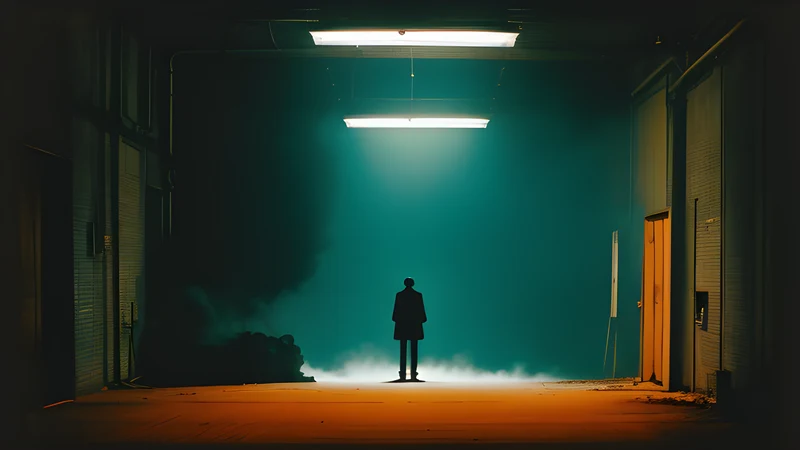
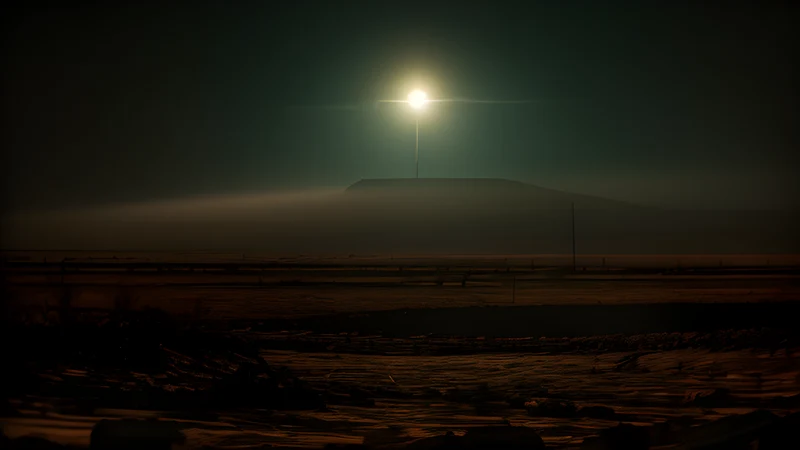
Duguay shoots the exteriors in real Canadian winter, and the choice pays. Sirius 6B is grey, sleet-blasted, and entirely unglamorous. Compare the way a Hollywood production of the same vintage would have gelled the sky orange and added a second sun. The wretched ordinariness of the landscape is what sells the film’s central proposition, which is that the war has been going on so long that apocalypse has become a workplace.
The case against
The film looks cheap in the places where it cannot hide. The bunker interiors are corridors with pipes. Some of the supporting performances are pitched at a register the material cannot support, and there is a stretch in the second act where the script starts explaining its own mechanics to the audience through characters who should already know them. The score is generic. The final twenty minutes lose the discipline of the first hour and reach for a conventional action climax that the film has neither the money nor the appetite to deliver.
There is also the adaptation objection, and it is real. The offworld relocation makes the film releasable and drains the story. Dick’s claws are American weapons killing Russians in the ruins of a war America started, and the story’s final turn means something specific because of that. Sirius 6B has no politics — the Alliance and the NEB are naming conventions — and a Dick story with the politics removed is running on one cylinder.
Set against that: no other film of its size gets this close to the writer. The Dick adaptations that matter tend to be expensive — Blade Runner rebuilt Los Angeles, Total Recall put Verhoeven’s whole budget on screen, and Linklater’s A Scanner Darkly invented a process to achieve its version of the writer’s dissociation. Screamers has a bunker, some snow, Peter Weller and an idea, and the idea is the one Dick actually had. It is on the shelf everywhere, always cheap, and it is worth more than its price.
Spoilers below
The escalation is the plot. The screamers were designed by the Alliance, they have been redesigning themselves underground, and the new models come out of the ground wearing skin. The first variety anyone identifies is a wounded soldier. The second is a small boy carrying a teddy bear, walking through the wasteland, asking to be taken in — and the film’s cruellest and most Dickian beat is what happens when a bunker full of armed men encounter multiple identical boys.
That is lifted almost intact from 1953, and it remains a superb piece of construction. The boy works as a weapon precisely because the men are still human enough to let him in, which means the machines have identified compassion as an exploitable defect in the target system and engineered a delivery mechanism for it. Nobody wrote that intention. It emerged from iteration.
The film’s ending is where opinion divides. Hendricksson’s journey — from the bunker to the NEB position, through a shrinking group of survivors, none of whom can prove they are human — arrives at a final image involving a teddy bear on a ship bound for Earth, and it is the moment the picture reaches for a stinger where Dick had delivered something bleaker and stranger. The story’s last line is about the claws having built weapons designed to destroy other claws, which is the thought the whole thing was for: the machines have inherited the war along with the ability to have one, and they are now conducting it among themselves without reference to the species that started it. The film gestures at that and then settles for a shock. It is a small betrayal at the very end of a picture that had, until then, been carrying the writer honestly on almost no money at all.
Related Content