Sátántangó: Tarr's Seven-Hour Rain-Soaked Epic
Twelve chapters, six forward and six back, on a collapsed collective farm where the rain never once lets up
Contents
A tango is six steps forward and six steps back. László Krasznahorkai built his first novel on that plan in 1985: twelve chapters, numbered up to six and then back down to one, so the book advances into its own middle and retreats out the other side and finishes where it started. Béla Tarr filmed it in 1994 at four hundred and thirty-nine minutes, kept the structure, and added rain.
Seven hours and nineteen minutes. Around a hundred and fifty shots in all of it — a rate of roughly one cut every three minutes, sustained across a working day. It was shot over several years on a collapsed collective farm on the Hungarian plain, in black and white, with a score by Mihály Vig, who also plays the con man at the centre of the thing. It is the most intimidating object in European cinema and it has spent thirty years being described by people who have not watched it, which is a shame, because the film is far funnier and far more vicious than its reputation permits.
The setup
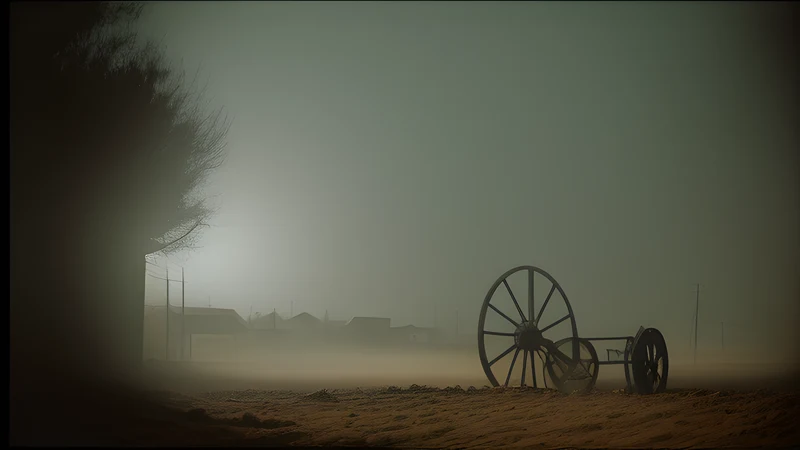
A collective farm has failed. The Soviet order that built it has gone, the enterprise has been wound up, and a dozen or so people are still living in its buildings because there is nowhere else. The rain has been falling for some time and shows no sign of stopping. Mud is everywhere; mud is, honestly, the film’s second lead.
The residents have a plan. There is money — a final payout from the dead collective — and they intend to divide it and leave. Everyone is also, quietly, planning to cheat everyone else out of their share, and Tarr establishes this with the flat lack of ceremony of a man reading a shopping list.
Then word arrives that Irimiás is coming back. Irimiás was thought dead. Irimiás is a talker, and to this village he is something close to a prophet — the one person who ever made them believe that their lives could have a shape. He arrives with his companion Petrina, and he has a proposal.
That is the whole plot, and I have given you nothing, because Sátántangó is not withholding anything. Tarr shows you the trap in the first hour and then makes you watch it close for six more.
The opening shot
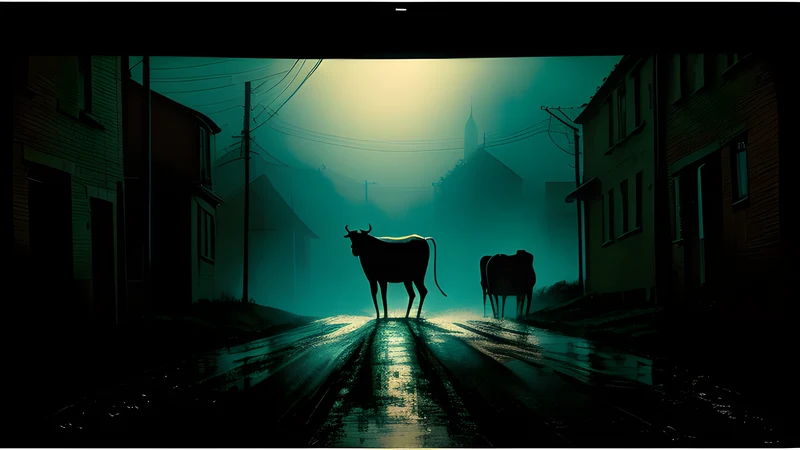
It begins with cows. A derelict farmyard, dawn, a herd shuffling out of a barn and moving between the buildings, and the camera tracks with them, sideways, for something like eight minutes. There is no dialogue. There is no music beyond ambient noise and a distant bell. There are cows, and mud, and walls that are losing their argument with the weather.
Every complaint about this film and every defence of it is available in that shot, and the honest thing is to say that it works as a filter. If eight minutes of cattle is an insult, leave now with my blessing; nothing later is shorter. If you stay, something happens around minute five: your attention, having exhausted its supply of impatience, gives up and starts actually looking. You notice the render coming off a wall. You notice the rhythm of the animals. You notice that you have been watching a place rather than a shot.
That transfer is Tarr’s whole method and it is a real technique with a real mechanism. Conventional editing makes the decisions for you — this face, now this hand, now this door — and the audience’s job is to receive. Tarr removes the decision-maker. The camera roams, loses interest, finds something else, waits. Nobody is telling you what matters, so you have to work it out, and the work changes what you are. By hour three you are watching this film the way you watch a room you are trapped in. Our essay on the long take as an instrument of dread maps how the tool operates in genre cinema; the slow cinema of dread covers the wider family. Tarr is the outer boundary of both.
Why it works
The structural trick is the reason it holds. Because the twelve chapters double back, you repeatedly watch the same hours from a different position, and the effect is nothing like Rashomon’s competing accounts — everyone agrees on the facts. What changes is what you can see from where you are standing.
So: a chapter follows the Doctor, an enormous alcoholic who never leaves his chair, who watches the village through his window and writes down every movement in ledgers, because documenting the place is the only power he has left. Later, another chapter walks past his window from outside, and you understand you have been in his notes. A chapter follows a small girl, Estike, alone. Later you see, from another angle, the adults who did not look for her.
The dance in the bar is where the machine peaks. The villagers get drunk and dance to an accordion for an extraordinarily long time — staggering, circling, whooping, in a low room while the wind takes the roof — and Tarr holds it well past pleasure, past comedy, past tedium, and out the far side into something genuinely infernal. A spider is meanwhile spinning webs over everything in the room, which Tarr shows you without underlining. These people are dancing while being wrapped up. The scene lasts long enough for you to arrive at that reading unassisted, which is why it lands.
And the film is funny. This gets left out. Petrina is a comic creation of real quality, the villagers’ mutual swindling is a farce played at a crawl, and Tarr’s timing — the held beat, the man walking all the way across the room to fetch the thing — is the timing of a very patient comedian. The despair works because the jokes work first.
The ancestor
The forebear here is Tarr himself, and it is the part of him that admirers of the late style tend to skip. He started in 1977 with Family Nest, a handheld, grainy, shouted piece of social realism about a young couple crammed into a flat with in-laws in Budapest — no long takes, no metaphysics, non-professional actors, faces jammed into the lens. It came out of what is sometimes called the Budapest school: Hungarian film-makers working in the 1970s in a hybrid of documentary and fiction, shooting real people in real rooms because the state would tolerate an argument about housing more readily than an argument about anything else.
That is where the mud comes from. Everything people call metaphysical in Sátántangó was first a housing complaint. The village is a real village of people with a real financial problem, and Tarr’s move between 1977 and 1994 was to keep the grievance and change the shutter speed — same faces, same rooms, same futility, filmed slowly enough that it stops looking like sociology and starts looking like the weather. Watch Family Nest and the seven-hour film stops being an art object and becomes what it is: a very angry man, still filing the same report, twenty years later.
Within the run, this is the middle panel: Sátántangó → Werckmeister Harmonies → The Turin Horse. Start with Werckmeister, which does the same work in two hours. Come here when you want the full dose.
The case against
The cat. In Estike’s chapter, the girl torments and then poisons a cat, at length, on camera, and Tarr shot it with a real animal. Assurances have been offered over the years about the animal’s welfare. The footage is what it is, it is genuinely distressing, and I am not going to pretend that the sequence’s power settles the question of whether Tarr had the right to obtain it. It is the strongest argument against the film and it is not a squeamish one.
Beyond that, the length is a claim on your life that the film cannot fully justify by argument. Tarr’s answer — that duration is the content, that you must be made to live in the village rather than be told about it — is coherent and self-serving, and there is no way to test it, since anyone who has given the film seven hours has an obvious interest in reporting that the seven hours were necessary. Uncut Gems does an endurance test in two hours; the question of what the extra five buy you is fair and open.
And the women are barely written. Estike is an emblem, the wives are functions, and the film’s moral intelligence, which is considerable, does not extend to noticing this.
The verdict
I have watched Sátántangó twice, both times at home, both times in one sitting because breaking it defeats the object, and the honest report is that the second half of the fourth hour is where the film stops being an event and becomes a condition. That is the reward. Nothing else in cinema does it. You surface at the end with the sensation of having been somewhere with a climate.
The argument underneath all the mud is unsentimental and rather cruel: Tarr thinks people in ruins will always find a voice to follow, and the voice will always be a chancer, and the ruin was mostly built by the last voice they followed. He does not despise them for it. That is the difference between him and every other miserabilist. The village is credulous because credulity is the only equipment they have.
The restoration is superb and the film plays repertory in single all-day sittings, usually with two intervals. Take the intervals. Eat beforehand. Go.
Spoilers below
Irimiás is a police informer. He is working for the authorities, he is reporting on the villagers, and his return is an operation. The film shows you his handlers early and never pretends otherwise.
His proposal to the village is a new commune, a fresh start, a place he has found where they can live properly, and it requires all of their money. They give it to him. Every one of them. They have spent the whole film scheming to cheat each other out of that money and they hand it over intact to the first man who offers them a story, and Tarr films the handover as a solemn, moving occasion, because to them it is one. Then Irimiás disperses them to lodgings in different towns, on the promise of the commune to come, and files his report.
The cruellest touch is that Irimiás may half believe it himself. Vig plays him with real conviction and something close to grief, and the film declines to tell you whether he is a cynic or a failed prophet who has taken a job. Tarr leaves the question in the room.
The last chapter belongs to the Doctor. He comes back to the village, which is now empty — everyone he has documented for years has gone, following a man who was reporting on them. He sits at his window. He can no longer see anything worth writing down. And so he gets up and boards the window over from the inside, nails a plank across the only thing he had, and in the dark he begins to write.
What he writes is the opening of the film. The words we heard at the start are his. The tango closes: six steps out, six steps back, and the man who watched it all has just sealed himself into the account of it. Tarr has spent seven hours teaching you to look at a thing until it means something, and he ends by putting up a board.
Related Content