Santa Sangre: Jodorowsky's Circus of Guilt and Armless Mothers
The film where the acid-Western surrealist finally found a beating heart
Contents
Most directors make their strangest film young and spend the rest of their careers apologising for it. Alejandro Jodorowsky did the opposite. Santa Sangre (1989) arrived when he was sixty, nearly two decades after the acid-Western notoriety of El Topo and the alchemical excess of The Holy Mountain, and it is the film where he finally discovered what all his imagery had been reaching for. The dream logic is intact. The provocations are intact. What is new is a story with a spine and characters you are asked to love, and the collision of those two registers produces the best film he ever made.
A circus, a saint, and a boy in an asylum
The film opens on a young man named Fenix, naked and feral in a psychiatric hospital, perched in a tree, refusing to be human. How he got there is the film. In an extended flashback we meet him as a boy — played by Jodorowsky’s son Adan, while the adult Fenix is played by another son, Axel — growing up inside a threadbare Mexican circus run by his parents. His father, Orgo, is a swaggering American knife-thrower and philanderer, a tattooed slab of machismo. His mother, Concha, is an aerialist and the leader of a heretical religious cult that worships a local girl who was raped and had her arms severed, her spilled blood pooled in a church the authorities want to demolish. The sect’s shrine — a limbless statue in a pool of red — gives the film its title, “Holy Blood.”
The family detonates. Orgo’s cruelty and Concha’s fanaticism reach a mutual, mutilating climax, and the trauma cleaves Fenix in two. When the story returns to the adult Fenix, he has escaped the asylum and fallen under the control of his armless mother, becoming her literal arms — standing behind her, reaching around her body to perform the gestures she can no longer make, playing piano for her, and, at her jealous command, killing the women who threaten her hold on him. It is one of the great sick metaphors in horror cinema: a son so consumed by his mother that he surrenders his own hands to her will.
Why it works: the imagery finally serves a wound
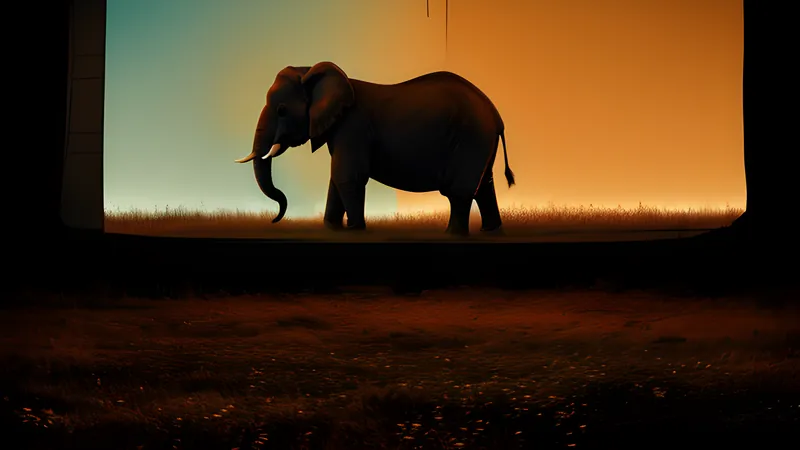
Jodorowsky’s earlier films dazzle and exhaust in equal measure because the images arrive as a torrent with no undertow of feeling to organise them. Santa Sangre solves that problem by anchoring every surreal flourish to a psychological truth about a damaged man. The elephant that dies and is given a full funeral procession, its enormous coffin heaved through the slums and tipped over a ravine for the poor to butcher — it is grotesque and unforgettable, and it also means something precise about how this boy learns that mourning and appetite live in the same body. The film earns its excesses because each one is load-bearing.
The craft argument runs through the central conceit’s staging. The four-armed illusion — mother in front, son behind, his arms doing her bidding — is achieved with nothing more than careful blocking, choreography, and two performers moving as one organism, and it is more unnerving than any effect because you can see it is real bodies. Jodorowsky rehearsed Axel and Blanca Guerra (who plays Concha) into a genuine physical fusion, so that the piano scenes and the murders play as a single four-limbed creature. That is theatre-craft, the same discipline that ran under El Topo, deployed here for horror rather than ritual. When a filmmaker can frighten you with blocking alone, he does not need the money for optical trickery.
There is also the matter of influence flowing both ways. Santa Sangre was produced by Claudio Argento, brother of Dario, and the film wears its Italian-horror lineage openly — the vivid, unnatural colour, the operatic murders, the killer’s-hands imagery all descend from the giallo tradition Argento’s family perfected. Jodorowsky took the giallo’s obsession with beautiful, choreographed killing and grafted it onto his own psychodrama, which is why the film feels like a bridge between two cults that rarely met. If you come to it from the surrealist side, it is the most legible thing he made; if you come from the horror side, it is the most soulful giallo-descendant on the shelf.
The circus as Jodorowsky’s true home
It is no accident that Jodorowsky set his most controlled film inside a circus. He grew up around performers, trained as a mime and a puppeteer, and spent his theatre years staging spectacles designed to overwhelm a live crowd. The circus in Santa Sangre is the place where his instincts finally match his subject — a world of painted faces, physical danger, and grotesque display, where a knife-thrower’s act and a religious rite look like the same thing. The film understands that a child raised in that environment learns to read violence as performance and love as a routine to be rehearsed, and it uses the setting to explain Fenix’s damage without a single line of expository dialogue.
The Down’s-syndrome performers, the transvestite wrestler, the tattooed woman, the mud-caked children of the slums who swarm the elephant’s coffin — Jodorowsky populates the frame with the marginal and the extraordinary in a way that could tip into exploitation, and largely does not, because the camera treats them as citizens of a coherent world rather than freaks on display. That generosity is part of what separates the mature Jodorowsky from the younger provocateur; the earlier films used bodies as shock material, and here the same faces are given interior lives. It is the difference between a filmmaker pointing at the strange and one who lives inside it.
The verdict
Santa Sangre is Jodorowsky’s masterpiece, and the reason is simple: it is the only one of his films where the delirium and the emotion pull in the same direction. The younger films are museums of astonishing images you admire from behind glass; this one reaches through the glass and grabs you, because underneath the circus and the cult and the four-armed murders is a genuinely moving film about a boy trying to escape the two people who made him. It is grotesque, occasionally cruel, and not for the squeamish — the violence is operatic and the Freudian machinery is unsubtle by design. But it is also tender in a way nothing else in his filmography attempts, and it resolves on grace rather than horror, which from this director counts as a small miracle.
Watch it as the culmination of the trilogy of himself — El Topo the raw provocation, The Holy Mountain the maximal statement, Santa Sangre the one where the man finally shows you the wound the images were always dressing. It also pairs beautifully with any of the other films where a private psychological terror is staged as full-blooded spectacle; horror rarely gets this personal while staying this operatic.
Where to watch: seek the Severin restoration, which does justice to the saturated colour that is half the film’s meaning. Give it your full attention on the largest screen you can manage. It is a circus, and it wants the big top.
Spoilers below
The engine of the film is the twist buried in the childhood flashback, and it reorganises everything. On the night the family destroys itself, the boy Fenix watches his father Orgo catch his mother Concha with the tattooed circus woman. Concha attacks Orgo by throwing acid on his genitals; in agonised revenge, Orgo takes his knives and severs both of Concha’s arms before cutting his own throat. Fenix witnesses the whole thing. That is the trauma the adult Fenix has walled off, and it is the source of the armless-mother compulsion that governs the rest of his life.
Here is the cruelty of the structure: the Concha who commands the adult Fenix to kill is not real. His mother died that night. What Fenix serves is a hallucination, a psychotic reconstruction of his mother assembled from guilt, and the “arms” he lends her are the instrument of a killing spree he cannot consciously acknowledge. Every woman who shows him tenderness — the tattooed woman, a wrestler, others — is murdered by his own hands under the delusion that his jealous mother demands it. The film has been a possession story with no ghost, only a mind eating itself.
The redemption is where Jodorowsky breaks his own pattern. Alma — the deaf-mute girl Fenix loved as a child, the tattooed woman’s daughter — reappears and refuses to be the next victim. Her refusal, and her steady insistence on his humanity, is what finally shatters the delusion. In the climax Fenix confronts the phantom of his mother, understands that his hands are his own, and chooses Alma and life. When the police arrive he raises his arms in surrender, and the gesture lands as liberation — a man reclaiming the limbs he had given away. After a career of burning his heroes and drowning his audiences in provocation, Jodorowsky ends on a boy becoming whole. It is the warmest thing he ever filmed, and it is all the more powerful for arriving out of so much blood.
Related Content