Sam Raimi: From the Cabin to the Multiplex
The self-taught splatter kid who taught Hollywood how a camera can move
Contents
There is a shot that recurs across Sam Raimi’s whole filmography, and once you notice it you cannot stop seeing it. The camera stops being an observer and becomes a predator. It skims low over the ground, tears through a forest, bursts through a window, races at a screaming face — a point of view that belongs to no character, only to a malevolent force with a body of its own. Raimi built a forty-year career on the belief that the camera is not furniture. It is a performer, and it can act.
He was born in Michigan in 1959, made shorts on Super-8 with his friends as a teenager, and taught himself everything by doing it wrong until it worked. He had no film school, no connections, and no money. What he had was a gang — chiefly the actor Bruce Campbell and the producer Robert Tapert — and a conviction that energy could substitute for budget. That conviction produced one of the most influential debut features in horror history, and it never left him. Even inside a $200-million studio machine, the splatter kid from the cabin is still visible in every frame.
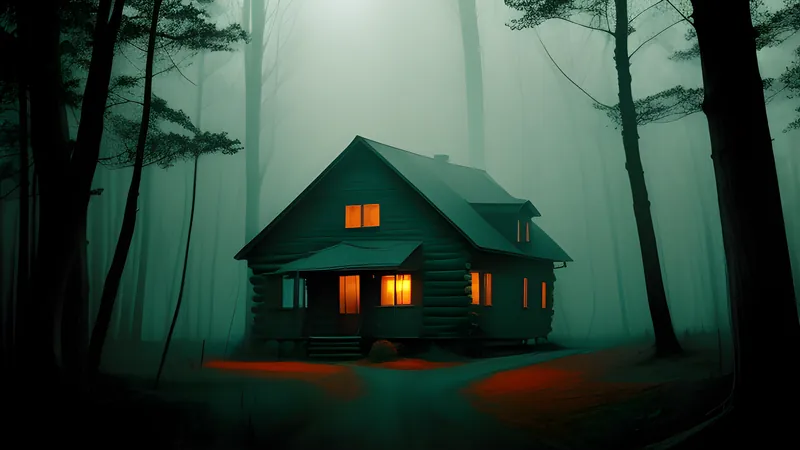
The cabin that started everything
The Evil Dead (1981) was shot in the woods of Tennessee on a budget scraped together from local investors, and the shoot was, by every account, a brutal endurance test — cold, mud, injuries, a crew of amateurs learning as they froze. What emerged was a horror film that moved like nothing before it. Five kids in a remote cabin, a recovered Book of the Dead, and an escalating siege of demonic possession, all delivered with a camera that would not sit still. Raimi mounted it on planks — the notorious “shaky-cam” rigs — and hurled it through the forest to embody the unseen evil stalking the woods. He built low-angle dollies, strapped lenses to bikes, did whatever it took to make the frame feel alive and hostile.
I have written about the mechanics of that predatory camera at length in the full review, so here the point is what it revealed about the man. Raimi treated technical limitation as a creative dare. He could not afford elaborate creatures, so he made the movement of the camera the monster. He could not afford smooth Hollywood coverage, so he invented rougher, faster, more visceral grammar. Stephen King championed the film, it found its audience on the emerging home-video circuit, and a career was launched out of pure ingenuity and stubbornness.
The trilogy that became a comedy
Here is the swerve that defines Raimi’s sensibility. Handed a bigger budget for Evil Dead II (1987), he did not simply make the first film again, larger. He remade it as a splatstick comedy — Grand Guignol crossed with the Three Stooges, a horror film that wanted to make you scream and laugh in the same breath. Campbell’s Ash became a slapstick everyman fighting his own possessed hand, geysers of coloured fluid replaced blood, and the camera got faster and funnier. Raimi had grown up on the physical comedy of the Stooges and the manic timing of Tex Avery cartoons, and Evil Dead II fused that comic vocabulary to horror so completely that the whole modern horror-comedy genre traces back through it.
Army of Darkness (1992) pushed the joke all the way, stranding Ash in the Middle Ages for a Harryhausen-tribute adventure with skeleton armies and one-liners. By then the balance had tipped fully from fright to farce, and some horror fans grumbled. But the trilogy as a whole is a masterclass in a director following his own instincts wherever they lead. Raimi never repeated himself out of caution. Each Evil Dead is a different film wearing the same cabin.
The years in the wilderness
Between the cult hits Raimi was quietly trying to prove he could work in any register, with wildly mixed results. Crimewave (1985), an early collaboration with the Coen brothers on the script, was a troubled production he has more or less disowned. Darkman (1990) was his first real studio picture — an original superhero built from Universal-monster DNA, a disfigured scientist in the mould of the Phantom and the Invisible Man, shot with all his kinetic verve. It is an underrated film and a clear rehearsal for what came later.
Then he genuinely stretched. A Simple Plan (1998) is a cold, controlled Coen-adjacent thriller about ordinary men destroyed by found money, and it contains none of the visual pyrotechnics — proof that Raimi could direct restraint when the material demanded it. The Gift (2000) worked a Southern-gothic supernatural mystery. For Love of the Game (1999) was a straight baseball romance. This is the stretch of the career people forget, and it matters, because it shows a genre showman deliberately widening his range before the biggest job of his life arrived.
Spider-Man, and the camera that never calmed down
Spider-Man (2002) made Raimi one of the most commercially important directors on Earth and effectively launched the modern superhero era, and the astonishing thing is how much of the cabin survived the transition. The web-swinging sequences move with the same predatory glee as the Evil Dead camera racing through the woods. Spider-Man 2 (2004) is widely regarded as one of the finest films the genre has produced, and its standout set piece — the operating-theatre massacre by Doctor Octopus’s mechanical arms — is pure Raimi horror, all whip-fast movement, screaming victims and a sequence staged like a demon attack. He smuggled his splatter sensibility into a family blockbuster and nobody stopped him.
There is a craft point worth pausing on, because it explains why the horror translated so cleanly to a blockbuster. Raimi cuts for impact the way a horror director does — a sudden push-in on a shocked face, a whip-pan to the source of a noise, a beat of stillness before the jolt. Superhero action before him tended to be shot for clarity and scale. Raimi shot it for sensation, borrowing the grammar of the jump scare and the haunted house, and audiences responded to the visceral charge without necessarily knowing where it came from. The operating-theatre scene works because it is staged as an exorcism gone wrong, complete with a possessed victim and a chorus of terrified onlookers. He was making a horror film inside a superhero film and betting the audience would feel the difference.
The relationship with the studio soured on Spider-Man 3 (2007), overstuffed at the producers’ insistence, and the planned fourth film collapsed. Raimi went back to his roots with Drag Me to Hell (2009), a gleeful, disgusting, moral little horror-comedy about a curse and a comeuppance, proving the cabin kid was intact under the blockbuster gloss. He detoured through the studio machine again with Oz the Great and Powerful (2013), then returned, fittingly, to horror-adjacent spectacle with Doctor Strange in the Multiverse of Madness (2022) — a Marvel film he was allowed to shoot like a haunted-house picture, complete with jump scares and a zombie and a camera that swoops like something hunting.
The unbroken line
What connects the cabin to the multiplex is a single idea, held for four decades: film is a kinetic medium, and motion is meaning. Raimi’s peers in the low-budget horror boom often stayed put — some of them, chronicled in the wider story of the genre’s rule-breakers I sketched in the final-girl rule and the films that broke it, traded on transgression or atmosphere. Raimi traded on velocity. His camera is always the most active thing in the room, and that restlessness became his signature long before the industry had a word for it.
There is a visual signature that ties the whole thing together beyond the moving camera: the Oldsmobile Delta 88 that Raimi owns and hides in nearly every film he makes, the Three Stooges eye-poke that keeps recurring, the fondness for a grotesque close-up held a beat too long. These are not tics so much as a maker signing his work, the mark of a director who came up making home movies with his friends and never lost the pleasure of it. Even the Spider-Man films are stuffed with in-jokes and cameos that only make sense if you know he still thinks of filmmaking as a game played with a gang.
His generosity is part of the legacy too. Through his and Tapert’s production shingles he has backed a long line of genre films and filmmakers, helped resurrect The Evil Dead as a franchise and a beloved Ash vs Evil Dead series, and kept championing the kind of scrappy horror that gave him his start. He never forgot that he came up with no permission from anyone.
If you want the whole arc in two films, watch The Evil Dead and then Spider-Man 2 back to back and clock how little the essential grammar changed. The budget went up by three orders of magnitude. The camera is still a predator, still delighting in the chase. That is a career with a spine — a self-taught kid who decided in a freezing Tennessee wood that a movie should move, and never once changed his mind.
Related Content