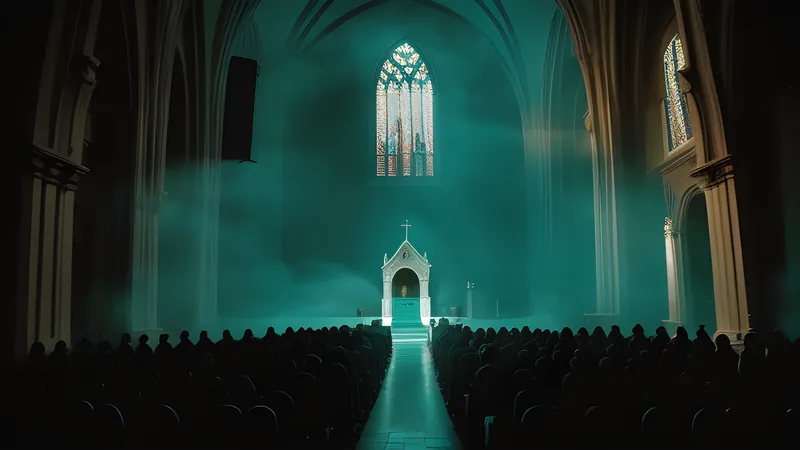
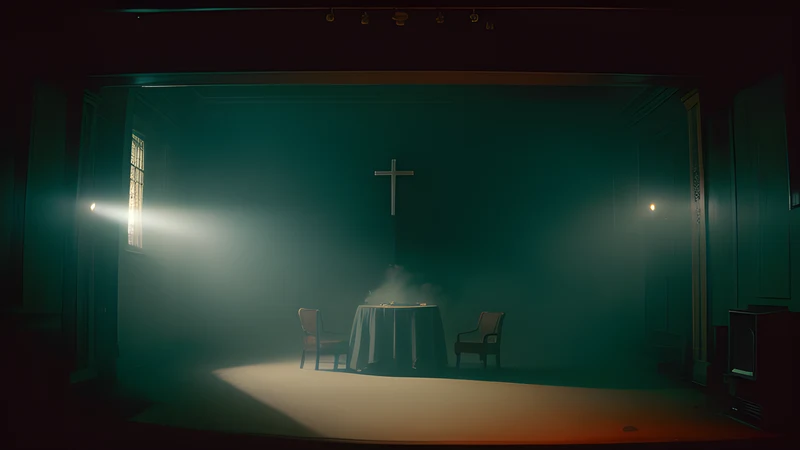
Saint Maud: The Nurse, the Cross, and the Void
Rose Glass's debut turns religious ecstasy into a horror engine
Contents
The best thing about Saint Maud is that it never once condescends to its main character. That sounds like a small mercy. It is the whole film. Rose Glass made her feature debut in 2019 with a story about a private palliative care nurse who believes God speaks to her, and the easy version of that story — the version a hundred lesser films have made — treats belief as a symptom and the believer as a specimen. Glass declines. For eighty-four minutes she stands exactly where Maud stands, and the result is a horror film that gets under the ribs in a way most of its better-funded contemporaries manage only in their trailers.
I did not see it in a cinema on its first pass, and almost nobody did. It premiered at Toronto in September 2019, then walked straight into the pandemic; the UK release slid to October 2020 and the US to February 2021, by which point A24 had spent the better part of eighteen months keeping a small British film warm. Most people met it at home, alone, on a laptop. That turns out to be roughly the correct viewing conditions.
The nurse who wants to be needed
Morfydd Clark plays Maud, a nurse working private assignments in a faded English seaside town — Scarborough, shot with the affectionate contempt of somebody who knows exactly what a wet Tuesday there feels like. She is a recent and ferocious convert to Catholicism. She was, before that, someone called Katie, and the film releases the details of what happened to Katie with the patience of a card sharp.
Her new client is Amanda Köhl, played by Jennifer Ehle: a former dancer and choreographer, now dying of lymphoma, marooned in a large house with her cigarettes and her books and a visitor named Carol whom she pays for. Amanda is glamorous, cruel, funny, and bored. She spots Maud’s devotion immediately and does what a bored clever person does with a gift like that — she picks it up and turns it over and enjoys the light coming through it.
The relationship that follows is the engine of the film, and Glass builds it out of a genuinely nasty insight: Maud needs to save Amanda because a saved Amanda would prove that Maud’s God is real and that Maud’s suffering has a shape. Amanda’s own need barely enters into it. The care is real. The motive underneath it is Maud’s own vertigo. Ehle plays the moment Amanda works this out with a flicker of something close to pity, and then discards the pity, because pity is boring and Amanda is dying and would rather be entertained.
The seaside as a purgatory
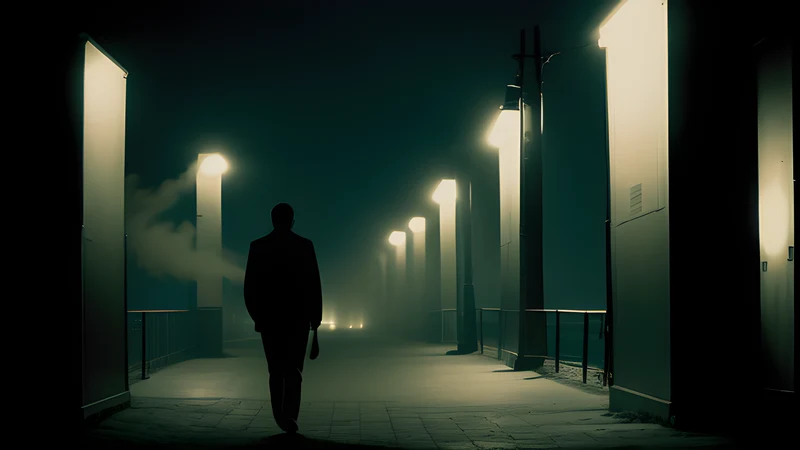
Ben Fordesman’s photography does something clever with the town. Coastal Britain in horror is usually rendered as bleakness — grey sea, grey sky, grey people. Fordesman shoots it as a place with the lights still on and nobody home: the arcade glow, the sodium orange of a promenade at two in the morning, the specific loneliness of a pub where everyone is having a nice time except you. Maud walks through it like a woman crossing a foreign country.
The interiors run the other way. Amanda’s house is warm, cluttered, expensively lived in. Maud’s bedsit is a cell with a mattress. Glass never underlines the contrast with dialogue; she just cuts between them and lets you feel the temperature drop. It’s the sort of economy that comes from a director who has thought about what the audience will do for free if you leave them room.
Adam Janota Bzowski’s score deserves its own paragraph. It works mostly in low drones and small, wrong-sounding string figures that seem to arrive from underneath the image rather than over it. When Maud’s ecstasies come, the sound doesn’t swell heroically. It thickens. The effect is closer to pressure than to music, and it is doing a great deal of the film’s argument: whatever is happening to this woman is physical before it is theological.
Why the camera believes her
Here is the craft move the film is built on, and it’s worth spelling out because it is the reason Saint Maud works and a dozen similar films don’t.
Glass and Fordesman shoot Maud’s religious experiences from inside them. When she feels God arrive, the camera rolls — literally, the frame rotates, the horizon tips, the room turns over — and the film does not cut away to a sceptical wide shot to reassure you that she is a mad woman in a small room. There is no exterior narrator. There is no doctor character explaining pathology. The audience is given Maud’s sensorium and nothing else, and so the audience has to decide, alone, what it thinks is happening.
That decision is the film’s real subject. Glass has said in interviews that she wanted the question kept open, and she keeps it open by refusing the one shot that would close it. Compare this to almost any studio possession picture, where the camera’s neutrality is a promise that reality exists somewhere off-screen. Saint Maud offers no such promise. This is the same trick The Entity pulls in a much cruder register — arguing with its own sceptics by simply declining to hand them a vantage point — and it’s the reason both films leave a bruise.
There’s a moment where God answers Maud in Welsh. Clark is Welsh; the choice makes the voice both intimate and utterly alien, a private language surfacing from somewhere Maud didn’t put it. It’s the single most economical piece of characterisation in the film, and it costs one line.
The real ancestor
Everyone reaches for Repulsion here, and they’re right, though the descent is worth tracing properly. Polanski’s 1965 film puts you inside Carol Ledoux’s flat and inside her deterioration with the same refusal to step outside and check, and Saint Maud is unmistakably its granddaughter — the isolated woman, the apartment as skull, the world’s ordinary noises turning into threats.
The other parent is Taxi Driver. That sounds glib until you notice the shape: a lonely person narrating their own righteousness to an absent listener, mortifying their body, choosing one damaged stranger to redeem, and building toward an act of violence that they experience as grace. Maud’s voiceover to God is Travis Bickle’s diary with better vocabulary.
And underneath both sits the strain of British cinema that took religious ecstasy seriously enough to find it terrifying — Ken Russell above all, whose The Devils understood that faith and appetite use the same nervous system. Glass is quieter than Russell by about four orders of magnitude, and she is after the same thing: the moment where devotion stops being a belief and becomes a physical need.
If you want to place it in the wider revival, it belongs beside The Babadook and Hereditary as a film where the supernatural reading and the psychological reading are the same reading, held at the same time, and the film’s discipline lies in never blinking. For the religious register specifically, it sits at the far serious end of the tradition I’ve mapped in the possession film and the return of the religious — a strain that usually arrives with a priest and a bag, and here arrives with a nurse and a nail.
The case against
Two honest objections.
The first is that the film’s central relationship is short. Maud and Amanda have perhaps four substantial scenes together before the film’s structure moves them apart, and Ehle is so good that you feel the loss when the picture becomes a solo. Glass’s tight running time is mostly a virtue — the thing has no fat on it at all — and it does mean the middle stretch has to carry a lot on Clark alone. She carries it. You still notice the weight.
The second is that the film is legible. A patient viewer will see roughly where it is going by the halfway mark, because Glass plants her mechanism early and fairly. Some people find that a flaw. I think the legibility is the point: the film is running a tragedy, and a tragedy is supposed to be visible while you watch it happen. But if you came for a puzzle, you’ll feel the answer arriving before you wanted it.
What is beyond argument is Clark. She plays Maud without a single note of performed madness — no wild eyes, no trembling. She plays a person being extremely reasonable inside a wrong premise, which is far harder and far more frightening. Watch her posture change when she thinks she’s being useful. It’s a whole character in a spine.
Saint Maud is on the major streamers in most territories and worth owning; the disc transfer holds the sodium light properly, which matters more here than usual. Watch it late, alone, with the sound up. Then watch Repulsion the following night and see how little has changed in fifty-five years about the horror of a small room and a certain conviction.
Spoilers below
The film’s structure is a slow reveal of Katie. She was an NHS nurse; a patient died badly on her watch — the flashback is brief, bloody, and shot like a memory rather than an event — and the breakdown that followed produced the conversion. God arrived out of a hospital room she could not survive without him.
Amanda’s cruelty crystallises at the party. She has been calling Maud her saviour, half-affectionately, and then in front of guests she performs the joke properly, and Maud strikes her. That is the hinge: the moment Maud’s mission fails as a mission and becomes something she has to complete for herself.
What follows — the drift, the drinking, the return to Katie, the pub, the pick-up on the beach — is Glass showing us the world Maud converted to escape, and it is far more frightening than the visions. Then the nail in the shoe. Then the return to Amanda’s house, and the killing, and the tail Maud sees on Amanda’s back, which the film shows us without comment, exactly as promised.
And then the beach. Maud, robed, the white sheet, the accelerant, the crowd. The final shot is one of the great cuts in modern horror: the camera holds on her transfigured, ascending, glorious, the score swelling into rapture — and then the sound rips and the image snaps to what is actually happening, a young woman screaming in a fire on the sand, for one second, and the film ends.
That second is the entire argument. Glass gave you eighty-three minutes inside Maud’s head on the understanding that she would show you the outside exactly once, at the last possible moment, and let you carry the gap home. The film offers no verdict on whether God was there. It offers the cost of the question, paid in full.
Related Content