Riccardo Freda: The Forgotten Father of Italian Horror
The sculptor-turned-swashbuckler who made Italy's first horror film on a bet and walked off it
Contents
Every history of Italian horror begins with the same sentence about Mario Bava and Black Sunday, and every history of Italian horror is starting three years late. The first Italian sound horror film was I Vampiri, released in 1957, and it was directed by a man who had bet his producers he could shoot the thing in under a fortnight, who walked off the set with two days left to run, and who spent the following four decades telling interviewers that horror was beneath him and that his own reputation had been inflated by Frenchmen.
Riccardo Freda was born in Alexandria, in Egypt, in 1909, to Italian parents, and raised in Milan. He trained as a sculptor, which is a fact worth holding on to, because his films are composed by someone who thinks about mass, volume and the way light lands on a surface. He came into the industry through criticism and screenwriting, and began directing in 1942 with a costume adventure. For fifteen years he was one of the most reliable makers of Italian spectacle: swashbucklers, historical melodramas, Les Misérables in 1948, Spartaco in 1953, Theodora, Slave Empress in 1954. Fast, handsome, entirely commercial pictures, made by a man who could stage a crowd.
The twelve-day wager
The origin story of I Vampiri is the kind that usually collapses under examination and mostly does not. Freda maintained he told his producers that Italian audiences would watch a domestic horror film and that he could prove it cheaply, and shot the picture at speed — the figure he gave was twelve days, and the schedule was certainly close to that. He then left before the end. His cinematographer, a man called Mario Bava, finished the direction, shot the effects and rescued the picture.
Freda’s own account of the departure changed over the years, and in the versions he liked best it was a kindness: he had walked, he said, in order to force the studio to hand Bava a camera and reveal what he could do. It is a lovely story and it is probably at least partly retrospective. What is certain is that Bava shot the film’s most famous passage, in which the Duchess ages decades on camera in a single unbroken take, achieved with graduated makeup and a slow transition between coloured filters, the transformation appearing purely as an optical event in the lens.
The film itself deserves better than its status as a footnote. It is set in contemporary Paris, which is the first and most revealing decision: Italy’s first horror picture takes place in France, with a French journalist hero investigating the drained bodies of young women pulled from the Seine, because even in 1957 the makers understood that Italian horror would have to happen somewhere else. The Duchess du Grand needs blood to hold her youth, her scientist keeps supplying it, and Gianna Maria Canale plays both the ancient woman and the young one. Underneath the gothic furniture it is a newspaper procedural, and the tension between the two registers — a reporter chasing a story, a countess in a crypt — is the exact hybrid the giallo would monetise fifteen years later.
The film flopped in Italy. The explanation usually given is the one that shaped everything after: Italian audiences of 1957 wanted horror to be American or British, and distrusted a gothic with Italian names on it. So the industry learned to lie. When Freda made Caltiki, the Immortal Monster in 1959 — and left that one for Bava to finish as well — he signed it “Robert Hampton”. Bava would later be “John M. Old”. Margheriti became “Anthony M. Dawson”. An entire national cinema conducted itself under assumed names for a decade, and the colourising of the gothic the British were doing openly at Bray, the Italians did in disguise.
The Hichcock films
Freda’s best work as a horror director came in 1962 and 1963, both times with Barbara Steele, who had just been made an icon by Bava’s gothic masterpiece of two faces.
The Horrible Dr. Hichcock (1962) is a genuinely startling film to encounter, and the missing “t” in the title is a wink at a director whose name could not be used. A Victorian surgeon has a private pharmacological arrangement with his wife involving an anaesthetic and a game they both consent to; the game goes wrong, she dies, and he remarries. The picture is about necrophilia, in 1962, and Freda gets it past the censors almost entirely through composition — everything is implied by a hand on a sheet, a door, a lit corridor, a green filter. Riccardo Pallottini photographed it in colours that owe a great deal to Bava’s example, and Steele plays the second wife as a woman slowly discovering the terms of a contract nobody read to her.
The Ghost (1963) reunited them and is lesser — a Scottish-set inheritance plot with a séance and a twist — but it has a cruelty in the last reel that the Italians would spend the next fifteen years imitating. Both films went out under the Hampton name, and both were sold abroad as British.
The sculptor’s eye
Freda’s craft is worth separating from his mythology, because the mythology is largely his own invention and the craft is real.
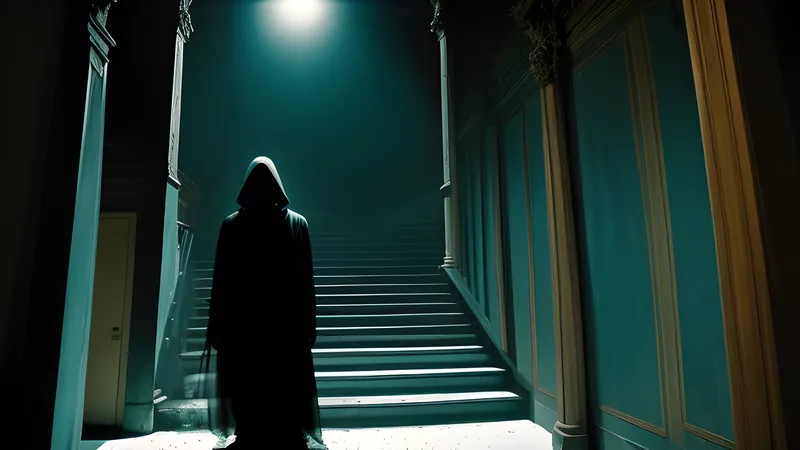
He composed in depth and he moved the camera with a confidence almost nobody in Italian genre cinema had at the time. Where Bava built his images out of light and glass — the magician’s approach, the effect achieved in front of the lens — Freda built his out of space and bodies. A Freda gothic is a series of rooms with people placed in them at specific distances, and the horror comes from the geometry: a figure at the far end of a corridor, a staircase used at full height, a face arriving in the foreground while the important event happens forty feet behind it. The sculptor is visible in every frame. He liked marble, drapery and the weight of things.
He was also fast in a way that has been mistaken for carelessness. Freda shot his coverage in his head and printed few takes, which gives the good films an unusual forward pressure and the bad ones a sense of a man leaving the building. His literacy shows too — the swashbucklers are properly constructed melodramas, and The Horrible Dr. Hichcock is a better piece of screenwriting architecture than its reputation as a curiosity allows.
The difficult man
Freda gave interviews for forty years and contradicted himself in most of them. He was scornful about the genre that made his name, dismissive about Bava in ways that curdled as Bava’s stock rose and his own did not, and enthusiastic about the auteurist attention from France while insisting he was a craftsman who worked for money. He disowned The Iguana with the Tongue of Fire (1971), a giallo he made during the boom and plainly despised, and he told people so at length. Double Face (1969), with Klaus Kinski trapped in a Swinging London mystery, is better than he admitted.
There is a version of this career in which Freda is the great might-have-been, sabotaged by a market that gave him no room. There is another in which he was a very good technician with a vast ego and an allergy to finishing things, who left two films for a subordinate to complete and then wrote himself the flattering explanation. The evidence supports both, and the honest position is that a man who abandoned his own historic first film with forty-eight hours left on the schedule has forfeited the right to be surprised that someone else got the credit.
The French made him
The reason anyone outside Italy discusses Freda at all is a magazine. Midi-Minuit Fantastique, which ran in Paris through the sixties, was the first serious critical operation anywhere to treat Euro-horror as an art form, and its writers — Jean-Claude Romer, Michel Caen and their circle — decided early that Freda was a major director. They interviewed him at length, ran the Hampton films under his real name, and installed him in a French canon at a moment when Italian critics regarded him as a hack who made monster pictures for the provinces.
This is the same mechanism that produced Fisher’s reputation, and Hawks’s, and Fuller’s, and it had the same distorting effect. Freda enjoyed the attention enormously and played up to it, supplying the magazine with the sardonic auteur persona it wanted while simultaneously insisting he made films for money and thought the genre was rubbish. Both performances were sincere. He was a man who had been told by his own country that his best work was disreputable and by another country that it was art, and he never resolved the two positions, which is probably why the interviews contradict each other so freely.
The honest case against
He made roughly fifty films and perhaps four matter. The peplums and swashbucklers are efficient and anonymous; the sixties eurospy work is filler; Murder Obsession (1981), his final picture, is a fond gothic-giallo with real images stranded in a plot that collapses. Freda never developed the way Bava did, because he never regarded the genre as worth developing in. He treated horror as an assignment he could do standing up, and it repaid him with exactly the level of attention he gave it.
Against that: he was first. I Vampiri exists three years before Black Sunday, and everything the father of Italian horror went on to build was built on a set Freda had walked off. The Italian gothic’s whole vocabulary — the decaying palazzo, the veiled woman on the staircase, the aristocratic pervert, the crypt — is standing there fully formed in 1957, and the man who put it there thought it was a bet he had won.
Where to start
The Horrible Dr. Hichcock first, in one of the boutique restorations that finally show Pallottini’s colour properly. Then I Vampiri for the history and the ageing shot. Then The Ghost. Then stop, and go and watch what Antonio Margheriti did with the same sets and the same star, or slot Freda into the Eurohorror canon where he belongs — near the front, in a bad temper, taking no responsibility.
Related Content