Retribution: Kiyoshi Kurosawa's Red-Dress Ghost
A detective, a drowned woman and a city built on landfill that refuses to settle
Contents
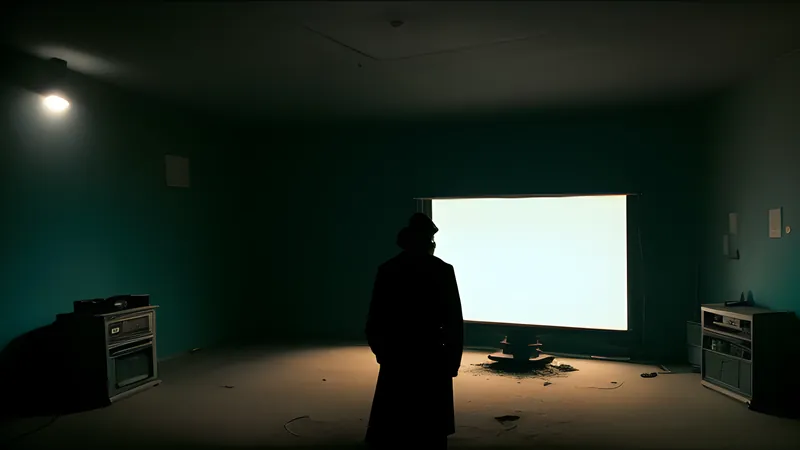
There is a shot in Retribution — and there are versions of it in most Kiyoshi Kurosawa films — where a character stands in the foreground doing something ordinary, and the frame is wide enough and deep enough that you have time to scan it, and you find a figure standing perfectly still a long way behind them. The character does not see it. The camera does not push in. There is no music. The shot holds for several seconds longer than is comfortable and then simply moves on.
That is the whole of Kurosawa’s method, and Retribution is the film where he applies it to a police procedural. It is his last major ghost picture, it closes out the J-horror wave he helped build, and it is about a city standing on ground that was never really land.
A woman in red, face down in salt water
Detective Yoshioka is called to a body. A woman in a red dress has been drowned in a puddle on the reclaimed flats of Tokyo Bay — face-down, in a shallow pool of salt water, on ground that used to be sea. The detail that opens the case is the detail that opens the film: she was drowned in saltwater, in a city, on land that is a lie the engineers told the ocean.
Yoshioka has a problem. The evidence at the scene points at him. A button, a fibre, a memory that will not come. He is investigating a murder he may have committed, in a Tokyo he no longer recognises, and a woman in a red dress starts appearing in his apartment.
Kōji Yakusho plays Yoshioka, and by 2006 he and Kurosawa had a decade of history — he had been the hollowed-out detective in Cure in 1997, which is the film Retribution is in permanent conversation with. Yakusho is one of the great screen listeners, and Kurosawa uses him as an absence. Yoshioka reacts to almost nothing. He is told his life is collapsing and he receives the news like weather.
Why it works: the middle distance is the monster
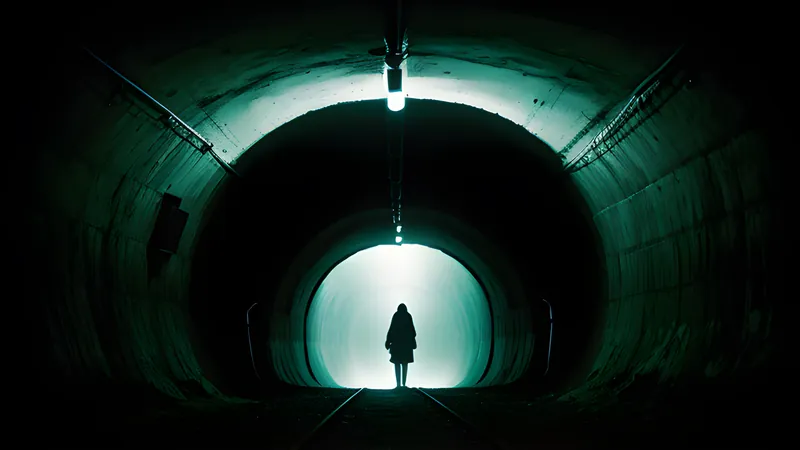
Every horror director has a signature distance. The J-horror house style, as Ringu and Ju-on codified it, is intimate — the ghost is close, in your hair, under the bed, an inch from the lens. Kurosawa works at forty feet.
His ghosts stand still, in daylight, in the back of a wide static frame, and they wait for you to notice them. There is no sting on the soundtrack. There is no cut. The horror is entirely a matter of the audience’s own attention — you find the figure, or you do not, and the film is indifferent either way. This produces a specific and unusual sensation: the dread of having been alone with something for a while without knowing.
The technique also means Kurosawa cannot be scary on a small screen with the lights on, which is part of why his reputation lagged the wave he belonged to. It requires you to look. Our piece on dread without a jump scare makes the longer case; Retribution is the purest demonstration in his filmography.
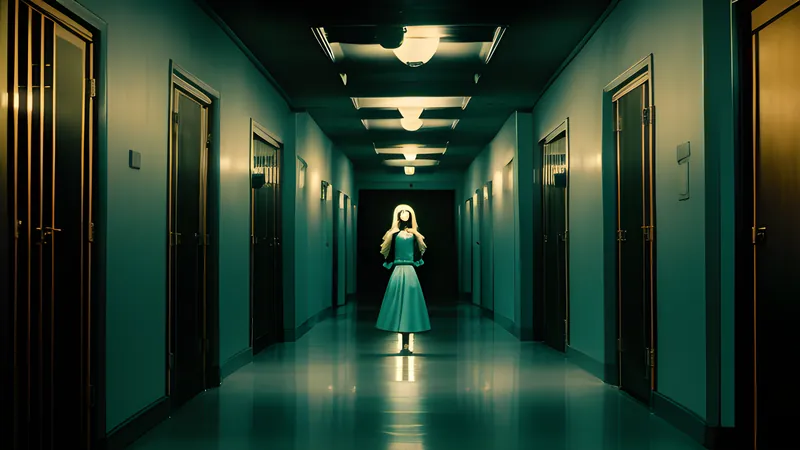
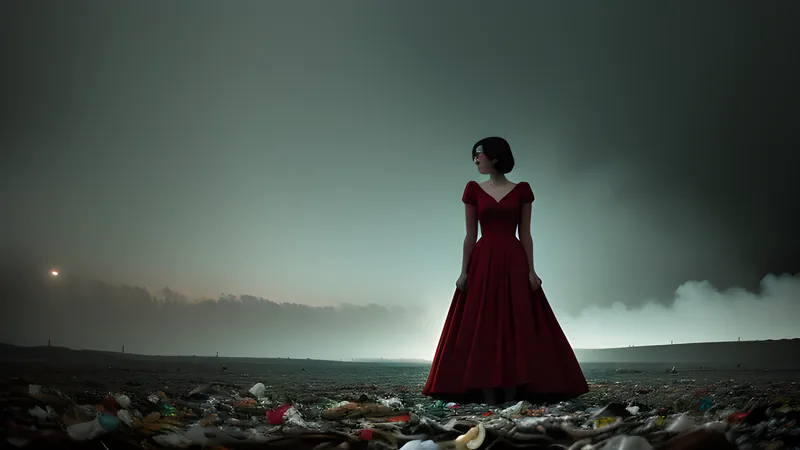
The red is the other craft decision, and it is close to a rule violation. Kurosawa’s palette is concrete, ash, wet grey — the man shoots Tokyo like a car park in November. Into that he drops a red dress, and it is the only saturated thing in the film. The ghost is legible from any distance, in any frame, at any depth, because she is the only colour available. He has effectively built a visual field in which one thing can be seen, which is why the figure at the back of the shot works at forty feet when it would not work otherwise. That is a designed effect, arrived at by subtracting everything else for two hours.
The landfill argument
The setting is doing the thinking, and it is the most interesting thing in the film.
Kurosawa shoots the Tokyo Bay reclamation zone — the artificial ground, the half-finished developments, the abandoned buildings, the flats where the city was extended into the water on rubbish and fill. The film is preoccupied with an old, damaged building slated for demolition and with ground that was manufactured. His Tokyo is a place that was made by burying something.
That gives the ghost story its foundation. A city built on landfill is a city with a layer underneath it that everyone has agreed to stop thinking about, and Retribution is a film about what that layer contains. The horror is municipal. Kurosawa had made the same argument at national scale in Pulse in 2001, where the dead overflowed because there was nowhere left to put them; here the overflow is geological, and it is happening under a specific bay in a specific city.
The J-Horror Theater slot
Retribution was made for Takashige Ichise’s J-Horror Theater line, the prestige horror run that also produced Takashi Shimizu’s Reincarnation the year before. The two make an instructive pair. Shimizu took the brief and made a well-behaved, expensive, elaborately plotted haunted-hotel film. Kurosawa took the same brief and made something that barely functions as a genre product — a ghost film with no scares in the ordinary sense, a procedural with no procedure, and an ending that offers the audience nothing to hold.
Ichise was trying to give the wave an art-house shelf. Kurosawa was the only director on the line who was already an art-house film-maker, and the mismatch shows in every commercial metric and none of the critical ones.
The collector’s cross-reference
The ancestor is Antonioni. L’Avventura and Red Desert supply the actual grammar here — the alienated figure in an industrial landscape, the mystery that dissolves rather than resolves, the architecture that has more agency than the people. Kurosawa is a genuine Antonioni descendant who happened to work in horror, and Retribution is where the debt is least disguised, red dress included.
Domestically, it belongs with the kaidan tradition of the wronged spirit whose claim is moral — the line that runs through Ugetsu and Onibaba and out into the wave. The difference is jurisdiction. A classical kaidan ghost haunts the person who wronged her.
For Kurosawa’s own beginnings in the genre, the fossil is Sweet Home from 1989 — a gore-heavy studio haunted-house film with Dick Smith effects, made by the same man who would spend the next twenty years removing every single one of those tools from his kit. Watch them back to back and the discipline is almost violent. Where all of this sits is mapped in our Japanese horror essential ten.
The case against
It is Kurosawa’s least essential major film and I say that as an admirer.
The procedural scaffolding is perfunctory. The murder investigation exists to move Yoshioka around, the supporting detectives are functions, and the case’s mechanics collapse if you press them. Kurosawa has never been interested in plot and here he has taken on a genre made entirely of plot, which produces a film that is slightly bored by its own first hour.
The ghost’s performance divides people fairly. She screams. She is played big, theatrical, operatic — a startling choice from a director whose whole method is stillness — and for some viewers the register punctures the film. I think it is deliberate, and I also think it does not fully work.
And it arrives late. By 2006 the vengeful-spirit film had been exhausted by its own success, and Retribution has the air of a director tidying up a genre he had finished with. He did not make another ghost film of consequence, and the drift into Tokyo Sonata and his later dramas began almost immediately.
The verdict
Watch it for the frames. Watch it for Yakusho doing almost nothing with total authority. Watch it for a horror film whose real subject is urban planning. It has a solid physical release and turns up regularly on the cult streaming services; give it a dark room and a screen with some size, because the entire design depends on your ability to search the back of a shot.
If you have never seen a Kurosawa ghost, start with Pulse. If you already have, this is the coda.
Spoilers below
The film’s answer to “did Yoshioka do it” is the reason it stays in the mind, and it is a refusal.
The woman in red is not his victim in any sense the investigation could use. She died decades earlier, in a psychiatric hospital on the bay, abandoned — one of the buried things the reclaimed ground is standing on. Her grievance is universal, and her logic is stated plainly: she died, so everyone must die. That is the whole moral content of the haunting. She wants company, and she is entirely indifferent to who supplies it.
That inverts the kaidan tradition completely, and it is Kurosawa’s real contribution to the ghost film. A classical vengeful spirit is a moral instrument — she haunts the guilty, the story resolves when the debt is paid, and the audience leaves with the ledger balanced. Kurosawa’s ghost has no ledger. She attaches to Yoshioka because he was available, and she would have attached to anyone. The evidence pointing at him is real, and its meaning is that the city is generalising guilt across everyone standing on the fill.
The set-piece that stayed with me is a building collapsing into the bay, filmed in a wide, patient frame, with the ghost’s screaming laid over it. Kurosawa spends his effects budget on demolition. The city eating its own damaged structure is the closest the film comes to a monster.
The ending gives Yoshioka a choice about whether to accept a guilt that is not his — and the film declines to tell you what he chooses, or whether the choice matters, or whether he was ever outside the haunting at all. The last images place him on the reclaimed ground with the water where it should not be. Kurosawa ends where he began, on the fill, with the sea coming back for its property.
The J-horror wave started with a woman climbing out of a well to punish the people who watched a tape. It ended here, with a woman who has no interest in who watched anything, on land that was never land, telling a detective that everyone is going to die because she did.
Related Content