Reincarnation: Shimizu Beyond the Grudge
A film crew restages a hotel massacre and the hotel objects
Contents
Reincarnation arrived in 2005 with a job to do. Takashi Shimizu had spent five films inside the Saeki house, finishing with the Hollywood remake and its sequel, and the question hanging over him was whether the man who made Ju-on had anything else. Producer Takashige Ichise — the money and the taste behind Ringu, Dark Water and Ju-on, which is to say behind the entire commercial J-horror wave — was assembling a prestige horror line called J-Horror Theater, six films from six directors, and he handed Shimizu a slot.
What Shimizu delivered is his most formally disciplined film and the one nobody defends. That gap is worth examining, because Reincarnation is doing something more difficult than Ju-on ever attempted, and it is doing it slightly too quietly to get credit.
A massacre, a film about the massacre, and an actress
In 1970, a university professor took a camera to a hotel in Gunma and killed eleven people, including his own children, filming as he went. He shot himself last. The footage survived.
Thirty-five years later, a director named Matsumura is making a film about it, shooting on location. Nagisa Sugiura is a young actress cast as the professor’s daughter. She gets the part and immediately begins to see things — a girl with a doll, a corridor that is in the wrong building, a succession of images that behave less like hauntings and more like memories filed under the wrong name.
That is the premise, and the premise is the reason the film is good. Shimizu is running a haunted-hotel picture, a film-industry satire, and a puzzle box on the same track, and the three keep switching which one is in front.
Why it works: the doll, and the discipline of the mid-shot
The doll is the best-deployed prop in Shimizu’s filmography, and the reason is restraint.
Horror dolls are cheap. A doll in a frame is a promise the audience has seen kept a hundred times — it will move, or its head will turn, and everyone in the cinema is braced for it from the moment it appears. Shimizu’s move is to refuse. The doll in Reincarnation mostly just exists. It is held. It is carried. It sits in the middle distance being a doll, in perfectly ordinary light, and Shimizu declines the jump he has set up over and over until the audience stops flinching. By the time the doll finally does something, it has been established as furniture, and the violation lands because the film spent an hour teaching you to relax around it.
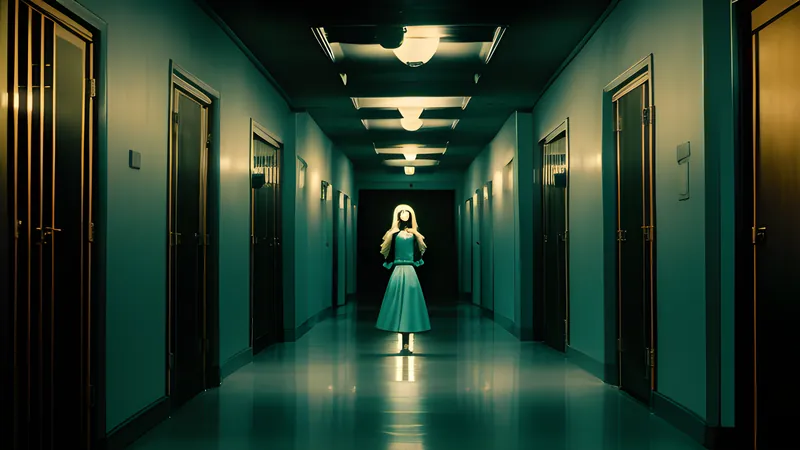
The framing is the other discipline. Ju-on is a film of close-ups and violated intimate space — a hand in the hair, a face under the duvet, the camera pressed against a body. Reincarnation backs off. Shimizu shoots long corridors in wide, symmetrical, static frames and puts the wrongness at the far end, small, where you have to look for it. Several of the film’s best shots contain a figure that a third of the audience will miss entirely on first pass. That is a Kiyoshi Kurosawa technique — see our piece on dread without a jump scare — and Shimizu borrowing it in 2005 is the sound of a director consciously trying to grow up.
The hotel itself is shot as a floor plan. Shimizu’s real subject has always been architecture; our Ju-on piece argues that the Saeki house is the actual protagonist of those films. Here the building is doubled — the real hotel and the set of the hotel — and the film spends its energy making you unsure which one a given corridor belongs to. Every location is two locations. The geography is the horror.
The film-industry layer
The best material in Reincarnation is the stuff about making a film, and it is delivered without a single wink.
Matsumura is a director recreating a mass murder for entertainment, and the film watches him do it with a flat, unimpressed eye. He restages children’s deaths. He asks actors to stand where bodies fell. He is pleased with the authenticity. Nobody in the production says this is monstrous, because in the ordinary run of film-making it simply is not — it is a job, with a schedule, and the professor’s real footage is a research asset.
Yuka plays Nagisa and does the film’s heaviest lifting. She has to play an actress preparing for a role while being colonised by the person the role is based on, which means the audience can never tell whether a given moment is craft or possession. Yuka keeps both readings live for the whole running time. It is a better performance than the film’s reputation implies.
The J-Horror Theater line deserves a word, because it explains the film’s ambitions and its ceiling. Ichise’s idea was a curated run of six theatrical horror films by name directors — Shimizu here, Kiyoshi Kurosawa the following year, Norio Tsuruta, Masayuki Ochiai and others across the run. It was a deliberate move upmarket, an attempt to give a genre that had been built on video tapes and cheap sequels a prestige shelf of its own. The ambition is visible in every frame of Reincarnation: the period recreation is expensive, the hotel is a real build, the 8mm inserts are properly designed. This is a horror film with production values, made by a producer trying to prove the wave had grown into an art form. The line never quite landed commercially, and the attempt is more interesting than most of what the boom produced at its peak.
The collector’s cross-reference
The ancestor is Peeping Tom. Michael Powell’s 1960 film established the whole idea that a camera recording a death is itself the crime, and Reincarnation is a J-horror descendant of it — the professor’s 8mm footage is the film’s cursed object in exactly the way Mark Lewis’s camera was.
The hotel is Kubrick’s, obviously, and Shimizu does not pretend otherwise. A remote hotel, a father who kills his family, a building that keeps the event on file — the debt to The Shining is structural and openly acknowledged by the staging.
The doll runs back to Dead of Night, which set the terms in 1945 for every possessed-object film since. And the cursed-recording engine is Ringu — Ichise produced both, and the family resemblance is a house style rather than a coincidence.
Within Shimizu’s own run, the useful comparison is Marebito, the DV film he made the year before with no supervision at all. Marebito is wild and broken. Reincarnation is neat and finished. The director is more interesting in the broken one, which is a depressing thing to have to report. Its J-Horror Theater sibling Retribution, Kiyoshi Kurosawa’s entry in the same line the following year, shows what the format could do in the hands of a director willing to break it.
The case against
It is over-plotted. The film has a reveal that requires a substantial amount of explanation, and the last twenty minutes are heavily occupied with delivering it. Shimizu’s gift is atmospheric accumulation, and a puzzle box demands a different skill — one he does not obviously have. The resolution is clever and it arrives as information rather than as dread.
The parallel investigation thread, following a second young woman with her own connection to the massacre, is the film’s weakest limb. It exists to service the mechanism, it takes screen time away from Yuka, and the payoff does not repay the withdrawal.
And the J-Horror Theater brand was, in the end, a diminishing proposition. The wave was cresting by 2005 — Ringu was seven years old, the American remakes were in full flow, and the long-haired ghost had become a shorthand that audiences could complete themselves. Reincarnation is a well-made film arriving at the moment its entire vocabulary stopped being frightening, and no amount of craft survives that.
The verdict
Watch it for the doll, for the corridors, and for Yuka. Watch it as evidence that Shimizu had a second gear and was denied the chance to use it — the film’s failure to connect pushed him back towards the franchise, and Japanese horror lost a formalist. It circulates on the cult streaming services and has had a decent physical release; the transfer matters here more than it did for Marebito, because the whole design depends on your ability to see something small at the end of a long, dim corridor.
Its place in our Japanese horror essential ten is arguable. Its place in Shimizu’s career is not.
Spoilers below
The mechanism is reincarnation, played straight, and the film’s cruelty is in the casting.
Nagisa is the professor’s daughter. She was the girl with the doll, killed in the hotel in 1970, and she has come back — which means her visions are recollections. The audition she won, the part she was cast in, the location she was sent to: the whole production has been the mechanism returning her to the site of her own death, and Matsumura’s grubby true-crime film is the instrument that did it.
Then Shimizu turns the screw. Every principal on the shoot is a reincarnation of a victim. The production has assembled the dead. The professor’s project — filming his own family’s murder — was an attempt to make the event permanent, and the film about the event is the completion of it. He was building a loop, and Matsumura, thirty-five years later, is his unwitting second unit.
The last movement gives Nagisa the worst possible knowledge, and Yuka plays the recognition with a kind of exhausted acceptance rather than terror, which is the right choice and the reason the ending works at all. She is being reclaimed, and some part of her has been expecting it since the audition.
The final image puts her in the doll’s place — the object she has carried through the film is revealed as her own position, and the camera holds on it. The professor got his permanent record. His daughter is in it, on a shelf, still.
Shimizu made a film about an actress destroyed by a role, released it into an industry that had already stopped listening, and then went back to remaking The Grudge. There is a loop in that too.
Related Content