Race with the Devil: Satanists and a Winnebago
Peter Fonda, Warren Oates and a luxury motor home flee a Texas cult in the strangest hybrid the 1970s produced
Contents
The pitch is so blunt it sounds like a bet somebody lost. Two couples take a luxury motor home from San Antonio towards a ski holiday in Aspen, park up for the night in a quiet spot off the road, and through a pair of binoculars watch a robed congregation across a valley cut a girl’s throat. The cult sees them seeing. Then it is four hundred miles of Texas blacktop in a vehicle with the top speed of a garden shed.
Race with the Devil came out in 1975, directed by Jack Starrett for 20th Century Fox, and it is the most efficient collision of two genres anyone attempted that decade: the satanic-panic horror film welded to the American car-chase picture, running on a chassis borrowed from the paranoia thriller. It should be a mess. It is instead a lean, mean seventy-eight minutes that has quietly influenced everything that ends with the discovery that the locals are all in on it.
Frank and Roger go on holiday
Peter Fonda plays Roger Marsh and Warren Oates plays Frank Stewart, motorcycle-dealership partners who have earned a break; Lara Parker and Loretta Swit play Kelly and Alice, their wives. The film’s first ten minutes are a holiday advert — the new camper, the fridge, the dog, the bikes on the back, two couples with money and a plan.
Casting Fonda and Oates is the film’s first real idea, and it is a joke with teeth. Fonda had been the free man on the open American road since Easy Rider in 1969, and Oates had co-starred with him in The Hired Hand in 1971, Fonda’s own directorial debut. Here the counterculture’s most iconic rider is boxed into a Winnebago with a spice rack, wearing a golf shirt, having become exactly the sort of man he once rode past. The open road that promised freedom six years earlier is now a corridor with a cult at both ends. The film does not underline it. It just casts him and lets you notice.
Oates is the film’s engine. He plays Frank as a practical man who keeps trying to solve a metaphysical problem with sensible measures — call the sheriff, check the map, take the next town — and Oates was constitutionally incapable of a false note, so the escalating panic reads as a competent adult discovering that competence is worthless here.
The vehicle is the horror
Starrett’s genuine innovation is the choice of vehicle, and it is worth spelling out because so many imitators have missed why it works.
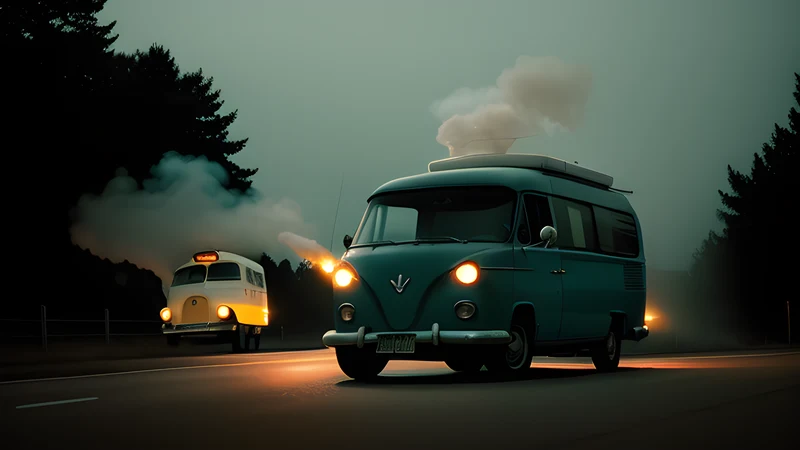
A chase film normally needs a fast car. Everything the form does — the cut to the speedometer, the swerve, the overtake — assumes the hero can outrun something. Starrett gives his heroes a thirty-foot recreational vehicle: slow, top-heavy, made of thin panel, with enormous windows on every side. It cannot outrun a tractor. It cannot be defended. And critically, it is a home — with a kitchen and a bed and a sofa — so every attack on it is a home invasion conducted at fifty miles an hour.
That single decision reorganises the whole film. The set-pieces stop being about speed and become about siege, which is a horror grammar rather than an action one. Pursuers climb aboard. Things come through the windows. The wives are inside a domestic space that is being taken apart while the husbands are up front unable to help, and the vehicle’s helpless wallowing bulk does more for the tension than any amount of engine noise. It is the pursuit sequence of Spielberg’s Duel, made four years earlier for television, inverted: there the ordinary man is in the small car and the monster is the enormous truck; here the ordinary people are the enormous truck, and the monster is everybody else.
Starrett knew his way around this material. He directed Cleopatra Jones, and genre audiences know his face as Galt, the sadistic deputy in First Blood. He shoots Texas as an unbroken sheet of hot nothing, and the film’s most effective compositions are the ones with nothing in them at all: a road, a horizon, a wing mirror with a shape in it.
Everyone is in on it
The other half of Race with the Devil is pure 1975 paranoia, and it is executed with real discipline. The couples do the correct thing at every stage. They report it. They go to the sheriff. The sheriff is helpful, drives out, finds no body, suggests it was a dog. They go to a library and read up on witchcraft. They keep meeting kindly, slow-talking locals — mechanics, waitresses, campsite neighbours — who are unfailingly polite, and one of whom is lying.
This is the machinery of the seventies conspiracy thriller transplanted into horror. The dread comes from institutional failure rather than the supernatural: there is a rational, correct procedure for what has happened to these people, they follow it exactly, and it delivers them straight back to the cult. Nobody has to prove Satan exists for the film to work. It only has to prove that the sheriff’s office cannot be trusted, which in 1975 was the cheapest sale in America. I laid out how thoroughly that mistrust colonised the decade’s cinema in the paranoia thriller of the 1970s and the death of trust and picked the best of them in ten essential 1970s paranoia thrillers.
The clearest ancestor is The Wicker Man, two years earlier, which had established the definitive shape: an outsider, a community with a secret, a helpful and smiling population, and an investigation that is actually a procession. Starrett’s version is the American drive-in remix — same conspiracy, no ballads, a V8 instead of a policeman’s rectitude.
Why it works
Race with the Devil works because it never once explains itself, and because it is short. There is no lore. Nobody delivers a monologue about the cult’s history, no book is found, no ritual is decoded beyond the one glimpsed through binoculars in the first reel. The film’s entire supply of information is that thing on the hillside, and its entire supply of tension is that everyone who has been nice to you since might have been standing on that hillside.
Its weaknesses are real and cheerfully worn. The women are written thinly, given little to do beyond react, and Swit and Parker are better than the material allows. The middle sags in a couple of places where the film pads with scenery. The dog subplot exists purely to be cruel.
None of that dents the thing that lasts, which is the mood: a hot, flat, sunlit horror where the danger arrives through the windscreen and the only sanctuary is a poorly built box on wheels. That mood went straight into the Australian films of the following decade, which had the same idea about a landscape being complicit — the ozploitation boom is largely this film with a different accent — and it is still running through modern British horror. Ben Wheatley’s Kill List does the same manoeuvre in slower motion: an ordinary journey, ordinary people, and a final revelation that the pastoral countryside has been organised around you the whole time.
Where to watch: there is a good Blu-ray with the scope framing intact, which matters, because half the film’s dread lives in the empty right-hand third of the widescreen frame where a vehicle is about to appear. A cropped television version throws the whole grammar away.
The verdict is that this is the best of the drive-in satanic pictures and the only one with a genuinely original engine, a horror film that understood before nearly anyone that the terror of the cult is really the terror of the neighbours. Pair it with The Wicker Man for the version with a thesis, or with why the 1970s was horror’s greatest decade for the context that made both possible.
Spoilers below
The film’s most quietly horrible scene is not a chase. It is a mechanic’s yard.
The rattlesnakes are the turn. After a stop for repairs, the couples get back on the road, and the camper’s interior begins producing snakes — dozens of them, in the cupboards, in the bed, in the confined space of a moving vehicle. Nobody attacked them. Somebody friendly and unhurried simply opened the door while they were being helped, and did it thoroughly, and smiled at them afterwards. It is the film’s thesis compressed into one set-piece: every service rendered to these people is an act of the conspiracy, and hospitality is the delivery mechanism.
From there the escalation is remorseless and unglamorous. They cannot go to the police because the police are the town. They cannot stop because stopping is how it gets in. So they drive, and the film narrows to the only thing left — forward motion, in a vehicle with no capacity for it, on a road with no end.
And then Starrett delivers one of the great cruel endings of the decade, and he delivers it without a monster. The camper finally breaks free onto open highway at night, and the relief is allowed to last a few seconds. Then headlights arrive on both sides. The pursuing vehicles fan out and encircle the motor home in a slow ring of fire, robed figures standing in the firelight, and the film simply freezes there — no rescue, no last stand, no reversal. The chase was never a chase. It was a herding operation, and the four of them drove the entire route their pursuers had laid out for them.
The freeze-frame does the final bit of work. There is no cut to a dawn, no coda, no explanation of what the cult wanted or who its members were. The film ends at the exact instant its characters understand that they were the offering all along, and then refuses to show you anything else.
Related Content