Quatermass and the Pit: The Martian Origins of the Devil
Nigel Kneale digs up a tube station, finds a spaceship, and explains the whole history of human evil
Contents
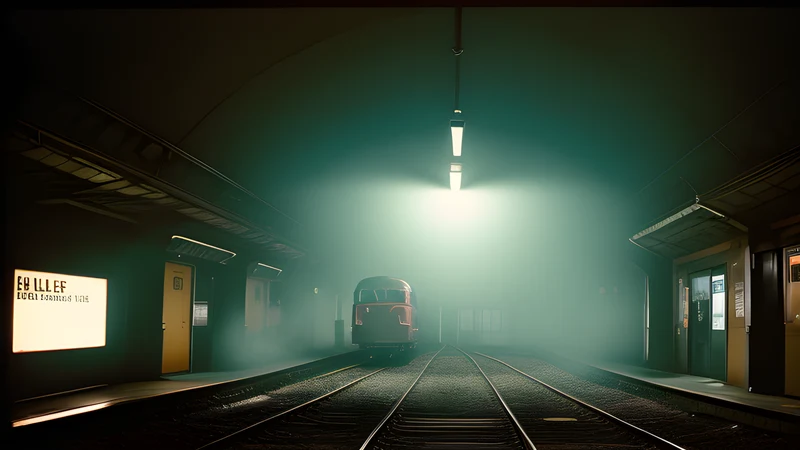
Workmen extending the Underground at a station called Hobbs End dig up a skull. Then more skulls, five million years old and wrong — the braincase too large for the date. Then, under the skulls, something metal that the Army assumes is an unexploded German bomb. Nigel Kneale’s premise is the finest cold open in British science fiction, and everything that follows is the slow, rigorous unpacking of a single idea: that the devil is a memory, and the memory is of Mars.
Quatermass and the Pit is the third and best of Hammer’s Quatermass pictures, adapted by Kneale from his own 1958–59 BBC serial, directed by Roy Ward Baker, and released in 1967 — a decade after Hammer acquired the property and sat on it. American audiences got it as Five Million Years to Earth, a title that sells the wrong film. It is Hammer’s most intelligent picture by a wide margin and one of the few horror films whose central conceit would still be worth arguing about if you removed every effect from it.
Kneale’s argument
The chain of reasoning is the entertainment, and Kneale builds it link by link with an almost legal patience. The ship is Martian. The ape-skulls found around it are hominids the Martians altered — a dying species seeding its intelligence into another world’s stock, so that something of Mars would continue. Human intelligence is therefore an inheritance. And what came with it, encoded, was the Martians’ own behaviour: their periodic ritual purges, in which the hive culled its own deviants.
From that, everything else falls out. Hobbs End is Old Hob, a name for the devil. The horned, insectoid Martians look like the thing every European culture drew on its church walls. The Wild Hunt, poltergeists, the local ghost stories that have clung to the site for centuries, the residents’ folklore about the road — all of it is racial memory, activated whenever the ship stirs. The film proposes that our religion is a description of our creators and our violence is a species-level inherited instinct, and it does so by treating both as data.
The dramatic engine is a fight between two Englishmen over what counts as evidence. Andrew Keir’s Quatermass follows the argument wherever it goes, and Julian Glover’s Colonel Breen refuses every step of it, insisting to the end that the object is a German psychological weapons hoax. Glover plays Breen as reasonable, well-briefed and completely closed, which makes him one of the best antagonists in British genre film — a man destroyed by a fact he has decided is inadmissible. James Donald’s Dr Roney is the third position, curious and humane, and Barbara Shelley’s Barbara Judd is the one who actually finds the folklore, doing the archival work while the men shout.
Keir is the definitive Quatermass. Kneale had objected loudly to Brian Donlevy’s brusque American professor in the two earlier Hammer films, and Keir’s version — Scottish, irascible, morally engaged, visibly frightened by his own conclusions — is far closer to the character on the page. The performance holds the film together because Keir plays intelligence as effort.
Craft on a Hammer budget
Baker shoots the pit as an archaeological dig, which is the film’s smartest formal decision. The camera treats the hull as a site: measured, photographed, argued over, approached from above on scaffolding, with technicians in and out of frame. Arthur Grant’s photography keeps the clay, the strip lights and the sheer mundanity of an urban excavation front and centre, so the ship reads as an object being processed by British institutions. Kneale’s horror always works this way — the committee, the ministry, the site meeting — and the paperwork is what sells the impossible.
The film was made at MGM-British at Elstree, one of the first Hammer productions after the company left Bray, and the loss of Bernard Robinson’s cramped gothic sets suits it. The Martians themselves, glimpsed as desiccated corpses inside the hull, are horned locust things designed with real conviction, and Les Bowie’s effects work is competent where it needs to be and threadbare where it does not matter. The optical work on the climax has aged; the idea underneath it has not moved an inch.
The compression is the other feat. Kneale’s BBC serial ran across six parts over the turn of 1958 and 1959, roughly three hours of television that reportedly emptied British pubs on the nights it went out, and he cut it himself to ninety-seven minutes without losing a single link in the chain of reasoning. Screenwriters adapting their own work usually protect it. Kneale filleted his, and the film is tighter for it — every scene either advances the argument or shows somebody refusing it.
The one sequence that everyone remembers is Sladden. Duncan Lamont plays a drill operator whose proximity to the hull opens him to the recorded memory, and the film sends him running through the streets in daylight while doors slam and rubble lifts around him — a poltergeist attack staged as a man being ridden by five million years of another planet’s history. Lamont plays it as agony rather than possession, and it is the moment the film’s thesis stops being a theory and becomes a physical assault.
The children it fathered
The influence here is genuinely enormous and mostly uncredited. The ancient-ship-with-a-dead-crew that infects the people who open it runs straight into Alien, and Tobe Hooper’s Lifeforce is essentially a Kneale premise with a bigger budget. The strongest acknowledgement came from John Carpenter, who took the pseudonym “Martin Quatermass” as the writing credit on Prince of Darkness — a film that is Kneale’s method transplanted to Los Angeles, with scientists arguing their way toward a theological horror using instruments. Carpenter has been explicit about the debt more than once, and it shows again in In the Mouth of Madness and across his whole sceptical career.
Set it against Hammer’s own supernatural wing and the contrast is instructive. The Devil Rides Out, from the year before, takes the devil at face value and stages him with chalk and candles. Quatermass and the Pit takes the same iconography and explains it, and ends up more frightening, because a devil you can exorcise is a devil with a procedure. The wider argument about what happens when horror goes looking for cosmic explanations sits in cosmic dread and the unadaptable Lovecraft.
The verdict is straightforward. Quatermass and the Pit is ninety-seven minutes, its effects are of their moment, and it contains the single best idea Hammer ever filmed. Kneale wrote a monster movie in which the monster is us, five million years late, and the film has the discipline to prove it before it shows it.
Spoilers below
The revelation sequence is the centrepiece. Roney’s optic-encephalograph records what Barbara Judd’s mind receives near the hull, and the film plays the tape: a Martian purge, the hive culling its own, filmed as a mass of insect bodies moving in unison across a red landscape. Quatermass watches a genocide committed by the beings who made him, and understands that he has watched it before, on a smaller scale, on Earth, repeatedly, whenever a crowd turns on the people it has decided are wrong. The film says the pogrom is inherited.
The climax then makes the point physically. The ship’s energy, released, raises a horned image over London — Kneale’s devil, hanging in the sky above a burning city, made of nothing but power — and the residual Martian instinct sweeps the crowd. People begin killing each other in the streets according to a criterion they cannot articulate, culling by a rule five million years old. Quatermass himself is taken by it and has to be knocked down by Roney, which is the boldest thing in the film: the rational hero is not immune, because the inheritance is in him too.
Roney is the one who works out the answer, and it is beautifully unmystical. The manifestation is energy and can therefore be earthed. He climbs a crane and swings its iron chain into the thing, and it discharges into the ground and dies, and it kills him. No prayer, no ritual, no faith. An electrical engineer’s solution to Satan, executed by a scientist who has understood that the devil obeys physics.
The last image is Quatermass and Barbara sitting exhausted in the ruins, saying nothing. Kneale gives them no reassurance, because the argument does not permit any: the ship has been destroyed, and the Martians have been dead for five million years, and the thing they put in us is still there and will be there tomorrow. The film’s final position is that we are haunted by our own genome and every witch-hunt since has been the ghost.
Related Content